
 Worksheets
Geometry Reasoning Review
Total questions: 60
Worksheet time: 3hrs 1mins

then RX + XT = RT


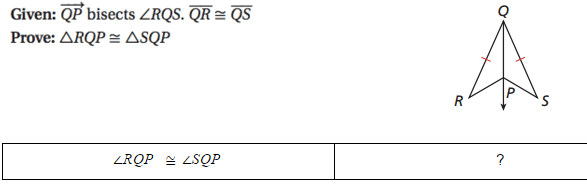

∡B≅∡G


If A is in the interior of <BDC, then m<BDA + m<ADC = m<BDC.
If A is in the interior of <BDC, then m<BDA + m<ADC = m<BDC.

Given: ∠1 and ∠3 are vertical angles. What should you conclude by the vertical angles theorem?
∠1 and ∠3 are a linear pair
undefined andundefined are right angles.
∠2≅∠3
∠1≅∠3
Given: ∠1 and ∠2 are supplementary. What can you conclude?
m∠1+m∠2=180°
m∠1+m∠2=90°
m∠1=m∠2
Nothing

What does it mean to bisect a segment or an angle?
Split it into 3 equal parts.
Split it into 2 equal parts.
Split into 4 equal parts.
Double it.

In the given proof, what is the statement for step 2?
Angles that form a linear pair are supplementary. m∠1+m∠3=180°
m∠3+m∠5=180°
m∠1=m∠3
∠3≅∠5

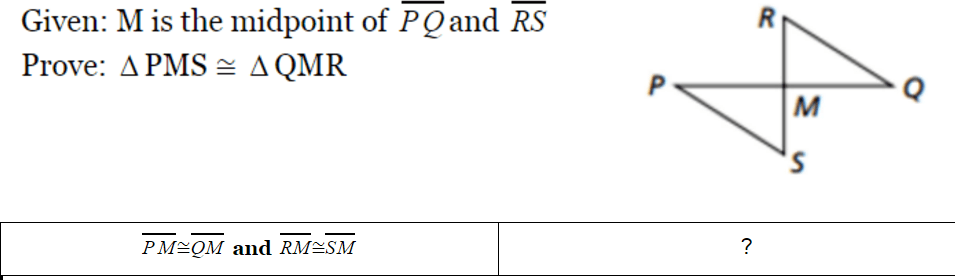
In the given proof, what is the statement for step 2?
AD≅DB
CD≅CD
m∠ADC+m∠BDC=180°
∠ADC≅∠BDC

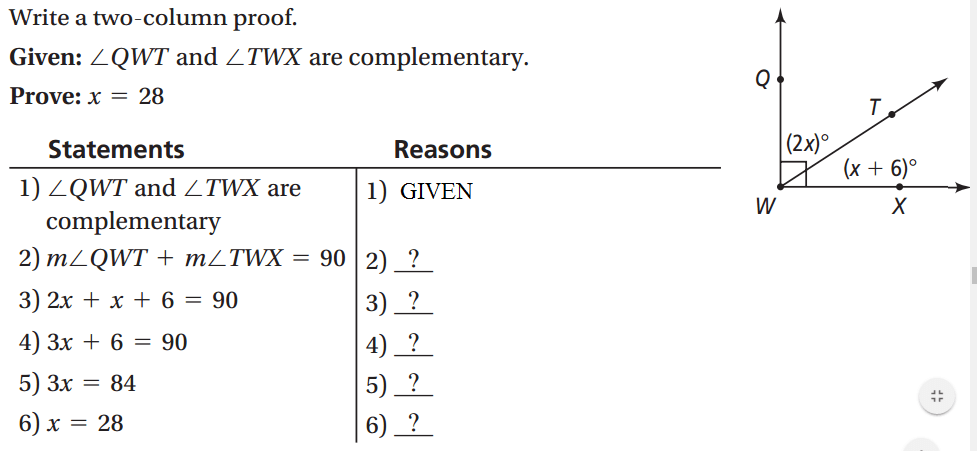
In the given proof, what is the reason for step 2?
Alternate Exterior Angle are Congruent
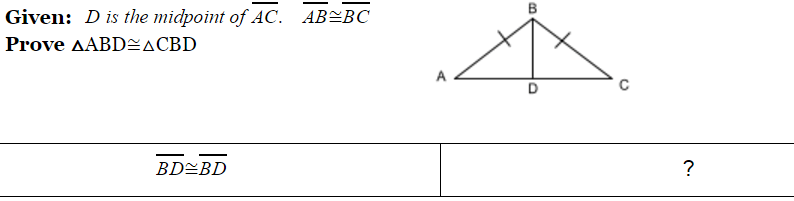
Reflexive Property of Congruence
Angles that form a linear pair are supplementary.
Alternate Interior Angles are Congruent.

Since segment BD is part of both triangles, it is congruent to itself, what do we call this?
Substitution
Commutative
Reflexive
CPCTC


Given: B is the midpoint of AC. What should you conclude?
AB + BC = AC
AB = BC
A is the segment bisector of BC
ABC is a straight angle

Given: <1 and <2 are a linear pair. Conclusion: m<1 + m<2 = 180. What is the reason that allows you to draw that conclusion?
Angle addition postulate
Definition of straight angle
Linear Pair Postulate
Definition of supplementary

Given: AB is the segment bisector of PQ. What conclusion can you draw?
PF = QF
F is the midpoint of PQ
m<PFA = m<QFA
<PFQ is a straight angle
If an angle is a straight angle, then its measure is 180°
Given: <ABC is a straight angle.
What conclusion can you draw?
<ABC is not an acute angle
<ABC is supplementary to another angle
m<ABC = 180°
<ABC is a straight angle

Which of the following is true about the conditional statement below?
If a man is 7 feet tall, then he plays basketball.
Hypothesis: a man is 7 feet tall
Conclusion: he plays basketball
Hypothesis: IF a man is 7 feet tall
Conclusion: THEN he plays basketball
Hypothesis: THEN he plays basketball
Conclusion: IF a man is 7 feet tall
Hypothesis: he plays basketball
Conclusion: a man is 7 feet tall

Which of the following is true about the conditional statement below?
If you are in Alaska, then you are
cold.
Hypothesis: you are in Alaska
Conclusion: you are
cold
Hypothesis: IF you are in Alaska
Conclusion: THEN you are
cold
Hypothesis: THEN you are
cold
Conclusion: IF you are in Alaska
Hypothesis: you are
cold
Conclusion: you are in Alaska
Which of the following is the CONVERSE of the statement below?
If an object is a ring, then it is
made of gold.
If an object is made of gold, then it is a ring.
If an object is not a ring, then it is not made of god.
If an object is not made of gold, then it is not a ring.
There is no converse of the statement.

Which of the following is the CONVERSE of the statement below?
If an object is a bird, then it can fly.
If an object can fly, then it is a bird.
If an object is not a bird, then it cannot fly
If an object cannot fly, then it is not a bird
There is no converse of the statement
Which of the following is the INVERSE of the statement below?
If an object is a computer, then it
has a hard drive.
If an object is not a computer, then it does not have a hard drive.
If an object does not have a hard drive, then it is not a computer.
If an object has a hard drive, then it is a computer.
There is no inverse of the statement.

Which of the following is the CONVERSE of the statement below?
If you play football, then you wear
a uniform.
If you wear a uniform, then you play football.
If you do not play football, then you do not wear a uniform.
If you do not wear a uniform, then you do not play football.
There is no converse of the statement.

Which of the following is the INVERSE of the statement below?
If an object is a battery, then it is
rechargeable.
If an object is not a battery, then it is not
rechargeable.
If an object is rechargeable, then it is not a battery.
If an object is not rechargeable, then it is not a battery.
There is no inverse of the statement.
Which of the following is the INVERSE of the statement below?
If an animal is black and white,
then it is a penguin.
If an animal is not black and white, then it is not a penguin
If an animal is a penguin, then it is black and white.
If an animal is not a penguin, then it is not black and white.
There is no inverse of the statement.

Which of the following is the CONTRAPOSITIVE of the statement below?
If a species walks on two feet, then
it is human.
If a species is not human, then it does not walk on two feet.
If a species is human, then it walks on two feet.
If a species does not walk on two feet, then it is not human.
There is no contrapositive of the statement.
Which of the following is the CONTRAPOSITIVE of the statement below?
If a gem is a ruby, then it is red.
If a gem is not red, then it is not a ruby.
If a gem is not a ruby, then it is not red.
If a gem is red, then it is a ruby.
There is no contrapositive statement.
Which of the following is the BICONDITIONAL of the statement below?
If there is lightning, then there is thunder.
If there is not lightning, then there is not thunder.
If there is thunder, then there is lightning.
There is lightning if and only if (iff) there is thunder.
There is no biconditional statement.

Which of the following is the CONTRAPOSITIVE of the statement below?
If a species is a fish, then it lives in
water.
If a species does not live in water, then it is not a fish.
If a species is not a fish, then it does not live in water.
If a species lives in water, then it is a fish.
There is not contrapositive of the statement.
Which of the following is a valid conditional statement for the following phrase:
An acute angle has a measure less than 90°.
If an angle is acute, then it has a measure less than 90°.
If an angle is not acute, then it does not have a measure less than 90°.
If an angle is acute, then it is acute.
If an angle does not measure less than 90°, then it is not acute.
If the conditional statement was "If an angle is acute, then it has a measure less than 90°.", which type of statement is the following?
An angle is acute if and only if (iff) it has a measure less than 90°.
Biconditional
Converse
Inverse
Contrapositive
If the conditional statement was "If an angle is acute, then it has a measure less than 90°.", which type of statement is the following?
If an angle does not have a measure less than 90°, then it is not acute.
Contrapositive
Converse
Biconditional
Inverse
If the conditional statement was "If an angle is acute, then it has a measure less than 90°.", which type of statement is the following?
If an angle has a measure less than 90°, then it is acute.
Converse
Contrapositive
Biconditional
Inverse
If the conditional statement was "If an angle is acute, then it has a measure less than 90°.", which type of statement is the following?
If an angle is not acute, then it does not have a measure less than 90°.
Inverse
Contrapositive
Biconditional
Converse
What is the hypothesis?
What is this? If Jenny does buy a keyboard, then she will not buy a guitar.
If Jason does not go out to dinner, then he will come to the volleyball game.

