
Font size
 Worksheets
Exam 2 review
Total questions: 25
Worksheet time: 18mins
A small, membrane bound sphere that transports materials in the cell is known as...
A Vesicle
The Rough ER
Ribosomes
The Cytoskeleton
The __________ controls the movement of the cell and is made up of filaments that shape the cell
Flagella
Smooth ER
The Cytoskeleton
Nucleus
The site of photosynthesis in plant cells is the _________
Smooth ER
Lysosome
Mitochondria
Chloroplast
The location of energy production (ATP synthesis) in both plant and animal cells is the ___________
Cell membrane
Mitochondria
Chloroplast
Central Vacuole
An amphipathic molecule has both polar and non-polar regions. The cell membrane, sometimes called the phospholipid bilayer is made of amphipathic molecules.
True
False
In plant cells, the solid cell wall is located inside of the flexible cell membrane
True
False
All cells can be classified into what 2 main categories?
Prokaryotes
Animal
Plant
Eukaryotes
Within the domain Eukarya, one can observe both plant and animal cells. Which of the following are characteristics of only animal cells?
Lysosomes
Cell membrane is the outside of the cell
Rounded
Chromosomes
Within the domain Eukarya, one can observe both plant and animal cells. Which of the following are characteristics of only plant cells?
Cell membrane on the outside
Cell wall on the outside
Chloroplast
Large central vacuole

Which beaker is hypertonic to the cell?
A
B
C
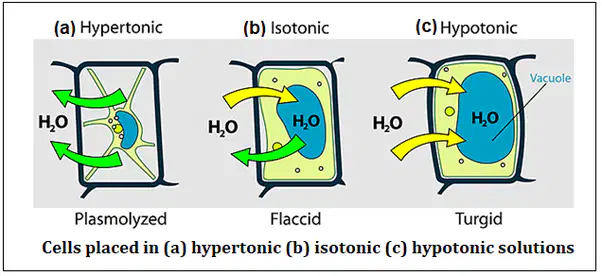
To keep vegetables firm, you should place them in a
Hypertonic solution
Hypotonic solution
Isotonic solution
Human IV fluid (liquid placed directly into the human bloodsteam) should be a
Hypertonic solution
Isotonic solution
Hypotonic solution
In passive transport, solutes move from an area of _______ concentration to ________ concentration
Low—>High
High—>Low
Osmosis specifically refers to when water molecules move from an area of high water concentration to low water concentration
True
False
Estrogen, a hormone, is secreted by the ovaries and tells the uterus to grow. This is an example of
Direct Intercellular signaling
Contact dependent signaling
Autocrine signaling
Paracrine signaling
Endocrine signaling
Electrical signals are passed from one cardiac cell’s cytoplasm directly to another cardiac cell’s cytoplasm.
This is an example of
Direct intercellular signaling
Contact dependent signaling
Autocrine signaling
Paracrine Signaling
Endocrine signaling
A dying cell displays a protein on its cell surface that is recognized by a macrophage which digests the dying cell. This is an example of
Direct intercellular signaling
Contact dependent signaling
Autocrine signaling
Paracrine signaling
Endocrine signaling
A cancer cell overproduces a growth hormone that binds to its receptors and causes it to divide.
This is an example of
Direct intercellular signaling
Contact dependent signaling
Autocrine signaling
Paracrine signaling
Endocrine signaling
You cut yourself and the cells in the injured area release signals that activate nearby platelets to form a clot.
This is an example of
Direct intercellular signaling
Contact dependent signaling
Autocrine signaling
Paracrine signaling
Endocrine signaling
Which cell structure is responsible for receiving most of the cell’s signals?
Nucleus
Cell wall
Cell membrane
Nuclear membrane
Which of the following are ways that two receptors would be different from each other?
They bind different signals
The are made of different sequences of amino acids
They may be found in different types of cells
They all have a different shape
All of the other answers are true
If there is a mutation in the DNA that codes for a protein cell receptor, which of the following is a possible consequence?
The receptor protein will change shape and my no longer accept the correct signal for the cell
The signal may not be transmitted into the cell
The cell may not respond to the change in the external environment.
All of the options are possible
Direct intercellular signaling can be described as...
Signals travel long distances and are usually longer lasting
Cells secrete signaling molecules that bind to their own cell surface and/or neighboring cells
Cell junctions allow signaling molecules to pass from one cell to another through junctions
Signal does not affect cell secreting the signal but does influence neighboring cells
Molecules bound to the surface of cells serve as signals to cells coming in contact with each other
The inside of a cell contains 20 M K+. The outside of the cell contains 15 M K+. If K+ is moving via active transport, what direction would it be moving?
Outside the cell towards inside the cell
Inside the cell towards outside the cell
There is note enough information to tell
The K+ will not move
Which component of the cell membrane contributes to maintaining the fluidity of plasma membranes under freezing conditions?
high levels of saturated fatty acid tails within the lipid bilayer
peripheral proteins
high levels of unsaturated fatty acid tails within the lipid bilayer
absence of cholesterol

