Wayground logo

Free Printable Worksheets

Font size

S
M
L
XL
Worksheets

Evolution (act 1-6)

Total questions: 30

Worksheet time: 3600secs

Name
Class
Date
1.

What is an inherited characteristic that helps organisms survive?

a)

Evolution

b)

Adaptation

c)

Natural Selection

d)

Extinction

2.

The process where organisms best fit for the environment are more likely to survive and reproduce.

a)

natural selection

b)

adaptation

c)

hibernation

d)

selective breeding

e)

hybridization

3.

Differences in an inherited trait between individual members of the same species.

a)
variations
b)
adapatations
c)
homologous structures
d)
analogous structures
4.

Organisms with traits that are best suited to their environment are more likely to survive and reproduce than organisms that are not very well adapted.

a)

natural selection

b)

artificial selection

c)

creationism

5.
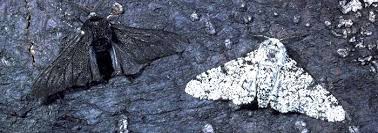
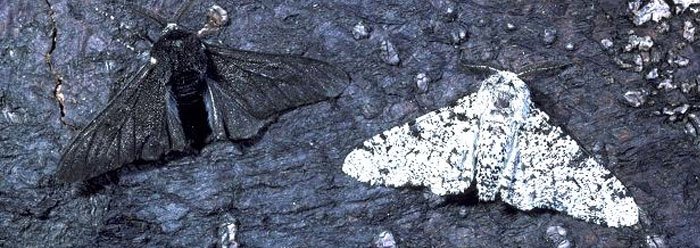
Predict which moth would increase in population
a)
light 
b)
dark
6.

Which of the following leads to genetic variation?

a)

mutations

b)

change in environment

c)

sunlight

d)

increase in disease

7.
Who is the father of evolution?
a)
Darwin
b)
Mendel
c)
Newton
d)
Einstein
8.
Which statement supports the theory of natural selection
a)
All organisms produce more offspring than can survive.
b)
Organisms live in harmony with one another despite limited resources.
c)
Organisms with favorable traits are more likely to die.
d)
Over time advantageous traits will be found in more of the population.
9.
____________ believed that those organisms that were best suited for their environment would survive and pass on their beneficial traits to their offspring. 
a)
Darwin
b)
Lamarck
c)
Watson
d)
Mendel
10.
_______ believed that organisms develop traits needed for survival and that traits that were unused would become weaker and gradually disappear. 
a)
Darwin
b)
Lamarck
c)
Mendel
d)
Watson
11.

The process by which an offspring receives genes from its parents.

a)

Inheritance

b)

Evolution

c)

Natural Selection

d)

Hypothesize

12.
Individuals that are well adapted to their environment will survive and produce:
a)
Fewer mutations
b)
Stronger genes
c)
More offspring
d)
Better traits
13.
What is the most important factor that contributes to a species evolving? 
a)
environmental change
b)
how old a species is
c)
what the ancestors look like
d)
what time of year a species reproduces.
14.

Who would have stated "acquired traits" such as a giraffe needing a long neck so they stretch it over time

a)

Darwin

b)

Lamarck

15.
What is the advantage of having different shaped beaks?
a)
To look different from other species.
b)
To be able to eat the food readily available in the environment.
c)
To protect itself against predators.
d)
To protect itself against prey.
16.
Why are advantageous traits more likely to be passed onto offspring?
a)
Because they are more likely to survive and reproduce.
b)
Because they come from dominant alleles.
c)
Because they come from recessive alleles.
d)
Because the trait is an acquired phenotype.
17.
Genetic differences between organisms of the same species
a)
Variation
b)
Adaptation
c)
Behavior
d)
Environment
18.
The trees these moths used to live on were white, but have been covered in soot from coal factories. Which moth will be more successful in this environment?
a)
Dark moth
b)
Light moth
c)
Both will be equally successful
d)
Neither will be successful
19.
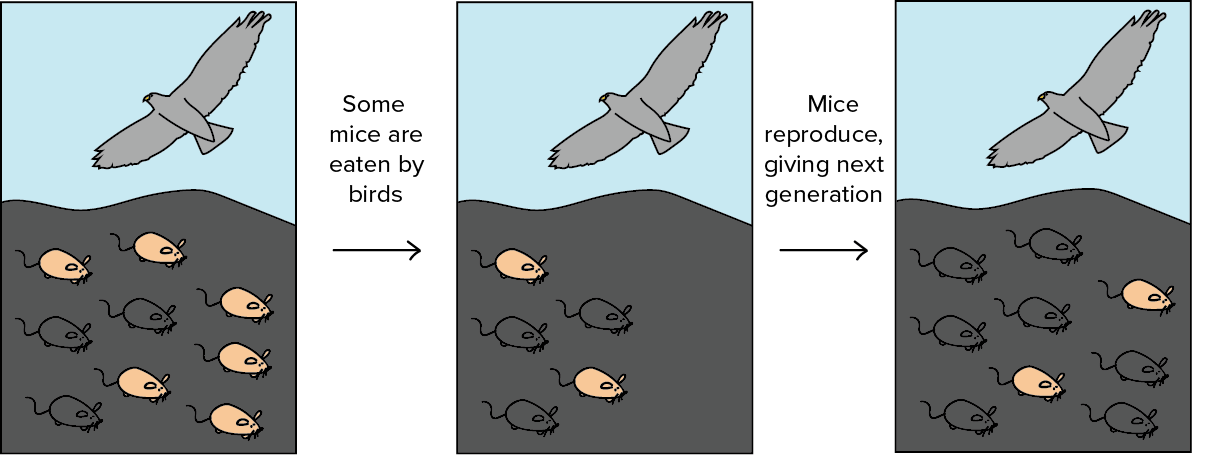
Why is the mouse population changing over time?
a)
The light mice can reproduce more successfully than the dark mice
b)
The hawks eat more dark mice than light mice because the dark mice taste better
c)
The hawks eat more light mice than dark mice because they can see the light mice more easily
d)
The hawks eat more dark mice than light mice because they can see the dark mice more easily
20.

Malaria is caused by

a)

A virus

b)

A bacteria

c)

A mutation in your DNA

d)

A parasite carried by mosquitoes

21.

Hemoglobin is a protein in ________ that carries oxygen throughout the body.

a)

food

b)

DNA

c)

red blood cells

d)

pocket mice

22.

In areas where there are high populations of mosquitoes, scientists noticed a _________ frequency of sickle cell disease.

a)

higher

b)

lower

c)

the same

23.

In areas with Malaria, natural selection has __________ the frequency of the sickle cell allele.

a)

increased

b)

decreased

c)

not affected

24.
Which statement best describes the process of evolution?
a)
Populations can survive in different locations on earth
b)
Environmental conditions limit the number of species on Earth
c)
Populations grow when resources are abundant
d)
The traits of a species can change over time
25.

Why did dark-colored rock pocket mice first appeared in a population of light-colored rock pocket mice?

a)

They have a mutation that affects their fur color

b)

They migrated due to climate change in their original environment.

c)

The dark colored volcanic rock caused the dark-color fur to adapt.

d)

They migrated to match the color of the environment better.

26.

The same mutation could be advantageous in some environments but harmful in others.

a)

True

b)

False

27.

The appearance of dark-colored volcanic rock caused the mutation for black fur to appear in the rock pocket mouse population.

a)

True

b)

False

28.

The Rock Pocket mice move to the environment that matches their fur.

a)

True

b)

False

29.

Dark mice are more likely to survive in the dark rocks because the predators cannot see them as easily.

a)

True

b)

False

30.
measure of an organisms's ability to survive and produce offspring relative to other members of a population 
a)
Natural Selection
b)
Adaptation
c)
Fitness
d)
Variation