
 Worksheets
bio cell structure and function
Total questions: 178
Worksheet time: 2hrs 45mins
The power house of cell is called
Cell wall
Mitochondria
Ribosomes
Nucleus
The cells of all organisms contain DNA. In cells of which of the following groups is the cellular DNA enclosed in a nucleus?
Bacteria
Eukaryotes
Prokartotes
Viruses
Which of the following statements is part of the cell theory?
Cells are composed mostly of empty space
Cells are generally large enough for the unaided eye to see
All cells are produced from existing cells.
Only animals are made up of cells.
All cells contain cell membranes. Which of the following describes the composition of cell membranes?
Cell membranes are composed of carbohydrate chains, which allow all materials to enter and leave the cell.
Cell membranes are composed of cellulose, which provide rigidity for the cell.
Cell membranes are composed of cytoplasm, which allows proteins to be excreted by the cell.
Cell membranes are composed of lipid molecules, which provide a flexible structure.
Which of the following structures are present in both plant and animal cells?
cell walls
centrioles
chloroplasts
mitochondria
Lysosomes are organelles that contain enzymes. Which of the following is a function of lysosomes?
Lysosomes build lipids, carbohydrates, and proteins.
Lysosomes package lipids, carbohydrates, and proteins.
Lysosomes break down lipids, carbohydrates, and proteins.
Lysosomes store lipids, carbohydrates, and proteins.
A number of scientists made contributions to cell theory. Which scientist used a light microscope to observe cells in a slice of cork?
Anton van Leeuwenhoek
Matthias Schleiden
Robert Hooke
Theodor Schwann
The Rough ER plays a major role in the processing of which of the following biological molecules?
carbohydrates
proteins
ATP
DNA
When a cell is deprived of oxygen, its lysosomes tend to burst and release their contents into the cell. What will be the likely consequence for the cell?
Other organelles will assume lysosome functions.
The cell will produce more ER.
The cell will undergo division.
The cell will die due to internal damage.
Some ribosomes float free in the cytoplasm, while other ribosomes are attached to which of the following organelles?
cell (plasma) membrane
Golgi apparatus
mitochondrion
endoplasmic reticulum
Which of the following is a major difference between a prokaryote and a eukaryote?
The need for nutrients.
The presence of a nucleus.
The presence of a cell membrane.
The presence of DNA.
Which of the following forms of life is NOT a eukaryote?
A protist such as an amoeba.
A plant cell such as Elodea.
A bacterial cell such as Streptococcus.
A human cell such as a red blood cell.
You are told that the cells on a microscope slide are plant, animal, or bacterial. You look at them through a microscope and see cell walls and membrane-bound organelles. How should these cells be classified?
plant cells
animal cells
They could be plant cells or bacterial cells.
They could be plant cells, animal cells or bacterial cells.
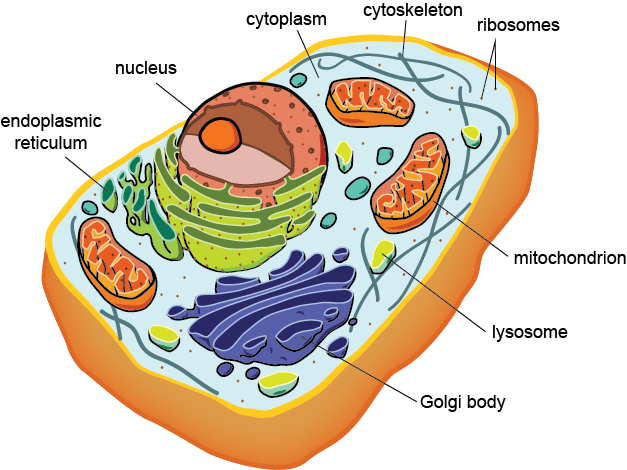

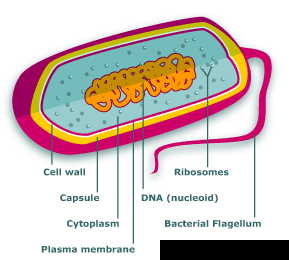
The Endosymbiotic Theory suggests that eukaryotic cells evolved when an ancient cell engulfed another, forming a permanent symbiotic relationship. Choose the evidence that best justifies this claim.
Both mitochondria and chloroplasts perform energy functions
Eukaryotic cells have many mitochondria
Eukaryotic cells have traits in common with archaea
Mitochondria and chloroplasts contain circular loops of unique DNA
Cells tend to be small, with sizes ranging between 1 and 100 mm. These small sizes help to ensure that cells have a favorable surface-area-to-volume ratio. Choose the statement that explains why a favorable surface-area-to-volume ratio is advantageous.
Higher surface-area-to-volume ratios improve the efficiency of transporting materials in and out of cells.
Lower surface-area-to-volume ratios improve the efficiency of transporting materials in and our of cells.
Higher surface-area-to-volume ratios speed up the flow of cytoplasm within cells.
Higher surface-area-to-volume ratios slow down the flow of cytoplasm within cells.
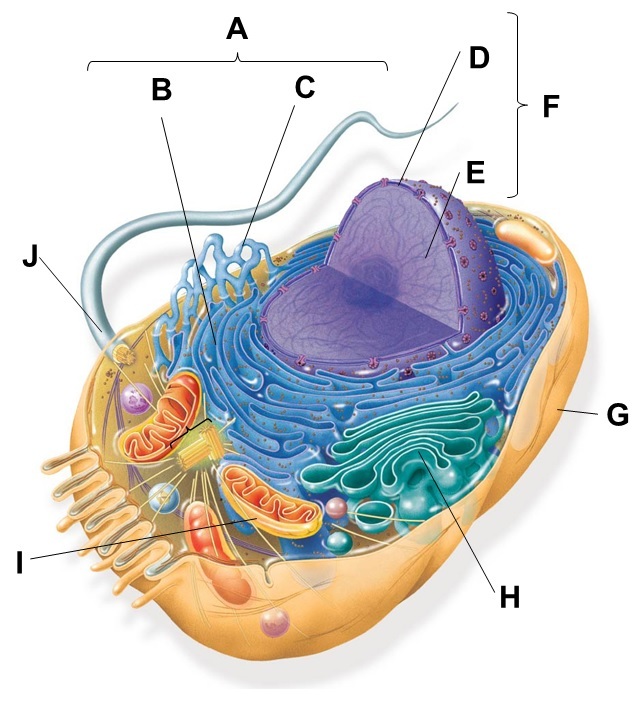
What structure is labeled by F (includes D and E)?
nucelolus
nucleus
nuclear membrane
nuclear pore
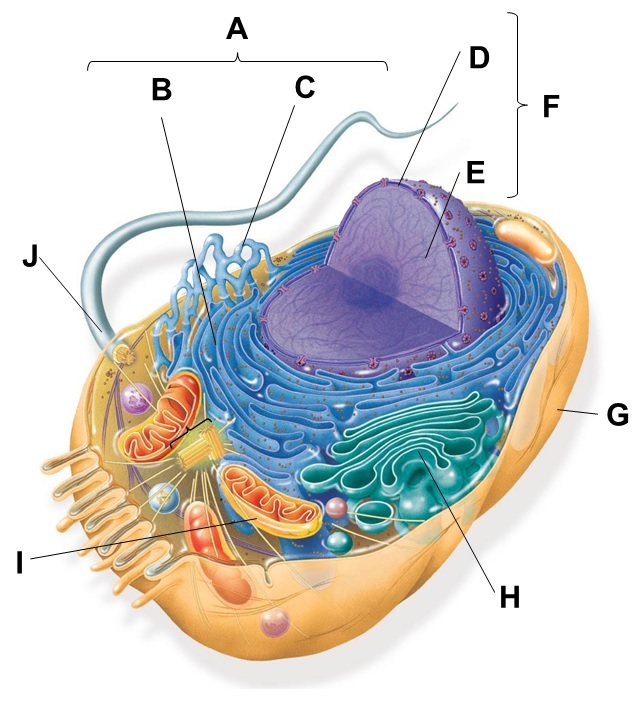
What structure is labeled by H?
endoplasmic reticulum
endomembrane system
Golgi body
mitochondria
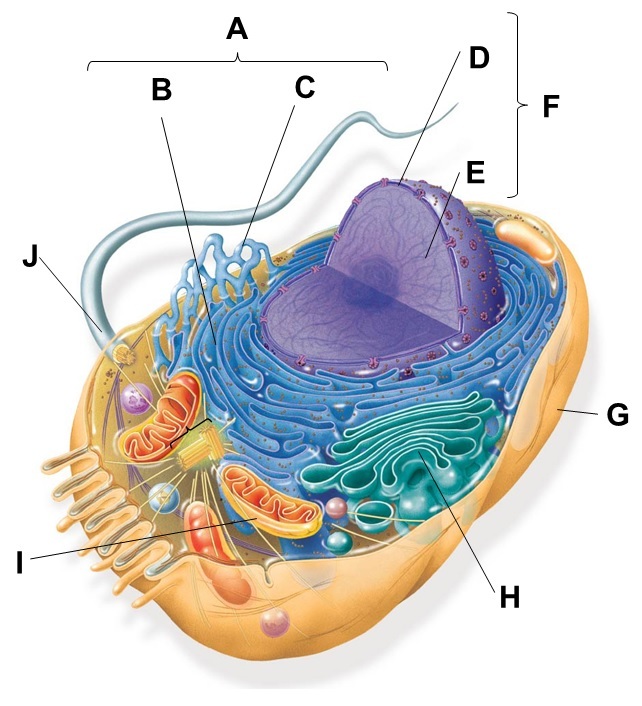
What structure is labeled by D?
nucleolus
nuclear envelope
chromatin
nuclear pore
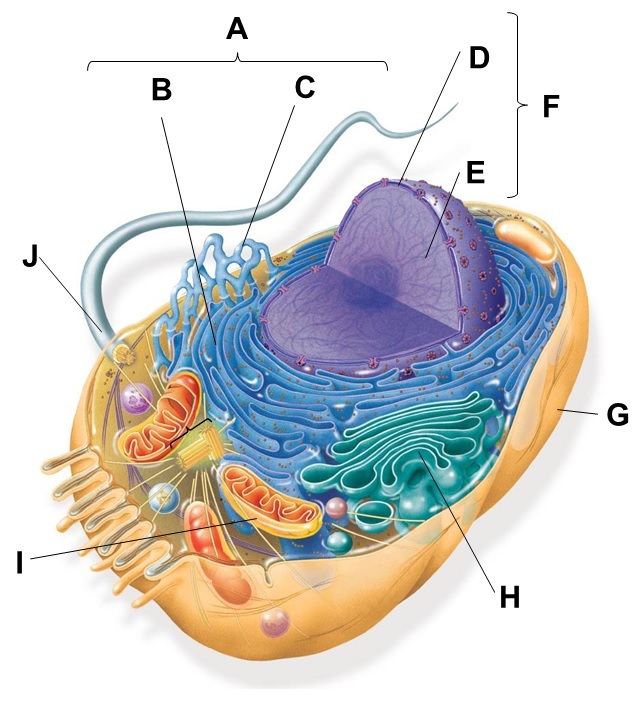
What structure is labeled by C?
ribosomes
Golgi body
rough ER
smooth ER
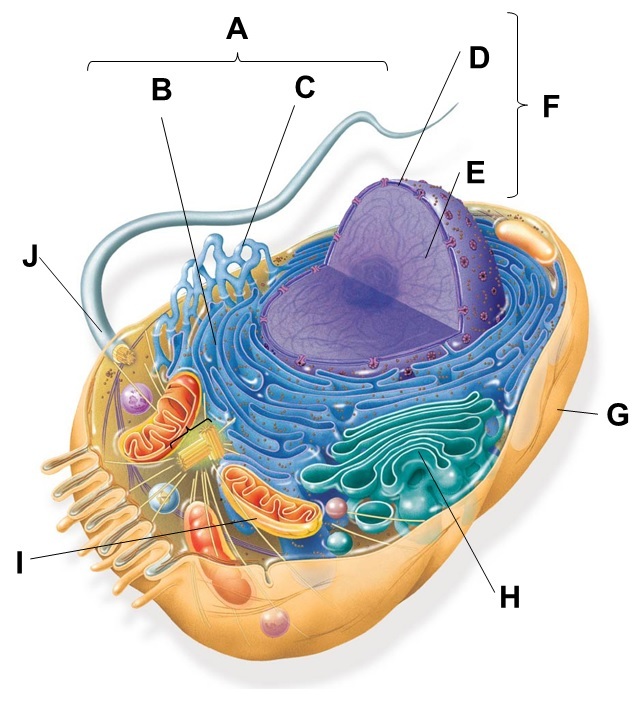
What structure is labeled by B?
smooth ER
rough ER
ribosomes
Golgi body
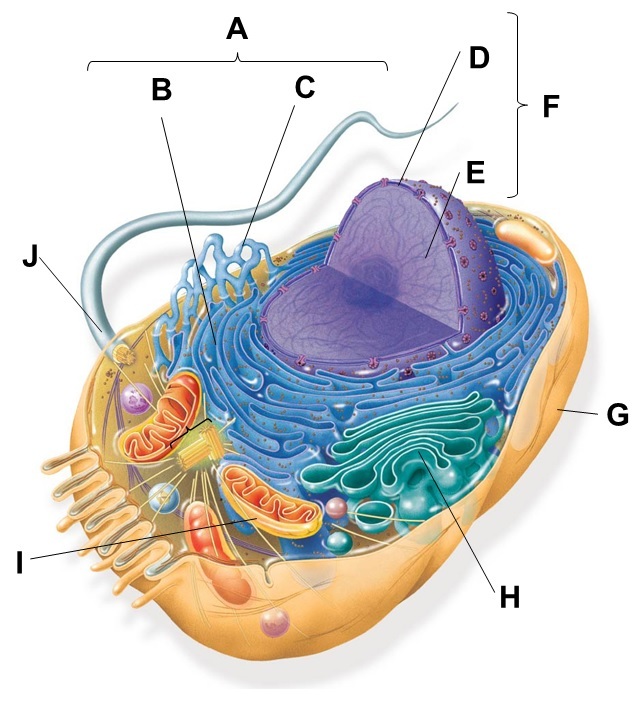
What structure is labeled by A (includes B and C)?
endomembrane system
nucleus
endoplasmic reticulum
ribosomes
Which of the following is FALSE?
Mitochondria possess their own DNA.
Cristae are the folds of the inner mitochondrial membrane.
Mitochondria contain ribosomes in the intermembrane space.
Mitochondria are involved in energy metabolism.
Which type of cell should have the MOST mitochondria?
photosynthetic cells in tree leaves
nondividing cells in the skin of your finger
muscle cells in the legs of a marathon runner
bacterial cells that are growing on sugars
inactive yeast cells stored in a bakery refrigerator
Consider two cells with the same volume but very different surface areas due to their difference in shape. The cell with the larger surface area is most likely to:
be involved in the rapid uptake of materials from the cell's environment
have a very high metabolic rate
be prokaryotic
be buried deep in the interior of an organism
be nearly spherical in shape
Which of the following eukaryotic organelles does not contain DNA?
nucleus
mitochondrion
endoplasmic reticulum
chloroplast
Which cell would be best for studying lysosomes?
muscle cell
nerve cell
phagocytic white blood cell
leaf cell in a plant
What is the most likely pathway taken by a newly synthesized protein that will be secreted by a cell?
ER --> Golgi --> nucleus
Golgi --> ER --> lysosome
nucleus --> ER --> Golgi
ER --> Golgi --> vesicles that fuse with the plasma membrane
Cyanide bonds to at least one molecule involved in producing ATP. If a cell is exposed to cyanide, most of the cyanide will be found within the:
mitochondria
ribosomes
peroxisomes
lysosomes
Which structure-function pair is mismatched?
nucleolus - production of ribosome subunits
lysosome - intracellular digestion
ribosome - protein synthesis
microtubule - muscle contraction
Which of the following is present in a prokaryotic cell?
mitochondrion
ribosome
nuclear envelope
chloroplast
Which structure is common in plant and animal cells?
chloroplast
wall made of cellulose
central vacuole
mitochondrion
Which structure is not part of the endomembrane system?
nuclear envelope
chlorplast
Golgi apparatus
plasma membrane
Endosymbiotic theory states that two cellular organelles originally started as different cells. Identify those two organelles from the list below.
Chloroplasts
Mitochondria
Nucleus
Rough Endoplasmic Reticulum
Cytoplasm
The nucleus is considered the CONTROL CENTER of the cell. Why is that so?
It is usually found at the center of the cell.
It is usually the biggest organelle of the cell.
It contains the information vital for making proteins and other cellular processes.
It decides the functions of each organelle and mandate how such functions take place.

Check the three major differences between a plant cell and an animal cell.
cell wall
mitochondria
large central vacuole
chloroplasts

The function of the golgi complex is to
make proteins for the cell.
make energy for the cell.
package and distribute materials such as proteins for the cell
controls the activities of the cell.

Check the functions of the cell wall.
provides support for the plant cell
provides structure and support for the plant cell
provides energy for the animal cell
provides structure for the animal cell
Ribosomes are important because
they make proteins for the cell.
they make glucose for the cell.
they transport materials throughout the cell.
they control the cell's activities

The function of the mitochondria is
is to make proteins for the cell.
transport materials in and out of the cell.
break down waste products for the cell.
break down glucose through cellular respiration and make energy for the cell.

Plant cells and animal cells
are both prokaryotic
are both eukaryotic
do not have a nucleus
do not have DNA


Which one of the following organelles is NOT FOUND in an animal cell?
plasma membrane
nucleus
chloroplast
rough endoplasmic reticulum

Provides extra support for the plant cell and gives in shape
chlorophyll
chloroplast
cell wall
vacuole

Which organelle is only found in the plant cell?
cell membrane
cell wall
nucleus
centriole

Does a vacuole store water and other materials?
no
yes
in other cells
Which organelle is bigger in the plant cell than in the animal cell?
Cell membrane
Vacuole
Cell wall
Chloroplast
Uses enzymes to break down food and worn out cell parts.
Lysosomes
Golgi apparatus
Vacuoles
Ribosome
Acts like a gatekeeper- allowing some materials to pass through it, but not others.
cytoplasm
plasma membrane
mitochondria
vacuoles

"Powerhouse of the cell" breaks down glucose molecules to release energy
Mitochondrion
Chloroplast
Cell Wall
Vacuole

What is the function of the smooth endosplasmic reticulum?
synthesises and transports glycerol and lipid
makes and transports proteins: contains ribosome

What does the nucleus coordinate?
The oxygen levels
the process of photosynthesis
the cells activities

All living things are made up of _______.
tissues
organs
cells
system


Both mitochondria and chloroplasts ____
contain their own unique ribosomes that are different than the cells
contain their own unique DNA that are different than the cells
are specialized organelles that capture and release energy
are found in both in plants and animals
An organelle involved in breaking down lipids, proteins, carbohydrates, damage organelles, and bacteria are ___
Golgi Appaparatus
Vesicles
Vacule
Lysosomes

Heliotropism is the seasonal motion of plant parts (flowers or leaves) to face their direction of the Sun. This is an example of ...
all living things being made of cells.
all living things maintaining homeostasis.
all living things growing and developing.
all living things responding to stimuli.
After eating, the pancreas releases a hormone called insulin to help the cells take in the sugar from the food to keep the blood stream at the appropriate sugar level. This is an example of ...
all living things containing DNA.
all living things maintaining homeostasis.
all living things evolving.
all living things reproducing.
Any living thing ...
is an abiotic factor.
meets 7 of the characteristics of life.
contains DNA.
moves.

Which characteristic is shown: A corn field absorbs sunlight to produce food.
Made of Cells
Respond to a Stimulus
Acquire and Use Energy
Genetic Code

Which characteristic is shown: An American alligator kills and eats a fish.
Change Over Time
Acquire and Use Energy
Grow and Develop
Made of Cells

What characteristic is shown: A bacteria cell divides itself in two.
Reproduce
Respond to a Stimulus
Homeostasis
Grow and Develop

What characteristic is shown: A giraffe gives birth to a healthy
Reproduce
Genetic Code
Change Over Time
Acquire and Use Energy
Identify the characteristic: A camel has eyelashes that work to keep the dust and sand out of its eyes.
All living things adapt/respond to their environment
All living things grow
All living things have cells
All living things use energy
Which of the following is NOT an example of an adaptation?
birds migrating during the winter months
the total sum of all the chemical reactions in your body
humans evolving the ability to digest lactose (sugar in milk)
the ability of dolphins to communicate in aquatic environments
Which of the following is an example of homeostasis?
adapting to your environment
maintaining an appropriate respiration rate
the sum of all of your chemical reactions
being composed of more than one cell

Which of the following is a response?
a flashlight shined into the eye
a rubber band popping your hand
your pupils constricting when exposed to bright light
blood glucose levels drop significantly


Identify the characteristic: a caterpillar hibernates in a cocoon and emerges as a butterfly.
All living things adapt to their environment
All living things use energy
All living things respond to their environment
All living things grow and develop
Identify the characteristic: green plants produce their own food through the process of photosynthesis.
All living things use energy
All living things contain cells
All living things maintain homeostasis
All living things grow and develop
Identify the characteristic: when you step out into the cold, your body shivers in order to keep its temperature at 98.6oF.
All living things use energy
All living things contain cells
All living things maintain homeostasis
All living things grow and develop
Maintaining a stable internal
environment is called
homeostasis
equilibrium
balance
evenness
Living things are based on a universal genetic
code. What molecule is responsible for that code?
RNA
Lipid
Protein
DNA
The combination of chemical reactions through
which an organism builds up or breaks down
materials as it carries out its life processes is called ...
absorption
metabolism
digestion
consumption


All ecosystems; the portion of earth occupied by living organisms.
Population
Ecosystem
Biosphere
Community
All of the organisms of different species in a given area plus all of the non living matter and energy.
Population
Ecosystem
Biosphere
Community
populations of different species inhabit the same area and interact with each other.
Population
Ecosystem
Biosphere
Community
group of individual of the same species living in the same area.
Population
Ecosystem
Biosphere
Community
combination of elements. Two or more atoms in a stable condition.
Organ system
Organ
Organism
Molecule
Living individual composed of organs and organ systems.
Organ system
Organ
Organism
Molecule
group of organs that work together to carry out more general function.
Organ system
Organ
Organism
Molecule
group of tissues that carry out specific function
Tissue
Organ
Cell
Molecule
group of cells
Tissue
Organ
Cell
Molecule
the smallest unite that exhibits all the characteristics of life.
Tissue
Organ
Cell
Molecule
Catabolism
building up
breaking down
Anabolism
building up
breaking down
is the sum of all chemical reactions in the cells of the organism that convert food sources into energy molecules (ATP) so that life can be sustained.
Metabolism
Anabolism
photosynthesis
Catabolism
Plants use the energy of the sunlight, chemicals from soil, water and air to make their own food by a process called
Metabolism
Anabolism
photosynthesis
Biosphere
Molecules of life is :
proteins, carbohydrates, lipids, nucleic acids
proteins, carbohydrates, lipids, fruit
proteins, Metabolism, lipids, fruit
proteins, Metabolism, lipids, nucleic acids
معنى: homeostasis
الاتزان الخارجي
الاتزان البيئي
الاتزان الداخلي
الموطن البيئي
معنى: the life require energy and materials
فائدة الحياة من الطاقة والمواد
الحياة تتطلب طاقه ومواد
What is the Biology
is the study of the natural world which consists of all matter and energy.
is the study of living organisms
the smallest unite that exhibits all the characteristics of life.
All cells originate from existing cells.
All living things are made of cells
All living things acquire and use energy
All living things grow and develop
What is the Science
is the study of the natural world which consists of all matter and energy.
is the study of living organisms
the smallest unite that exhibits all the characteristics of life.
All cells originate from existing cells.
All living things are based on a universal genetic code
All living things are made of cells
All living things acquire and use energy
All living things acquire and use energy
All living things are made of cells
All living things grow and develop
Change in the environment
stimulus
adaptation
response
homeostasis
Reaction to changes in the environment
adaptation
stimulus
response
internal stimuli
Characteristics of an organism that helps it survive
adaptation
stimulus
response
internal stimuli
When two living things depend on each other
homeostasis
adaptation
organization
interdependent
An organism's ability to maintain steady internal conditions when outside conditions change
internal stimulus
external stimulus
organization
homeostasis
Describes a living thing that is made of only one cell
unicellular
cell
multicellular
organism
A thing that has all the characteristics of life
unicellular
multicellular
cell
organism
A living thing that is made of two or more cells
unicellular
specialized
multicellular
homeostasis
The smallest unit of life
organism
cell
multicellular
unicellular
Carmen puts on a sweater on a cold day. What mechanism is taking place in this situation?
Homeostasis
Evolution
Metabolism
Heredity
Karlie's blood pressure increased in excitement when she aced the first biology quiz. What characteristic of life is this an example of?
Responding to the environment
Evolution
Heredity
Homeostasis
Baby, child, pre-teen, teenager, adult refers to what characteristic of life?
Growth and development
Evolution
Heredity
Responding to the environment
Living things are made up of units called
DNA
Cells
Homeostasis
Seeds
Which of the following is an example of homeostasis?
adapting to your environment
maintaining an appropriate respiration rate
the sum of all of your chemical reactions
being composed of more than one cell
Stimulus is
organisms that are made up of more than one cell
a membrane-covered structure that contains all of the materials necessary for life.
a change that affects the activity of an organism.
the maintenance of a stable internal environment.


Something that is currently showing all the characteristics of life:
living
nonlivng
dead
dormant
Something that isn't currently showing the characteristics of life but will when provided with the correct conditions:
living
nonliving
dead
dormant
Something that has never shown the characteristics of life and never will:
dormant
nonliving
living
dead
Something that once showed all the characteristics of life but no longer does and never will again:
dormant
nonliving
dead
living


What makes a chemical reaction?
matter is conserved
breaking and forming of chemical bonds
when products form reactants
when you do a lab

What gives water so many important properties for life?
adhesion and cohesion
the amount of carbon in each molecule
energy released exothermically
hydrogen bonds give it polarity
Why are chemistry and biology inherently related subjects?
Both are about matter ("stuff"). Bio is more specific to living things
Chem is based on atoms/molecules and their interactions. Living things function due to atoms/molecules
The functioning of living things is due to chemistry/chemical reactions/molecular interactions (i.e. metabolism)
All answers are correct

Which Major Class of Bio-molecule is this?
Carbohydrate
Lipid
Protein
Nucleic Acid

What is this specific type of molecule?
monosacharide
nucleotide
triglyceride
amino acid
Which Major Class of Bio-molecule is this?
Carbohydrate
Lipid
Protein
Nucleic Acid
Which of the following statements about the nucleus of an atom is false?
It contains protons and neutrons
It is very small/dense
Its overall charge is +
It allows for the chemical behavior of the atom
Which of the following is an example of trace element?
I
C
P
S
What are the elements of life?
CHNOPS
C, H, and O
C and H2O
Fire, magic, thunder, and Kanye
Which of the following is an example of a compound?
NaCl dissolved in water
NaCl
Na
Air
Anabolic biochemical reactions _ energy and allow for the _ of larger molecules
Require, breakdown
Require, buildup
Release, breakdown
Release, buildup
Which of the following is an example of homeostasis?
A plant respires to thermoregulate
A dog secretes insulin to decrease blood sugar levels
A bacterial cell expels water to regulate ion concentrations
All answers are correct
All of the following are characteristics of living things EXCEPT
Is composed of atoms
Order (cells and DNA)
Evolution
Response to stimuli
Growth & development
Which of the following is the smallest unit of a living thing?
Cell
Atom
Molecule
Organ