
 Worksheets
A Young Tinkerer Quiz
Total questions: 20
Worksheet time: 10mins
Name
Class
Date
1.
How did Kamkwamba first learn to make windmills?
a)
He asked some foreigners visiting his village to help him make his windmills.
b)
He figured it out himself after seeing a picture of a windmill in a textbook.
c)
He studied engineering at a local school and took a class in windmill design.
d)
He watched and then copied another villager who made windmills.
2.
What is the main problem that Mr. Kamkwamba is trying to solve?
a)
the lack of access to electricity in his country
b)
his family's expensive electricity bills
c)
the poorly constructed windmills in the village
d)
the pollution caused by electrical plants in Malawi
3.
Why do people visit the Kamkwamba family compound? Choose two options.
a)
They can use the electricity to charge their phones.
b)
They can borrow money from William Kamkwamba.
c)
They can stay at the compound and help make windmills.
d)
They can see the windmills they are curious about.
e)
They can pay for a tour of the house and its windmills.
4.
What has caused tension in William Kamkwamba's village?
a)
Other villagers observe the family's success and want the same for themselves.
b)
Other villagers think that William should focus on building windmills for them.
c)
Other villagers feel that the family is greedy and should share their wealth.
d)
Other villagers are angry because all the visitors are disturbing them.
5.
Which of the following examples best illustrates the meaning of scarcity?
a)
a restaurant that serves a delicious new dish
b)
a store that has beautiful jewelry in its windows
c)
a city that puts limits on water use during a drought
d)
a country that sends athletes to the summer Olympics
6.
What is the most likely meaning of desire in the following sentence?
The young actors desire a lead role in the new play, but they would also be happy with a small role.
a)
to want or wish for
b)
to feel or express
c)
to regard as true
d)
to reach a goal
7.
What is the meaning of attempts in this sentence?
Dad made several attempts to fix the leak, but the dripping continued.
a)
prices paid for something
b)
comments made to someone
c)
acts of trying to do something
d)
ideas about what someone should do
8.
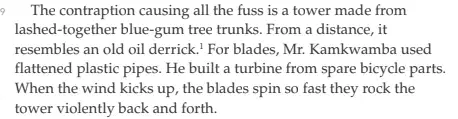
Read the excerpt in the image. What does this excerpt reveal about Mr. Kamkwamba's abilities?
a)
He is able to follow directions very carefully.
b)
He is able to work quickly under tight deadlines.
c)
He is able to find creative solutions to problems.
d)
He is able to persuade people to work hard for him.
9.

Part A: Read the excerpt in the image. Which sentence best describes the effect that Mr. Kamkwamba had on the audience at the TED conference?
a)
He startled them.
b)
He amused them.
c)
He offended them.
d)
He inspired them.
10.
Part B: Which phrase from the excerpt best supports the answer to Part A?
a)
about a windmill
b)
After the conference
c)
a group of entrepreneurs
d)
pledged to finance his education
11.
Part A: What is the central idea of the text?
a)
Mr. Kamkwamba became famous after he gave a TED talk about his ideas, and many people now visit his family home.
b)
The attention that Mr. Kamkwamba has gotten from his windmills may help him address energy shortages in Malawi.
c)
Mr. Kamkwamba lives in Malawi, a country that lacks energy resources like electricity.
d)
William has caused lots of tension in his village since everyone is jealous of his success.
12.
Part B: Which excerpt best supports the answer i Part A?
a)
Then, he wants to build more windmills for other villages across the country. Betting he can do it, a group of investors are putting him through school.
b)
“I was thinking about electricity,” says Mr. Kamkwamba, explaining how he got hooked on wind.
c)
Mr. Kamkwamba’s wind obsession started six years ago. ... When he wasn’t helping his family farm groundnuts and soybeans, he was reading.
d)
His backers have also showered him with new gadgets, including a cellphone with a hip-hop ringtone.
13.
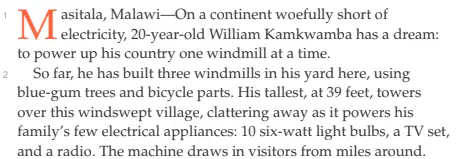
Read the excerpt in the image. What is the most likely reason for including this information at the beginning of the article?
a)
to explain the outcome early so readers can focus on Mr. Kamkwamba's interesting story
b)
to build tension by showing why people were opposed to Mr. Kamkwamba's efforts
c)
to set the scene (provide context) by explaining why poor parts of the world lack electrical supplies
d)
to make readers curious about how Mr. Kamkwamba might achieve his dream
14.

Read the excerpt in the image. What does the reader learn about Mr. Kamkwamba from the teacher’s direct quotation?
a)
He tries to study but spends too much time socializing with other students.
b)
He is a disappointment to his teacher because he does not work very hard.
c)
He is a good student but tends to focus too much on a single topic.
d)
He cares little for studying because he is distracted by his fame.
15.

Read the excerpt in the image. How do these details help the writer develop Mr. Kamkwamba's character?
a)
They provide an example of his generosity and his desire to help others.
b)
They provide an example of his shyness and challenges with making friends.
c)
They show that he is jealous and does not want anyone else to build windmills.
d)
They show that he is very clever but unable to share what he knows with others.
16.
Part A: Based on the facts and details from our text, what conclusion can you draw about education in Malawi?
a)
It is available only for male students.
b)
It is too expensive for many Malawians.
c)
It is entirely funded by the government.
d)
There are not enough Malawian teachers.
17.
Part B: Which sentence from our text best supports the answer to Part A?
a)
A few years ago, he built a windmill for the primary school in Masitala.
b)
He wasn’t going to school anymore because his family couldn’t afford the $80-a-year tuition.
c)
Two of Mr. Kamkwamba’s six sisters stay up late studying for school.
d)
Last November, Hartford Mchazime, a Malawian educator, heard about the windmill and drove out to the Kamkwamba house with some reporters.ill and
18.
Which sentence shows correct capitalization in a quotation?
a)
Gary said, "someone who worked hard was Thomas Edison."
b)
Jules asked, "who was he?" and Sue pointed to the light bulb.
c)
Our teacher replied, "He was an inventor who was born in Ohio."
d)
Penelope asked, "can we learn about some of Edison's inventions?"
19.
Which word in the sentence is a proper adjective that should be capitalized?
The tourists visited the scottish birthplace of Alexander Graham Bell, gifted inventor of the telephone.
a)
tourists
b)
scottish
c)
gifted
d)
inventor
20.
Which sentence shows the correct capitalization of proper nouns?
a)
On friday, the class read about George Washington Carver.
b)
Carver, a native of Missouri, helped African American farmers.
c)
Mr. Jackson taught his class how Carver helped Farmers grow Peanuts.
d)
Maria learned that franklin d. roosevelt made Carver's home a national monument.
100 %

