
 Worksheets
Prokaryotes vs. Eukaryotes STAAR questions
Total questions: 14
Worksheet time: 10mins
Scientist observe the traits of cells on four microscope slides and record their observations in a table. Based on the scientists' observations, identify the eukaryotic cell slides/
Click on the hot spot boxes for the eukaryotic cells in the image.
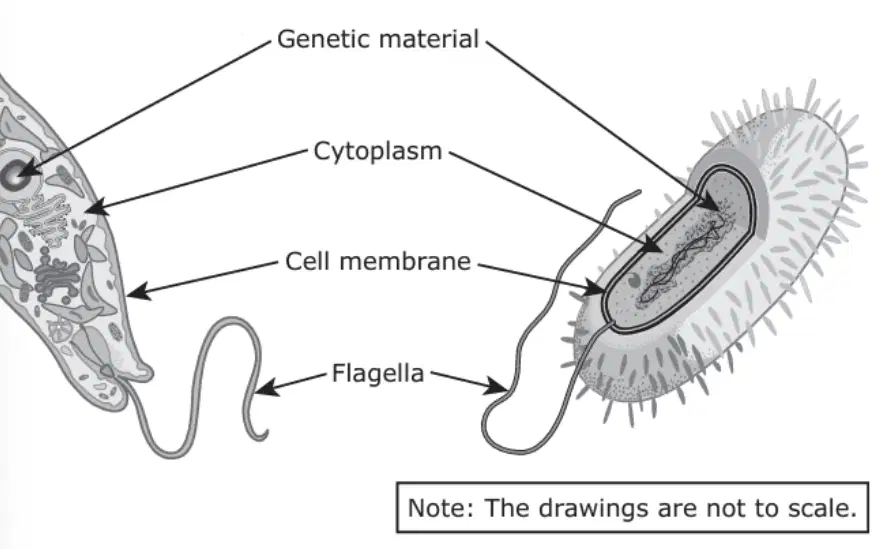
A prokaryotic cell and a eukaryotic cell are shown.
Which characteristics best distinguishes these cells are either prokaryotic or eukaryotic?
The organization of the genetic material
The location of the cytoplasm
The role of the cell membrane
The function of the flagella

Students use a microscope to look for structures present in four different cells. The students placed an X for each structure that was viewed for each cell on the table shown. Which cell in the table is a prokaryotic cell? (a)

The picture shows a student using a microscope to study a prepared slide of a single-celled organism.
A single-celled organism can be classified as a prokaryote based on the absence of —
a cell membrane
ribosomes
chromosomes
a nucleus
Both euglena and cyanobacteria are photosynthetic unicellular organisms found in pond water. The feature that distinguishes euglena from cyanobacteria is the —
ability to maintain homeostasis
presence of ribosomes
ability to reproduce
presence of a nuclear membrane

Students use a microscope to look for structures present in four different cells. The students placed an X for each structure that was viewed for each cell on the table shown. Which cell that was viewed is most likely a prokaryote?
F. Cell W
G. Cell X
H. Cell Y
J. Cell Z

A student groups different types of cells as shown.
Which table headings should the student use for the two groups?


Students created note cards comparing characteristics of eukaryotic and prokaryotic cells. Which set of note cards most accurately compares these cells?


Some students used information they gathered from lab investigations to prepare a table. They entered the table in their lab notebooks.
Which of these correctly identifies the two cells described in the table?
Cell 1 is eukaryotic, and Cell 2 is prokaryotic.
Cell 1 is prokaryotic, and Cell 2 is eukaryotic.
Both Cell 1 and Cell 2 are eukaryotic.
Both Cell 1 and Cell 2 are prokaryotic.

Euglena are unicellular organisms that live in pond water. They move around using a flagella and can perform photosynthesis when needed. They contain many membrane bound organelles . What type of cells are they?
Prokaryotic Cell
Eukaryotic Cell
How does the DNA in eukaryotic cells compare to the DNA in prokaryotic cells?
Both cells contain genetic material within the nucleus
Both cells contain genetic material inside a mitochondrion
DNA in prokaryotic cells have a circular shape, unlike eukaryotic cells which have linear DNA
DNA is composed of amino acids in prokaryotic cells, unlike eukaryotic cells
A scientist is examining an unknown cell using an electron microscope. Which observed structure would indicate that the cell is MOST LIKELY prokaryotic?
Mitochondrion
Free-floating DNA
Chloroplast
Membrane-bound nucleus

