
 Worksheets
IGH Reading quiz 8 F24
Total questions: 12
Worksheet time: 7mins
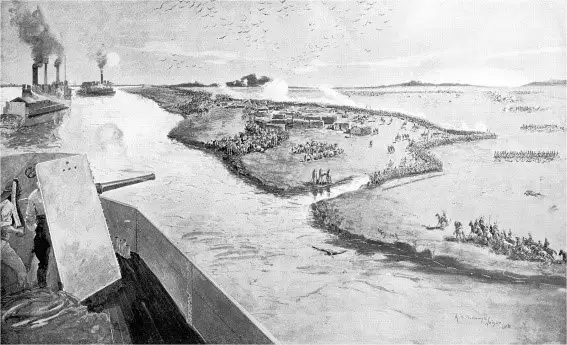
How does this image communicate the power of new naval technologies?
It includes flocks of birds at flight to indicate the startling sound of cannons
It juxtaposes the armed ship with a comparably unsophisticated pack of horses
It uses gray shading to show favor to the British forces
It shows acts of violence in clear, crisp detail

The English-French standoff at Fashoda is significant because:
The French defeated the English
France and England gave up their long-standing colonial rivalry to cooperate against Germany
Britain lost control of Egypt
The European population criticized the battle

Which meeting of superpowers, overseen by Otto von Bismarck, resulted in the division of 1.5M square miles of African territory among European countries without any African delegates being present or agreeing?
Conference of Congo Neutrality
Berlin Conference
European Nations Conference
Conference of Leopold II

Which African country did the Belgian King Leopold II claim?
(a)

Among the “spheres of influence” or colonies carved out by European powers, which geographic area suffered the most, with nearly all of it being conquered and subjected to European intervention?
China
East Indies
Africa
Indochina

The expanding imperial powers of the 19th century used all these reasons to impose and justify their dominance except:
Their ability to develop an advanced economy
Their technological and military prowess
The superiority of their race
Their Enlightenment ideas

What term refers to the misapplication of the idea of “survival of the fittest” to human races in the context of imperialism?
Social Darwinism
Rhodes Logic
Survivalism
Natural Selection
Which colonizing power preferred “integration,” or the maintenance of local elites via indirect rule while accepting individuals into colonial society?
Germany
Portugal
England
France

Which colonizing power preferred “assimilation,” or the imposition of the colonizer's culture?
Germany
Portugal
England
France

What is the most fundamental element that enabled the apex of imperialization between 1850 and 1914?
Enlightenment ideologies
Moral and religious codes
Technological advances
Treatment of disease

Due to international agreements put in place after World War I, in what decade did European empires reach their greatest territorial expanse?
1920s
1930s
1940s
1950s

Which of the following statements is true about the relationship between colonizing settlers and native populations?
An approximately equivalent number of colonizers were needed to keep order among native populations
A surprisingly small number of colonizers were needed to keep order among much larger native populations
A higher number of colonizers were needed to keep order among native populations
None of the above

