
 Worksheets
12C Food Webs STAAR
Total questions: 20
Worksheet time: 21mins

The populations of which organisms will most likely increase as a result of a disease that suddenly reduced the population of Texas horned lizards?
Grasses and ants
Ants and grasshoppers
Grasshoppers and Texas Cottonmouths
Texas cottonmouths and red shouldered hawks

Which statement provides the best explanation for the difference in biomass of organisms found at each trophic level?
Organisms at higher trophic levels have less energy available to them than organisms at lower trophic levels.
Organisms at higher trophic levels require smaller habitats than organisms at lower trophic levels.
Organisms at lower trophic levels provide less energy than organisms at higher trophic levels.
Organisms at lower trophic levels outcompete organisms at higher trophic levels.

When constructing an energy pyramid of a swamp ecosystem, which of these would be placed at the top of the pyramid.
Grass carp
American Alligator
Eastern mud turtle
Great blue heron

Based on this food web, which organisms are direct sources of energy for secondary consumers?
aphid, bird, rabbit
ladybug, fox, dragonfly
frog, butterfly, berries
mouse, snake, hawk

Based on the energy flow between trophic levels in an energy pyramid, how much energy would be expected to be found at the secondary consumer level in this energy pyramid?
100 Joules
500 Joules
1,000 Joules
50 Joules

Which organisms are both secondary and tertiary consumers?
chemosynthetic bacteria and amphipods
zooplankton and muscles
ratfish and octopuses
galatheid crabs and zoarcid fish

What is lost to the environment at each trophic level?
food sources
living space for the organisms
nutrients from soil
heat

A terrestrial food web is shown. Which of the following lists only organisms that are secondary consumers in this food web?
Mice, rabbits, herbivorous insects, squirrels
Predaceous insects, toads, spiders, foxes
Spiders, foxes, owl, hawks, snakes
Insectivorous birds, seed eating birds, owls, hawks

A food chain is shown. Which model best represents the amount of energy available for use at each trophic level represented in the food chain?


In a Central Texas grassland, the producers incorporate 12,000 kJ of energy from the sun into their tissues. About how much energy would be incorporated into the tissues of herbivores?
12,000 kJ
1,200 kJ
10,800 kJ
1,080 kJ
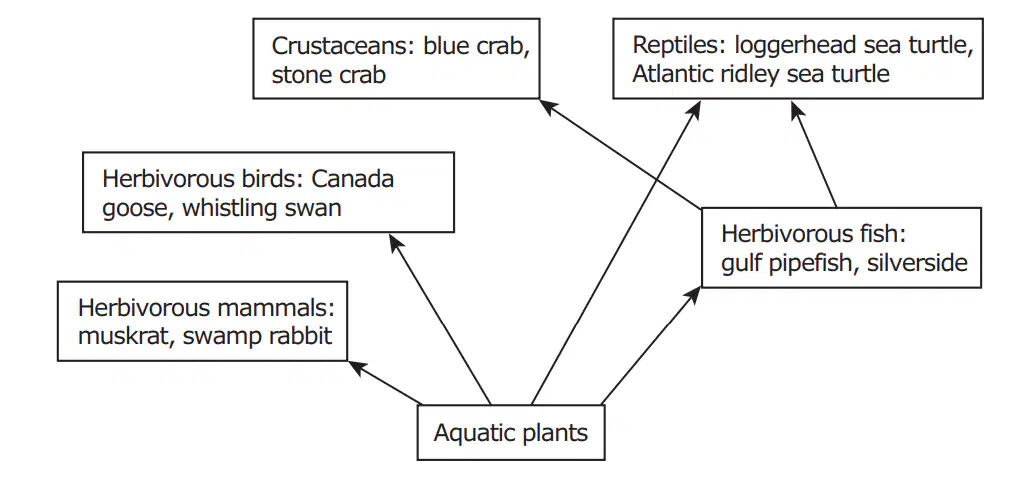
Some relationships between species found in the Texas Gulf Coast are shown in the food web.
Which energy pyramid best models energy flow in the Texas Gulf Coast community?


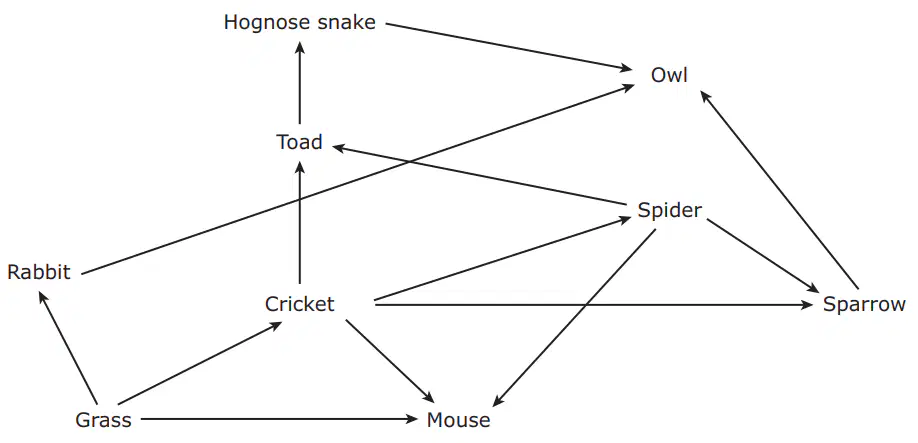
The flow of energy in a grassland ecosystem is shown.
Based on the diagram, which two populations best represent trophic levels that receive the LEAST amount of the total energy provided to the ecosystem by the grass?
Crickets and sparrows
Toads and spiders
Rabbits and mice
Hognose snakes and owls
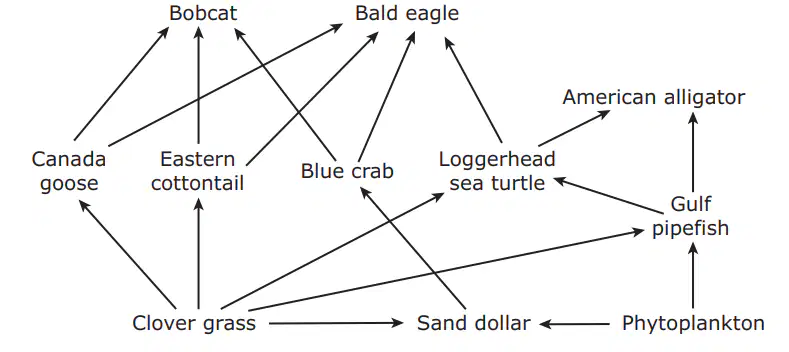
A food web representing a Gulf Coast ecosystem is shown.
Based on this food web, which organism occupies multiple trophic levels?
Canada goose
Eastern cottontail
Loggerhead sea turtle
Sand dollar

The diagram shows a partial East Texas food web. Which table correctly classifies these organisms?


The energy pyramid shows the energy made available by producers. Based on the energy flow between trophic levels in an energy pyramid, how much energy would be expected to be found at the secondary consumer level in this pyramid?
100 joules
500 joules
1,000 joules
50 joules

The food web shows the flow of energy through a sagebrush-steppe ecosystem. Which of these organisms are in a trophic level that receives a larger percentage of the energy captured by the producers than the percentage received at the bats' trophic level?
mountain lion
snakes
hawks
ground squirrels
A student is asked to draw a food web in which the same organism is a primary consumer as well as a secondary consumer. How should the organism be represented in the food web?
the organism must have an arrow pointing from it to a tertiary consumer and another arrow pointing from it to a decomposer
the organism must have an arrow pointing from it to a secondary consumer and another arrow pointing to it from the top predator
the organism must have an arrow pointing to it from a producer and another arrow pointing to it from a primary consumer
the organism must have an arrow pointing from it to a primary consumer and another arrow pointing away from it to a decomposer

Which of the following are missing from the food web shown above?
producer
decomposers
omnivores
predators

The Texas blind salamander (Eurycea rathbuni) lives in the Edwards Aquifer region around San Marcos. Along with other species the salamander lives in total darkness in the underground crevices and caves of the aquifer region. The table lists some of the organisms that live in this environment and their food sources. In the energy pyramid for these aquifer cave dwellers, which of the following would be placed at the bottom?
snails
blind shrimp
protozoa
Texas blind salamander
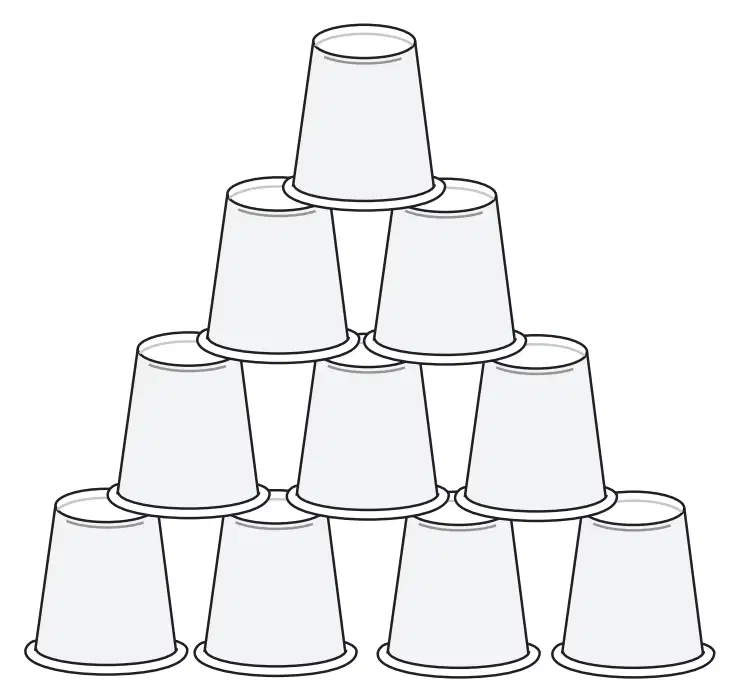
A student makes a model of an energy pyramid by stacking cups as shown. The producers are represented by the bottom level of four cups. How much energy will be obtained at the top of this energy pyramid if the cups representing the primary consumers have 37,000 kilojoules (kJ) of energy?
37,000 kJ
3,700 kJ
370 kJ
3.7 kJ

