
 Worksheets
Unit 3 Ancient Greece Review Quiz
Total questions: 31
Worksheet time: 16mins
Name
Class
Date
1.
A type of government in which power is held by the nobility or land-owning class.
a)
Aristocracy
b)
Democracy
c)
Oligarchy
d)
Theocracy
2.
Place where the most important Greek gods and goddesses lived.
a)
Peloponnesian War
b)
Oligarchy
c)
Plato
d)
Mt. Olympus
3.
A type of government where power lies in the hands of citizens
a)
Aristocracy
b)
Oligarchy
c)
Democracy
d)
Patriarchy
4.
War fought between Athens and Sparta
a)
Mt. Olympus
b)
Persian War
c)
Civil War
d)
Peloponnesian War
5.
A type of government where a few or small group holds power.
a)
Aristocracy
b)
Democracy
c)
Matriarchy
d)
Oligarchy
6.
King of the Olympian gods
a)
Mt. Olympus
b)
Socrates
c)
Zeus
d)
Helots
7.
From childhood, Spartan boys were trained to be _____.
a)
philosophers
b)
soldiers
c)
politicians
d)
artists
8.
Athens was defeated during the Peloponnesian War by an alliance led by the _____.
a)
Macedonians
b)
Persians
c)
Spartans
d)
Delian League
9.
A major factor in Greece's victories during the Persian Wars was:
a)
its vastly greater number of warships / navy
b)
the poor relationship between Athens and Sparta
c)
the relationship between Sparta and Thebes
d)
the alliance of the independent city-states
10.
The Spartans were able to defeat the Athenians in the Peloponnesian War with the aid of the _____.
a)
Ionians
b)
Persians
c)
Delian League
d)
Minoans
11.
Why was the Delian League formed?
a)
To guard against future attacks from Persia.
b)
To create a trading alliance.
c)
To give all polis equal power in Greece.
d)
To unite the polis into one empire.
12.
Athens is located in the region of _____, while Sparta is located in the region of _____.
a)
Greece, Persia
b)
Persia, Greece
c)
Peloponnesus, Attica
d)
Attica, Peloponnesus
13.
What was significant about Alexander the Great's empire?
a)
Alexander chose to cut it in half and give up control of one of the halves.
b)
It was the geographically largest empire of the ancient world.
c)
It was the first empire to adopt Christianity as an official religion.
d)
Alexander managed to unify the peoples he conquered and peacefully transfer power to his son.
14.
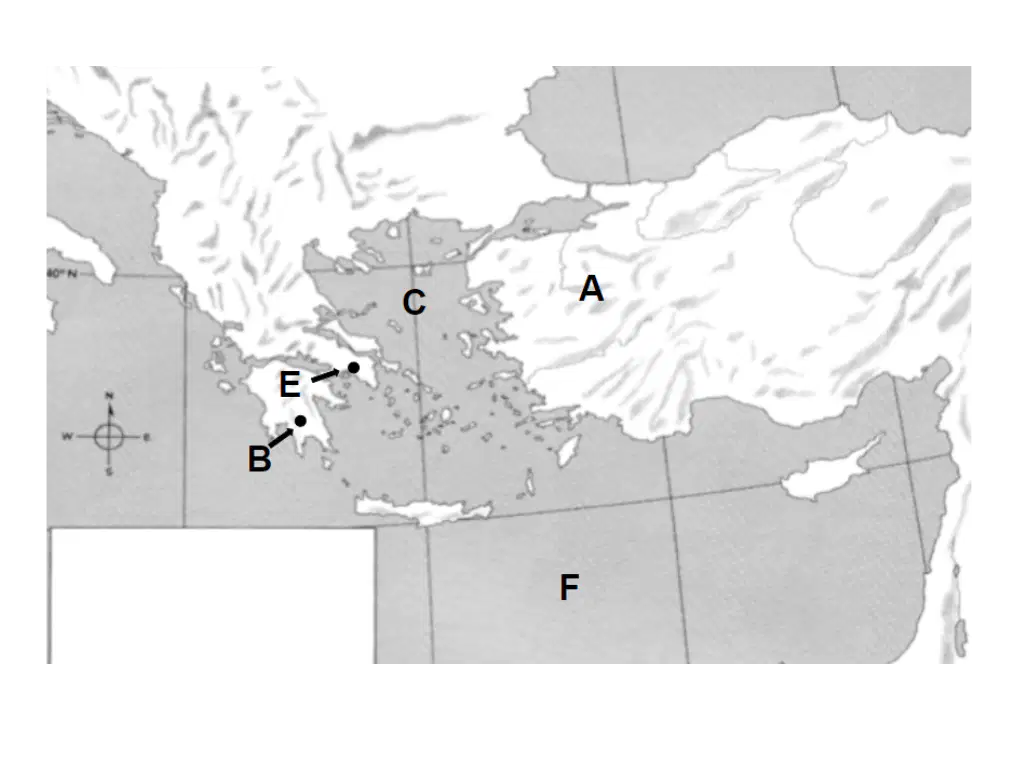
What is at point A?
a)
Persian Empire
b)
Aegean Sea
c)
Egypt
d)
Athens
e)
Sparta
15.
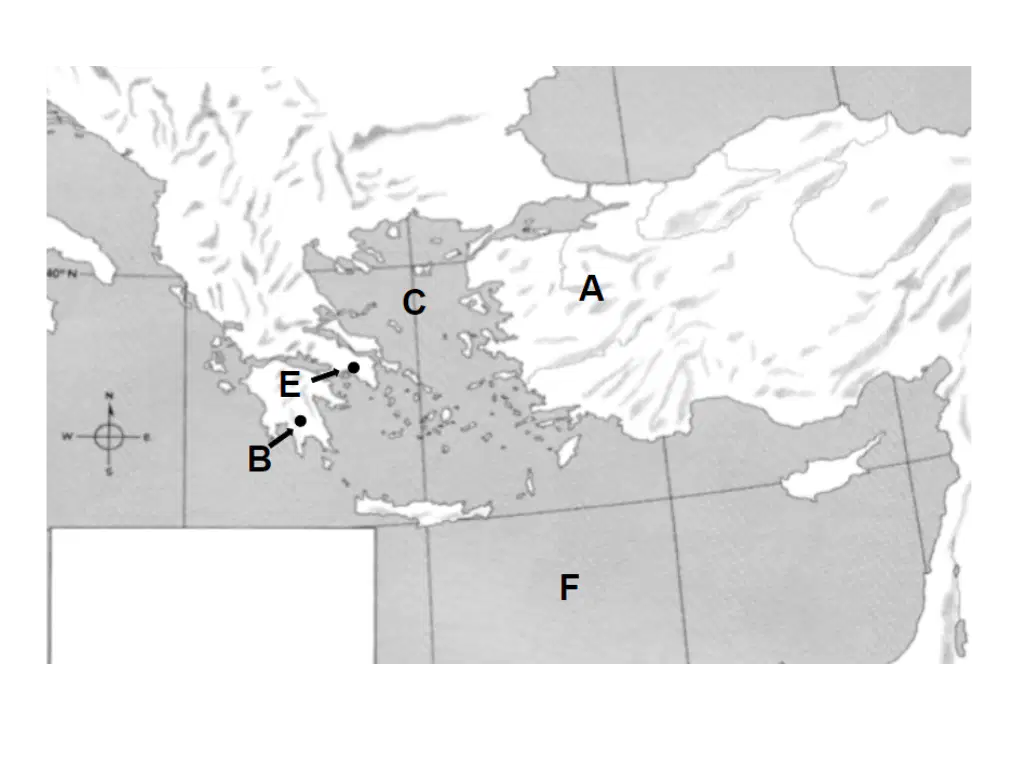
What is at point B?
a)
Sparta
b)
Aegean Sea
c)
Egypt
d)
Persian Empire
e)
Athens
16.
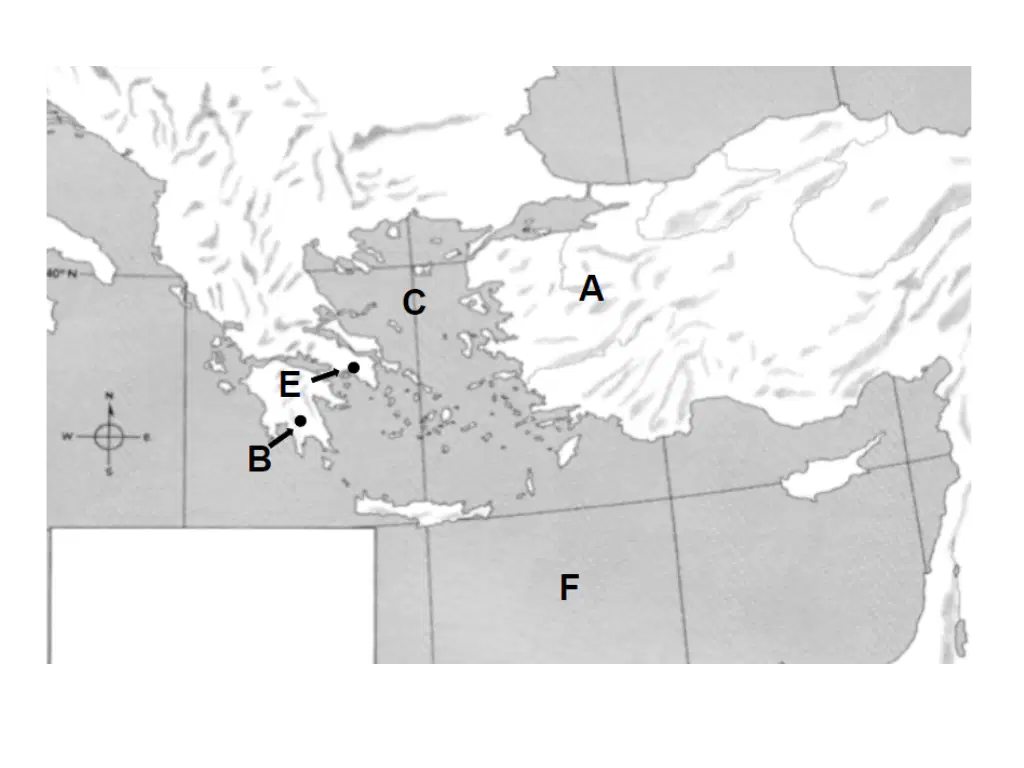
What is at point C?
a)
Aegean Sea
b)
Egypt
c)
Persian Empire
d)
Athens
e)
Sparta
17.
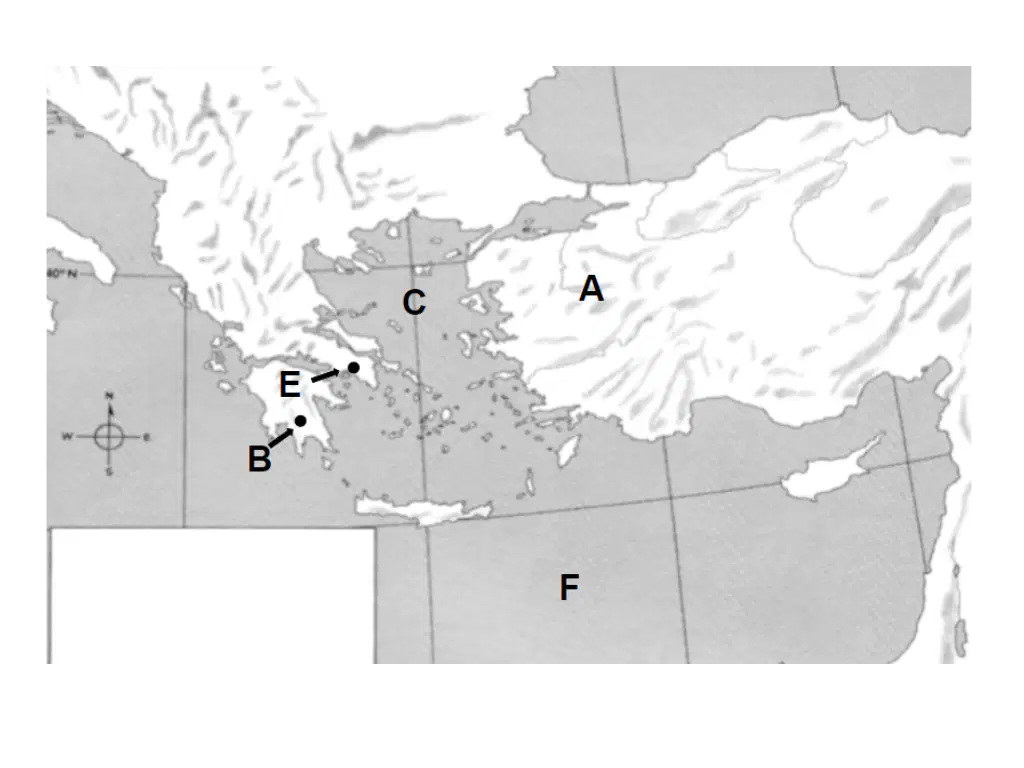
What is at point E?
a)
Athens
b)
Aegean Sea
c)
Egypt
d)
Persian Empire
e)
Sparta
18.
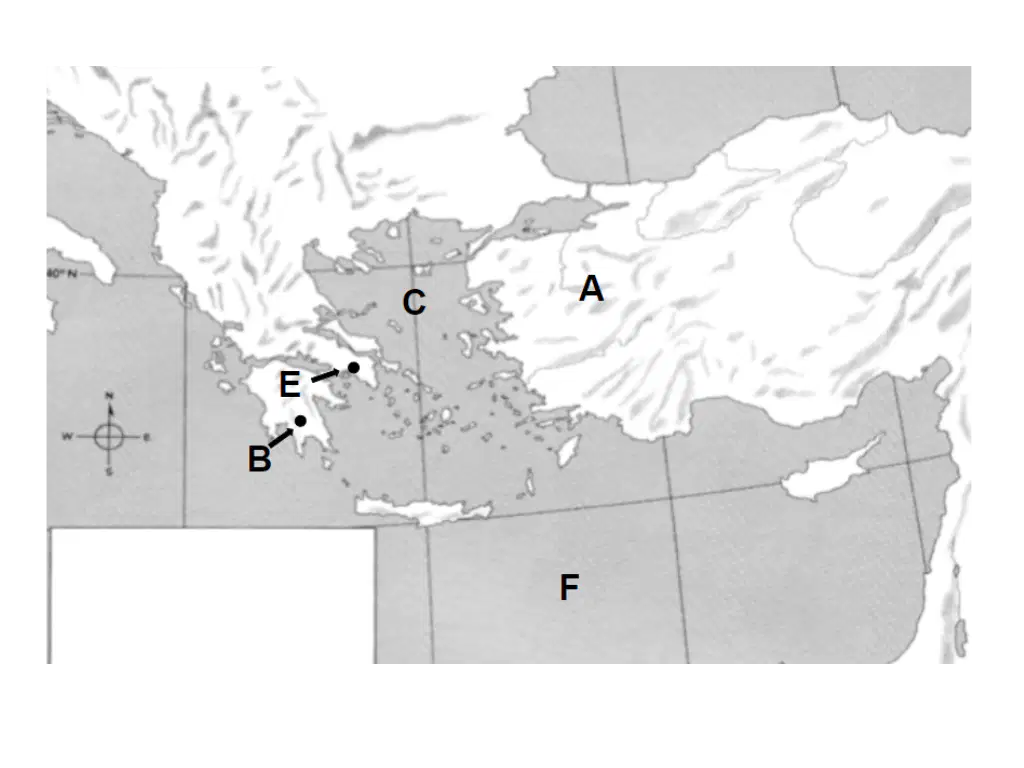
What is at point F?
a)
Mediterranean Sea
b)
Aegean Sea
c)
Egypt
d)
Persian Empire
e)
Athens
19.
Ancient civilization that heavily influenced later Greek polis; lived on the island of Crete.
a)
Trojans
b)
Minoans
c)
Mycenaeans
d)
Spartans
e)
Dorians
20.
Location of Minoan palace:
a)
Peloponnese
b)
Troy
c)
Knossos
d)
Acropolis
21.
Bright watercolor paintings done on top of wet plaster:
a)
murals
b)
portraits
c)
frescoes
d)
acryllic
22.
This civilization of sea traders were at least partially responsible for the disappearance of the Minoans:
a)
Trojans
b)
Minoans
c)
Myceneans
d)
Spartans
e)
Dorians
23.
Famous war likely fought over control of economically-desirable water straits.
a)
Persian War
b)
Peloponnesian War
c)
Civil War
d)
Trojan War
24.
Wrote the epic poems Iliad and Odyssey
a)
Socrates
b)
Homer
c)
Plato
d)
Alexander
25.
Word that is a synonym for "city-state" when referring to Greece.
a)
Helot
b)
Polis
c)
Phalanx
d)
Frescoe
26.
The "high city," a central location in a Greek towns built higher up than the rest.
a)
Acropolis
b)
Parthenon
c)
Collesium
d)
Circus
27.
A type of government with a single, hereditary leader.
a)
Aristocracy
b)
Democracy
c)
Monarchy
d)
Oligarchy
28.
Because of Greece's geography, city-states throughout history were often _____.
a)
close together, sharing lands peacefully.
b)
overcrowded.
c)
united.
d)
spread apart with smaller populations.
29.
"Hellenistic" refers to a culture that adopts customs from:
a)
Greece
b)
Persia
c)
Egypt
d)
India
e)
All of the above
30.
Rulers that seized power by force are called:
a)
monarchs
b)
philosophers
c)
tyrants
d)
emperors
31.
The lawmaking body of government:
a)
Legislature
b)
Judicial
c)
Executive
100 %

