
 Worksheets
1st Nine Weeks Exam
Total questions: 150
Worksheet time: 5hrs 39mins
Match the algebraic expressions to the situations they represent
Margie is 7 years older than Carrie. If Margie is m years old, how old is Carrie?
m - 7
Notebooks cost $5 each. How much do n notebooks cost?
5 * n
24 less than double x
2x - 24
increase the product of y and 4 by 2
4y + 2
31 * (18 + g)
one-third as much as 18 more than g
Which equation generalizes this pattern?
4 + 4 = 2 x 4
21+21= 2 ×21
a + a = 2 x a
a + b = a x b
a(a+b) = a x a + a x b
a + b = b + a
use order of operations to solve:
52×4 − 2 ×8
(a)
Match the following graphs to their inequalities

All numbers greater than 3
t > 3

All numbers less than or equal to -4
open circle
The number is not included in the solution set
closed circle
the number is included in the solution set
Find the next three numbers in the pattern: 6, 12, 18, 24...
30, 36, 42
30, 36, 43
27, 30, 33
27, 33, 39
Find the next three numbers in the pattern: 1, 4, 3, 6, 5...
(a)
Find the next three numbers in the pattern: 1, 3, 9, 27, 81...
243, 769, 2817
242, 729, 1287
242, 792, 2177
243, 729, 2187
The area of the circle A found by using the formula πr2
Rational Numbers
Irrational Numbers
Natural Numbers
Whole Numbers
The last four digits of a debit/credit card
Natural Numbers
Integers
Whole Numbers
Rational Numbers
Write the numbers in decreasing order:
1, −3, −2, 8, 318, 1, 31, −2, −3
8, 1, 31, −3,−2
8, 31, 1, −2, −3
1, 31, −2, −3, 8
a + b = b + a
(a ⋅ b) ⋅ c = (c ⋅ b) ⋅ a
Identify the property
a (1) = a
identity of addition
identity of multiplication
inverse of addtion
multiplication of zero
Pick the answer that is an example of the identity property of addition.
a + (-a) = 0
1 + 1 = 2
a + 0 = a
a + b = b + a
a(b + c) = ab + ac
a + (-a) = 0
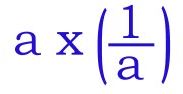
If you multiply a number and its multiplicative inverse, what do you get?
0
1
Not enough information
None of these
What is the additive inverse of 2/3?
-2/3
3/2
2/3
-3/2
Any number you multiply by zero is equal to zero.
True
False
True or false: abc = cba
True
False, if c = 0.
False, if a > b.
False, three variables can't multiply.
Which operations are inverses of each other?
Addition and Multiplication
Subtraction and Division
Addition and Subtraction
Multiplication and Division
b − 3 + 6 − 2b
-b + 3
3b + 9
b + 3
-3b + 3
9 + 5r − 9r
4r + 9
-4r - 9
-4r + 9
5r
−2(7 − n) + 4
-n + 18
-2n - 10
-n + 9
2n - 10
−8(−5b + 7) + 5b
45b − 56
-35b + 7
-45b + 56
10b - 1
−4p − (1 − 6 p)
-10p
2p − 1
-10p -1
-2p - 4
−7(k − 8) + 2k
-5k - 56
-5k - 8
10k - 7
−5k + 56
4 − 5(−4n + 3)
-9n + 7
20n - 11
-20n + 19
20n + 19
1 + 7(1 − 3b)
-3b + 9
21b + 8
-3b + 7
-21b + 8
3 − 8(7 − 5n)
-5n + 59
-40n +31
40n - 53
-35n -5
−6(a + 8)
-6a + 8
-6a - 48
-6a + 2
6a + 48
6(−5n + 7)
-11n + 13
30n + 42
-30n + 7
-30n + 42
−8(1 − 5x)
-8 + 40x
8 + 40x
-8 - 40x
8 - 40x
Factor. 6a + 20
2(a + 10)
6(a + 14)
2(3a + 10)
3(2a + 5)
Factor. 4x + 10
4(x + 10)
2(2x + 10)
4(x + 2)
2(2x + 5)
Factor. 45c + 10d
45(c + 10d)
5(9c + 2d)
5cd(9 + 2)
2(22.5c + 5d)
Factor. 27 - 9x + 15y
9(3 - x + 15y)
3(9 - 3x + 5y)
2(13 - 5x + 7y)
3(9 - 9x + 5y)
addition, subtraction, multiplication, division
operations
solution
algebraic expression
equation
A letter used to represent a number value in an expression or an equation.
equation
operations
variable
algebraic expression
A mathematical statement that says that two expressions have the same value; any number sentence with an =.
solution
factor
algebraic expression
equation
The value of a variable that makes an equation true.
operation
expression
factor
solution
Match the following:
Division
Quotient
Addition
Sum
Multiplication
Product
Subtraction
Difference
Match the following:
x
the square root of a number
x2
a number squared
3x
the cube root of a number
x3
a number cubed
3x + 5 when x = 5
when a = 3, b = 4, and c = -6
Reorder the following steps to solve for x
5(x-4) + 3x -1 = 10x -2
Combine like terms
Distribute the 5
Subtract 8x
Add 3
Divide by 2
Solve for x
5x - (2x + 2) = 5
x = 1
x = 3
x = -1
x = 5
What is the best first step to solve this equation
5 (x-4) + 3x -2 = 4 (2x-1)
Subtract 3x
Combine Like Terms
Distribute the 5 & 4
Add 2
Solve for x
6 (x-1) = 6
x = 2
x = -2
x = 7
x = -7
Solve for x
2x - 12 = -5x +4x
x = 3
x = 4
x = -3
x = -4

Is there a mistake on the equation solved? If so where was the mistake made?
This equation is solved correctly.
The mistake was made on the first step of combining like terms on the left side.
The mistake was made on the second step of moving the variable to the left side.
The mistake was made on the third step of moving the constant to the right side.
The mistake was made on the last step when isolating the variable by removing the coefficient

Is there a mistake on the equation solved? If so where was the mistake made?
This equation is solved correctly.
The mistake was made on the second step of combining like terms on the left side.
The mistake was made on the third step of moving the variable to the right side.
The mistake was made on the fourth step of moving the constant to the left side.
The mistake was made on the first step doing the distributive property.

Is there a mistake on the equation solved? If so where was the mistake made?
This equation is solved correctly.
The mistake was made on the first step of doing the distributive property.
The mistake was made on the second step of moving the variable.

Solve the equation.
x = 6
x = 30
x = 3.3
x = 54

Solve the equation.
x = 21
x = 27
x = 36
x = 2.25

Solve the equation.
x = 0.6
x = 2.3
x = 4
x = -1

Solve the equation.
x = 1
x = 5
x = 0.27
x = 1.36

What will the equation look like after you distribute?
-6x - 8 = 10
-6x + 8 = 10
-5x - 6 = 10
-5x + 6 = 10

What is the first step in solving this equation?
add 4 to both sides
distribute the 4
subtract 4 to both sides
subtract 12 to both sides

What will the equation look like after you combine like terms?
-5x + 5 = 35
x + 5 = 35
5x + 5 = 35
-x + 5 = 35

What is the first step in solving this equation?
subtract 3 to both sides
subtract the 6 - 2
distribute 2
distribute -2
Solve 21 + m = 33
m = 54
m = 12
m = -54
m = -12
Solve a - 5 = - 12
a = 7
a = -7
a = 17
a = -17
Solve 3(n - 7) = - 30
n = -3
n = 3
Solve the inequality
6 + h ≥ 12
h ≥ 6
h ≥ -6
h ≥ 18
h ≥ -18
14 + y > 5
y > 19
y > -9
y > 9
y > -19
x + 0.7 > - 0.3
x > - 0.4
x > 0.4
x > -1
x > 1
w - 8 ≥ 5.6
w ≥ -3.6
w ≥ 3.6
w ≥ -13.6
w ≥ 13.6
Write an inequality for this statement:
Four more than a number is more than 13
n + 4 ≥ 13
n + 4 > 13
13 > n + 4
13 < 4n
Write an inequality for this statement:
The sum of a number and 19 is at least 8.2
n + 19 ≥ 8.2
n - 19 ≥ 8.2
n + 19 ≤ 8.2
n - 19 ≤ 8.2
Solve the inequality
6y ≤ 18
y ≤ 3
3 ≤ y
y > 3
3 > y
-3t ≥ 33
t ≥ -11
t ≤ -11
-56 ≤ -8r
7 ≥ r
-7 ≥ r
6x + 14 ≥ 20
x ≥ 1
1 ≥ x
x ≥ 5.6
5.6 ≥ x
x/13 + 3 ≥ 4
x ≥ 13
13 ≥ x
x ≥ 91
91 ≥ x
∣ 2x + 9 ∣ = 15
|−2n| + 10 = −50
| m - 2 | < 8
| x - 7 | > 3
| 2x – 3 | + 5 =10.
l 2x−1 l +4 = 8
∣ -2x + 9 ∣ > 15
| 6 - 2x | = -5
y = − | x | + 4
y = | x + 2 | + 2


Is this set of ordered pairs a function or not a function?
{5,-2), (3,-5), (2,-5), (0,-2), (-1,-3)}

Does the given table represent a function?
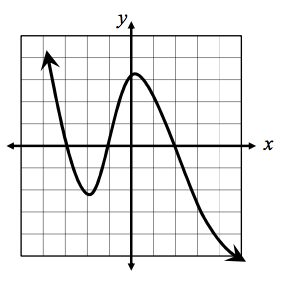
Which graph shows a relation that is a function?




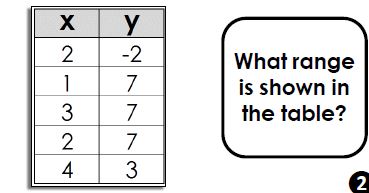
{-2, 3, 7}
[-2, 7]
{1, 2, 3, 4}
[1, 4]

What is the domain?
{0, 1, 2, 15}
(0, 1, 2, 3}
{3, 7, 11, 15}
{3, 7, 11, 3}
What is the range?
{0, 1, 2, 15}
(0, 1, 2, 3}
{3, 7, 11, 15}
{3, 7, 11, 3}

What is the domain?
{3, 4}
{1, 2, 3}
{1, 2, 3, 4}
{1, 3}
What is the range?
{3, 4}
{1, 2, 3}
{1, 2, 3, 4}
{1, 3}
The function h(t) represents the height in inches of a plant after t weeks. What does the notation h(4) = 5 mean?
After 5 week the plant is 4 inches tall
The plant grows at a rate of 5/4 inch per week
After 4 weeks the plant is 5 inches tall
The plant grows at a rate of 1 inch per week

Evaluate f(-3)
f(-3) = -3
f(-3) = 0
f(-3) = 2
not enough information to give an answer

f(-2) = -1
f(-2) = -9
f(-2) = 9
f(-2) = 0

Evaluate f(8)
f(8) = -3
f(8) = 1
f(8) = 0
f(8) = -1

r(-2) = ?
r(-2) = -12
r(-2) = -8
r(-2) = -4
r(-2) = -2

Does this relation represent a function?
No
Yes

Function
Not a Function

A function is a relation where each input has exactly (a) output.
In a function the outputs represent the (a) values.


Does this table represent a function?
No, every input has exactly one output
Yes, every input has exactly one output
Yes, every input goes to more than one output
No, every input goes to more than one output

Which table represents y as a function of x?
Table 1
Table 2
Find the value of y when x = 2.

Find the value of y when x = 2.


Solve for the unknown variable:
If a varies directly as b and a = 12 when b = 20, what is the value of b if a = 123? (no space)
(a)
Solve for the unknown variable:
If z varies directly as r and z = 243 when r = 27. What is the value of z when r = 780? (do not use comma)
(a)

Does y varies directly as x? Type YES or NO (use capital letter)
(a)

