NEW
Font size
 Worksheets
Population Ecology Review
Total questions: 23
Worksheet time: 17mins
What are the levels of ecology from smallest to the largest?
organism, population, community, ecosystem, biome, biosphere
organism, community, population, biome, ecosystem, biosphere
population, organism, community, ecosystem, biosphere, biome
biome, community, population, ecosystem, biosphere, organism
In a food chain, what breaks down dead material and helps turn it into nutrients in the soil?
producers
decomposers
animals
water
An organism that produces its own energy is called a(n)
Autotroph
Heterotroph
Detritivore
Omnivore


If there is 3500 Kcal available in trophic level 1, how much energy is available in trophic level 2?
35000 Kcal
35 Kcal
350 Kcal
0.35 Kcal

In the energy pyramid here, how much of the energy in each level gets lost as heat or used by the organism for survival?

What will most likely happen to the hawks and rodents if the insects were removed?
There will be more hawks and rodents
The rodents will eat more hawks
There will be fewer rodents and hawks
The hawks will eat more rodents

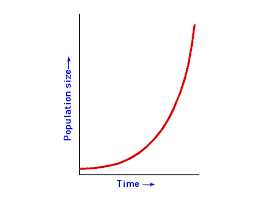
What is the arrow pointing at?
carrying capacity
biotic potential
density-independent
density dependent
What is an example of a density-independent limiting factor?
food
parasites
disease
pollution
When the birthrate of a population exceeds (more than) its death rate, the population
decreases
increases
stays the same
increases then decreases
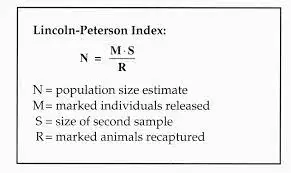
Conservationists want to find the population of a species of mountain goat. On one day, they captured, tagged, then released 12 mountain goats. A week later they captured 8 mountains goats. Of the 8 that were caught, 5 of them were already tagged. What would the estimate of the population be?
19
40
72
30


Which type of succession is being shown here?

Which type of succession is being shown here?


The brown tree snake was accidentally introduced to the island of Guam during World War II. Since then, this snake has caused the extinction of twelve native bird species by eating their eggs and young. One negative result of this snake's introduction was most likely
an increase in diversity as new species evolved to replace extinct species
an increase in mosquitoes due to an increase in bird species in the environment
a disruption of food chains and food webs in Guam's ecosystems
an abundance of brown tree snakes as a good source for humans

Select the correct statement based on the image above:
Community 1 has a more evenly spread abundance or number of each species than Community 2.
Community 1 has a less evenly spread abundance or number of each species than Community 2.
The evenness of species cannot be determined from this example.
In the mid 1900's, the wolves of Yellowstone were deeply affected by humans and their population significantly decreased-- making them endangered, and eventually removing them completely from the Yellowstone ecosystem. The removal of wolves, the top predator, caused what to happen to the biodiversity within Yellowstone?
A trophic cascade affected the entire food web in Yellowstone, causing some organisms to experience decreases, and others to grow rapidly.
Biodiversity increased when the wolves disappeared and more species were able to flourish without the wolves.
A trophic cascade irreversibly ruined the ecosystem in Yellowstone--destroying biodiversity forever.
The biodiversity of the park was not affected when the wolves were removed.