
NEW
Font size
 Worksheets
Photosynthesis Test review
Total questions: 20
Worksheet time: 10mins
Which pigment in plant cells captures light energy for photosynthesis?
Xantophyll
Carotenoid
Chlorophyll
All of the above
Which of the following correctly matches the type of nutrition to its definition?
Heterotrophic nutrition - Nutrition where organisms make their own food
Autotrophic Nutrition - Nutrition where organisms depend on others for food
Saprophytic Nutrition - Nutrition where organisms feed on dead organic material
Holozoic Nutrition - Nutrition where organisms can make their own food and eat other organisms
In photosynthesis, what gas is taken in by plants and used in the production of glucose?
Oxygen
Carbon dioxide
Hydrogen
Nitrogen
What is the primary process by which green plants convert sunlight into chemical energy?
Cellular respiration
Transpiration
Germination
Photosynthesis
Which of the following pairs of items does not correctly match parts of the leaf to their functions?
Stomata - Loses and gains water to control opening and closing of stomata
Phloem sieve tubes - Brings water to leaf for photosynthesis
Spongy mesophyll - Has many air spaces to aid gaseous exchange
Palisade mesophyll - Contains many chloroplasts for photosynthesis
A small hibiscus plant in a pot was placed in darkness for four days. It was then removed, placed in a large air-tight bell jar containing a beaker of sodium hydroxide and exposed to strong sunlight. After 3 hours the plant would have.
Formed starch because the strong sunlight provided the energy for photosynthesis
Not formed any starch because 3 hours was too short for photosynthesis to occur
Formed starch because chlorophyll, light and other conditions for photosynthesis were present
Not formed any starch because carbon dioxide in the bell jar was absorbed by the sodium hydroxide
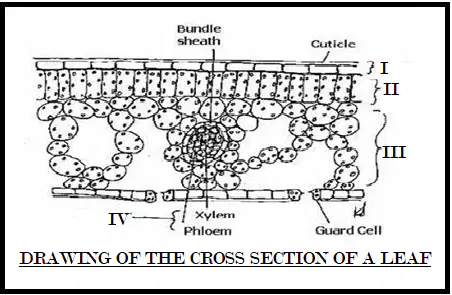
Which tissue contains the most chloroplasts?
Tissue I
Tissue II
Tissue III
Tissue IV
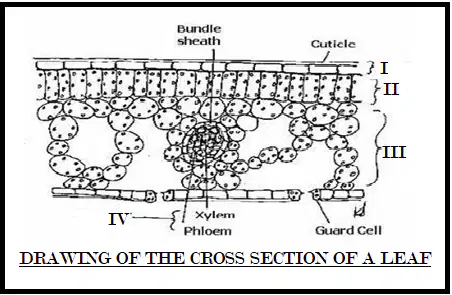
The function of tissue IV is to:
To trap sunlight for photosynthesis
Bring water to the leaf and take food away
Allow water vapor to escape
Allow for gaseous exchange
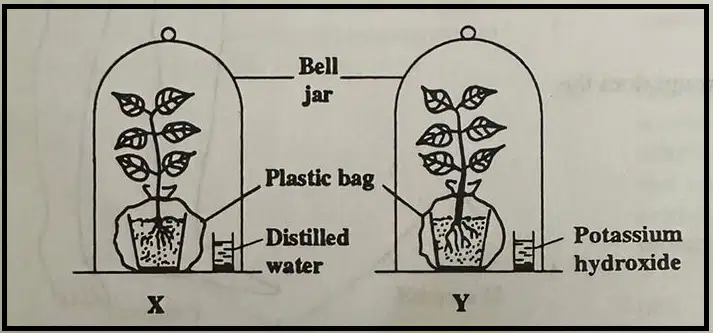
Before the experiment was set up, the plants were placed in a dark cupboard for about 24 hrs. This step was necessary to:
Reduce the quantity of sugar produced during photosynthesis
Allow the plant to get its store of carbon dioxide
Ensure that any starch produced was removed from the leaves i.e. to de-starch the plant
To stop further reduction of carbon dioxide to carbohydrate

The following pairs of statements relate to testing a leaf for starch. Which pair is NOT correctly matched?
Boil leaf in ethanol - Removes chlorophyll
Wash in water - Removes starch
Boil leaf in water - Kills the leaf
Test with iodine solution - Tests for starch
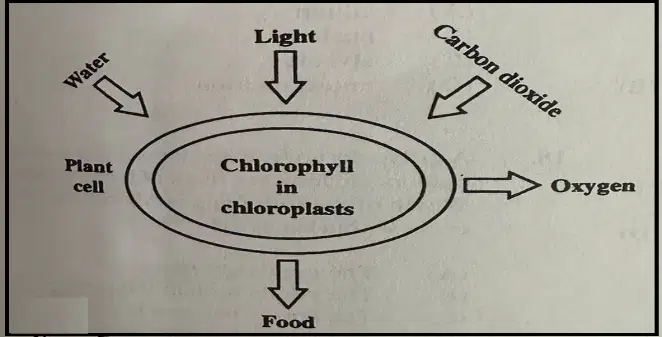
Where does the oxygen shown in the diagram comes from?
the atmosphere
chlorophyll
carbon dioxide
water
Which of the following is the correct equation for photosynthesis?
carbon dioxide + water---> glucose + oxygen
carbon dioxide + oxygen ---> water + glucose
carbon dioxide + water ----> oxygen + starch
oxygen + starch----->carbon dioxide+ water + energy
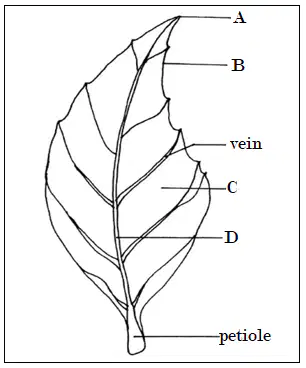
Which of the following correctly labels the parts of the leaf below?
A-apex, B-margin, C-lamina, D-midrib
A-apex, B-lamina, C-margin, D-midrib
A-apex, B-midrib, C-lamina, D-margin
A- tip, B-margin, C-midrib, D-lamina
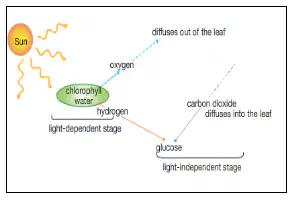
In which of the stages does carbon dioxide combine with hydrogen to form glucose?
light-dependent stage
the diffusion stage
light-independent stage
the energy stage
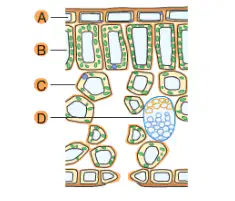
Which part of the diagram shown below contains the largest amount of chloroplasts?
option A
Option B
Option C
Option D
what is the purpose of chlorophyll during photosynthesis?
chlorophyll makes glucose
chlorophyll splits water into hydrogen and oxygen
chlorophyll joins hydrogen and carbon dioxide together
chlorophyll captures energy in sunlight
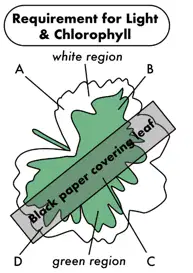
The variegated leaf in the picture above is from a plant which has been de-starched and then left in bright light for 24 hours. Which of the labelled region would test positive for starch?
Region A- the white region
Region B-the green region
Region C- the green region covered by black paper
Region D- the white region covered by black paper
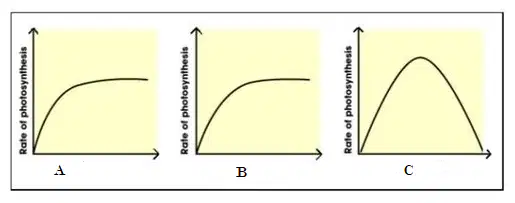
Which of the graphs below correctly shows the effects of temperature on the rate of photosynthesis?
Graph A
Graph B
Graph C
Graphs A and B
Which of the following correctly predicts what would happen if a plant is placed in soil that is lacking in magnesium and nitrogen?
The plants would have a lot of flowers and fruits becuause magnesium stunts the growth of flowers
the leaves would be pale yellow and the plant would have stunted growth because it cannot make chlorophyll to photosynthesize
the plant would have orange or red leaves
the plant would grow fast because magnesium in the soil stunts growth.
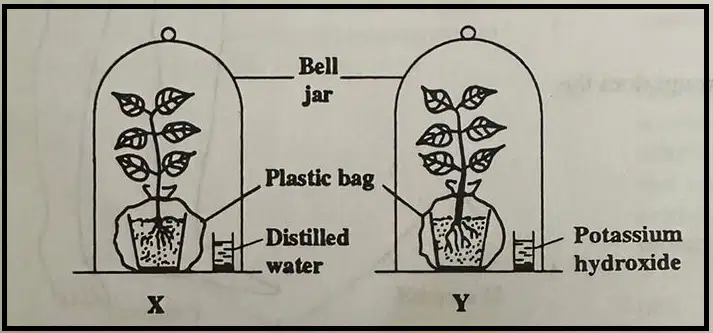
What is the aim of the experiment shown in the picture below?
to investigate the effects of potassium hydroxide on the growth of plants
to investigate the effects of water on the growth of plants
to investigate if carbon dioxide is necessary for photosynthesis
to investigate if oxygen was necessary for photosynthesis.

