
 Worksheets
Musculoskeletal System (NPTE Board Prep)
Total questions: 27
Worksheet time: 27mins
A K2 level ambulator with a unilateral transfemoral prosthesis is learning to ambulate up a steep incline (20 degrees). What technique is the MOST appropriate to navigate steep inclinations?
Lead with the prosthetic limb and ambulate with a reciprocal gait pattern
Lead with the contralateral limb and ambulate with a reciprocal gait pattern
Lead with the prosthetic limb and ambulate with a step-to gait pattern
Lead with the contralateral limb and ambulate with a step-to gait pattern
A physical therapist observes a patient complete hip abduction and adduction exercises in standing. Which axis of movement is utilized with these particular motions?
Frontal
Vertical
Anterior-posterior
Longitudinal
A patient is examined in physical therapy for complaints of right elbow pain. When asked to indicate the location of their pain, the patient points to both the anterior and lateral elbow.
The therapist decides to perform a special test to differentiate between lateral epicondylitis and distal biceps tendonitis. Which of the following special tests would be the MOST useful?
Cozen's test
Pinch grip test
Elbow flexion test
Bunnel-Littler test
A 21-year-old college gymnast reports pain on the posterior surface of the right calcaneus. Manual muscle test scores are 5/5 for all ankle musculature with pain on resisted plantarflexion. Passive range of motion are all within normal limits, with some pain on passive end range dorsiflexion. Palpation reveals tenderness along the insertion of the gastrocsoleus. Gait exam reveals an antalgic gait with pain at push-off. Which of the following is the MOST likely diagnosis?
Plantar fasciitis
Achilles tendinopathy
Calcaneal apophysitis
Heel spur
A 25-year-old long-distance runner came to the physical therapy clinic complaining of right heel pain. He reported that the pain often occurs at the start and toward the end of training. He reported that the pain is worse in the morning and after training. On examination, the physical therapist noticed that the patient has a low arch on the right foot compared to the left. Which of the following structures is most likely affected?
Plantar fascia
Spring ligament
Flexor retinaculum
Anterior talofibular ligament
A physical therapist is reviewing a patient's medical file before the initial examination. The x-ray report indicates a Hill-Sachs lesion at the right shoulder. This finding is associated with which of the following types of trauma?
Acromioclavicular joint separation
Avulsion of the supraspinatous
Glenohumeral dislocation
Humeral neck fracture

In the following photo, the examiner is resisting the patient's forward flexion of the shoulder. What special test is being performed?
Empty can test
Speed's test
Yergason's test
Neer's test
A physical therapist is performing a grade three mobilization to the distal femur in the posterior direction. Which of the following motions is the therapist trying to INCREASE?
Hip flexion
Knee flexion
Hip extension
Knee extension
A physical therapist is treating a patient with back pain and notices the patient has a limp. The therapist suspects that the leg lengths may be unequal. The physical therapist wants to assess the leg lengths for any anatomical discrepancies. Which of the following is the MOST accurate method to determine if there is a true leg-length discrepancy?
Perform a supine to long sit test and monitor how the malleoli line up
Tape measure from umbilicus to lateral malleolus
Tape measure from ASIS to medial malleolus
Tape measure from umbilicus to medial malleolus
A manual laborer reports elbow pain. During the examination, the physical therapist performs a moving valgus stress test, which is negative. Knowing that the moving valgus stress test has 100% sensitivity, which of the following is the MOST appropriate interpretation of the test findings?
Ulnar collateral ligament can now be ruled in as the source of the pain
Radial collateral ligament can now be ruled in as the source of the pain
Ulnar collateral ligament can now be ruled out as the source of the pain
Radial collateral ligament can now be ruled out as the source of the pain
A patient presents to an outpatient physical therapy clinic near a ski mountain with shoulder pain after a skiing-related fall the day before. The patient fell onto the shoulder with the arm adducted at his side. Palpation revealed tenderness at the acromioclavicular joint and no step-off from the clavicle to the acromion process. There is also pain at the end ranges of shoulder range of motion and with horizontal adduction. The BEST initial intervention is to:
begin pendulum exercises.
begin range of motion exercises.
provide a sling.
refer to the emergency department.
A patient reports difficulty in walking 6 weeks after undergoing right total hip arthroplasty (THA). Upon gait analysis, the physical therapist notices that the patient's left hip drops during weight-bearing on the right leg. The patient also notes that her hip muscles are easily fatigued upon prolonged walking. Based on this information, what would be the BEST intervention for the patient?
Wall squats with exercise ball at the back
Sidelying right hip abduction with ankle weights
Pelvic bridging with ball squeeze
Quadruped left hip extension with 90-degree knee flexion
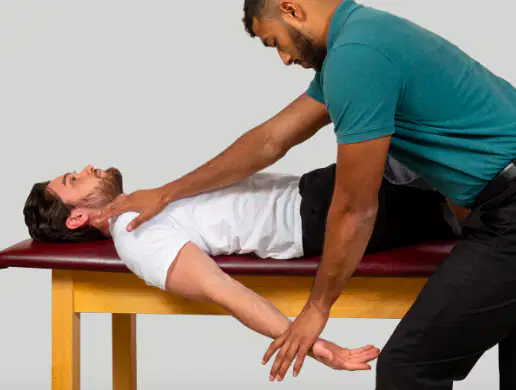
A physical therapist is assessing passive range of motion (PROM) of the right glenohumeral joint as shown in the picture. This picture was taken at the patient’s end range of motion. What is MOST likely limiting the range?
Passive tension in biceps
Limitation in the posterior capsule
Passive tension in triceps
Weakness of the posterior deltoid
A physical therapist is treating a patient 3 weeks after right ACL reconstruction and partial medial menisectomy. PROM is 0-130. The patient also has had some pain and swelling. Which of the following interventions is MOST appropriate for quadriceps strengthening?
Open chain quad sets at 20 degrees of knee flexion
Open chain quad sets at 60 degrees of knee flexion
Bilateral squats to 90 degrees only
Electric stimulation to the quadriceps to create a contraction 10 sec on 10 sec rest x 15 minutes
A physical therapist is examining a patient with shoulder pain. During shoulder elevation the therapist notes that the humeral head moves superiorly as the arm elevates. Which of the following options could be the reason for the movement of the humeral head in a superior direction?
Excessive mobility of the inferior portion of the glenohumeral capsule
Muscle imbalance with over-pull of the lower trapezius and under-pull of the upper trapezius
Weakness of the infraspinatous and teres minor
Weakness of the deltoid
A patient has deficits in thumb abduction due to capsular adhesions. Which mobilization is the MOST specific carpometacarpal joint technique to improve the patient’s range of motion?
Palmar glide of the first metacarpal on a stable trapezoid
Radial glide of the first metacarpal on a stable trapezium
Ulnar glide of the first metacarpal on a stable trapezoid
Dorsal glide of the first metacarpal on a stable trapezium
A high-level baseball catcher has been rehabilitating from a grade 2 ACL sprain over the past 6 weeks. Objective testing reveals minimal swelling, normal quadriceps activation, full pain-free active range of motion. Which of the following is the BEST intervention to progress this patient’s function?
Single leg stance on a foam surface
Squats with 10 lb dumbbells
Lateral resistance-band walks into hip abduction
Squatting on a BOSU ball with a weighted ball toss
A patient reports pain in their right knee that started after a football game in which another player collided into the medial side of the patient’s right knee. Which of the following techniques or procedures is MOST appropriate for identifying the underlying problem?
With the patient supine, the examiner applies a valgus directed force on the knee with knee in 20–30 degrees of flexion
With the patient supine, the examiner applies a varus directed force on the knee with knee in full extension
With the patient supine, the examiner flexes the patient’s knee to 90 degrees and applies pressure to lateral femoral epicondyle while knee is passively extended
With the patient prone with knee flexed to 90 degrees, the examiner medially and laterally rotates the tibia, combined with compression
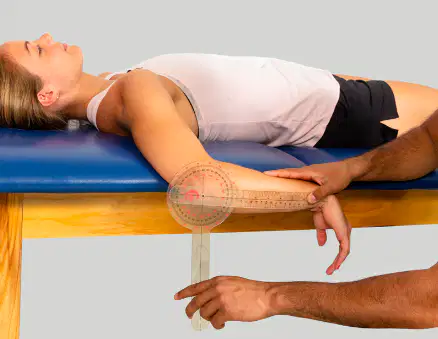
In this picture, a physical therapist is measuring passive range of motion (PROM) of right shoulder internal rotation with a goniometer. What is the MOST accurate interpretation of this picture?
This patient is hypermobile with excessive internal rotation PROM
Internal rotation PROM is within normal limits
This patient is hypomobile with insufficient internal rotation PROM
PROM is not being measured accurately
A patient stands with slight genu recurvatum on the right side. The therapist suspects a limitation in ankle mobility from an old fracture as the cause. Which of the following test results would confirm that suspicion?
Measure ankle dorsiflexion with the knee flexed and with the knee extended; if the range of motion is the same, this confirms the limitation is within the ankle joint
Measure ankle plantarflexion with the knee flexed and the knee extended; if the range of motion is the same, this confirms the limitation is within the ankle joint
Measure ankle dorsiflexion with the knee flexed and with the knee extended; if the range of motion is less when the knee is extended, this confirms the limitation is within the ankle joint.
Measure ankle plantarflexion with the knee flexed and the knee extended; if the range of motion is less when the knee is extended, this confirms the limitation is within the ankle joint
A patient is refered to physical therapy following reports of anterior shoulder pain and instability. The patient is a pitcher for his school's baseball team. Upon evaluation, the therapist finds that the patient's pain is present during the cocking phase of throwing. Which upper extremity special test will MOST likely be positive?
Apprehension and Relocation test
Hawkin's Kennedy test
Neer's test
Speed's test
A swimmer attends physical therapy for shoulder pain. The objective exam revealed passive ROM is WNL, and all resisted tests are weak and pain-free. There was also gross multidirectional hypermobility and a positive sulcus sign at the glenohumeral joint. Which intervention would BEST target the patient’s limitations on the first visit?
Standing internal and external rotation with theraband with shoulder in 90 degrees of abduction with emphasis on keeping the shoulder stable
Prone placing arms in the formation of a letter "T," then "W," then overhead to a "Y"
Perturbations in all directions on humerus in supine with arm rested on a towel
Planks with alternating upper and lower extremity lifts
A patient with right shoulder pain has a prominent inferior angle of the scapula upon observation. During active range of motion, that same scapula also demonstrates winging on return from elevation. Which of the following are the BEST interventions for the physical therapist to perform to help this patient's restrictions?
Manual pectoralis minor stretching; supine scapular punch/protraction with a 5 lb weight in the hand
Manual pectoralis minor stretching; seated rows with black therapy band
Manual pectoralis major stretching; prone horizontal rows with a 5 lb weight in the hand
Pectoralis major stretching with arms at 90/90 in a corner; prone push-up with a "plus" adding scapular protraction at end range
A physical therapist is examining a patient's feet. The therapist has the patient sit in a chair with both feet on the floor and measures the height of the navicular tuberosity from the floor. Both feet begin at 3 inches off the floor. The therapist then has the patient stand up and again measures the height of the navicular tuberosity from the floor. The navicular height does not change on the right. The navicular height is now .5 inches lower on the left. How should the therapist interpret this information?
The right foot is too mobile
The right foot is too rigid
The left foot is too mobile
The left foot is too rigid
An individual presents to the clinic with a history of repeated lateral ankle sprains. The most recent sprain was 3 weeks ago. During the examination, the physical therapist places the patient in prone position and places the foot in a position of subtalar neutral. The physical therapist is performing this test on the patient to:
determine if there is a bony abnormality in the foot.
assess if there is too much calcaneal inversion range of motion.
assess the height of the patient's longitudinal arch.
assess the flexibility of the gastrocnemius.
A patient with low back pain is being examined by a physical therapist. The therapist notices that each time the patient extends the right hip during gait the patient's back goes into a lordosis. The therapist suspects tight musculature. Which of the following tests would BEST identify the tight muscle(s)?
Thomas test and 90/90 test
FABER test and Thomas test
SLR and 90/90 test
Ely test and Thomas test
A patient reported hip pain after helping a friend move to a new house. The physical therapist notes tenderness in the area of the greater trochanter. Based on this information alone, besides the trochanteric bursa, which of the following structures could be the source of the pain?
gluteus medius, gluteus minimus, piriformis
piriformis, psoas major, iliacus
Biceps femoris, piriformis, obturator internus
Gluteus medius, gluteus minimus, quadratus lumborum

