
NEW
Font size
 Worksheets
Unit 3 Major Assessment physical science
Total questions: 24
Worksheet time: 18mins
What do all elements of the same atom have in common?
the same mass number
the same number of protons
Which statement is true about oxygen-17 and oxygen-18?
they are isotopes of oxygen
they have the same mass number
Which statement about the atomic nucleus is correct?
The nucleus is made of electrons and has a positive charge
The nucleus is made of protons and neutrons and has a positive charge
Moving from left to right across a row of the periodic table, which of the following values increases by exactly one from element to element?
atomic number
atomic mass unit
Which statement about subatomic particles is NOT true?
Unlike protons and electrons, neutrons have no charge
Protons and neutrons have the same charge
If E is the symbol for an element, which two of the following symbols represent isotopes of the same element?
I. 2011E
II. 2010E
III. 2110E
IV. 219E
I and II
II and III
Using the periodic table, determine the number of neutrons in 16O.
8
16
Isotopes of the same element have different
numbers of protons
numbers of neutrons
Atoms have no electric charge when they
have an equal number of electrons and protons
have an equal number of charged and non-charged particles
The sum of the protons and neutrons in an atom equals the
atomic number
mass number
Which subatomic particle has a negative charge?
neutron
electron
In which of the following sets is the symbol of the element, the number of protons, and the number of electrons given correctly?
Cs: 55 protons, 133 electrons
In: 49 protons, 49 electrons
How many protons, electrons, and neutrons does an atom with atomic number 50 and mass number 125 contain?
50 protons, 50 electrons, 75 neutrons
75 electrons, 50 protons, 50 neutrons
The number of protons in the nucleus; the periodic table is arranged by this
Valence Electrons
a
Atoms of the same element with different masses (different numbers of neutrons)
Isotopes
a
A region of space that contains electrons and may involved multiple energy levels
Atomic number
a
The sum of protons and neutrons; the mass of the nucleus of an atom
Mass Number
a
Located in the nucleus, this particle has a mass of 1 amu and no charge
Neutron
a
Located outside the nucleus, this particle has almost no mass and a negative charge
Electron
a
A positively charged ion (has more protons than electrons)
Cation
a
The electrons that occupy the outermost energy level of an atom
Valence Electrons
a
O (oxygen)
Valence electrons =
Wants to =
Resulting Charge =
Cation, Anion, or Isotope =
O (oxygen)
Valence electrons = 6
Wants to = gain electron
Resulting Charge = -2
Cation, Anion, or Isotope = Anion
O (oxygen)
Valence electrons = 1
Wants to = lose electron
Resulting Charge = +3
Cation, Anion, or Isotope = isotope
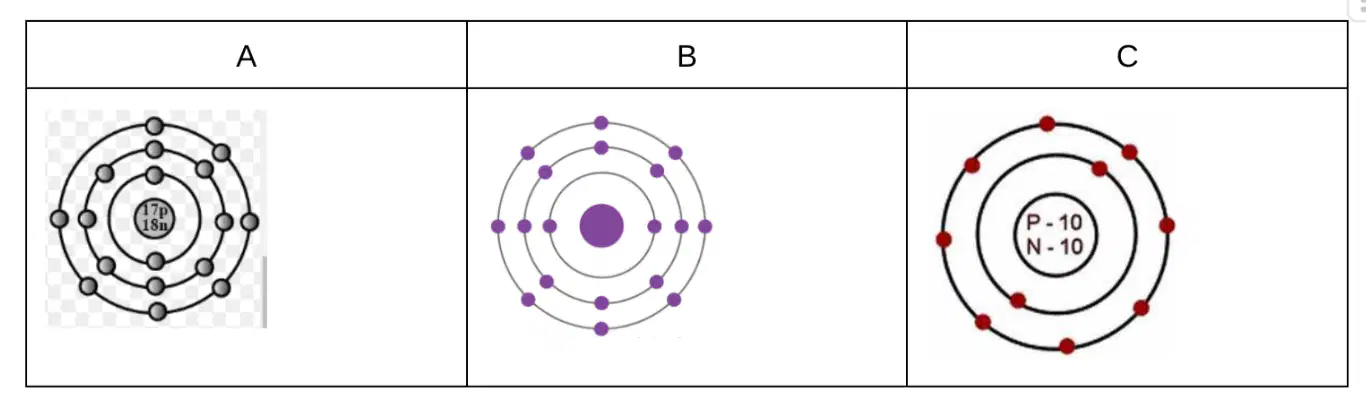
Which of the following accurately represents the Bohr Model for the ion that chlorine will most likely form?
A
B
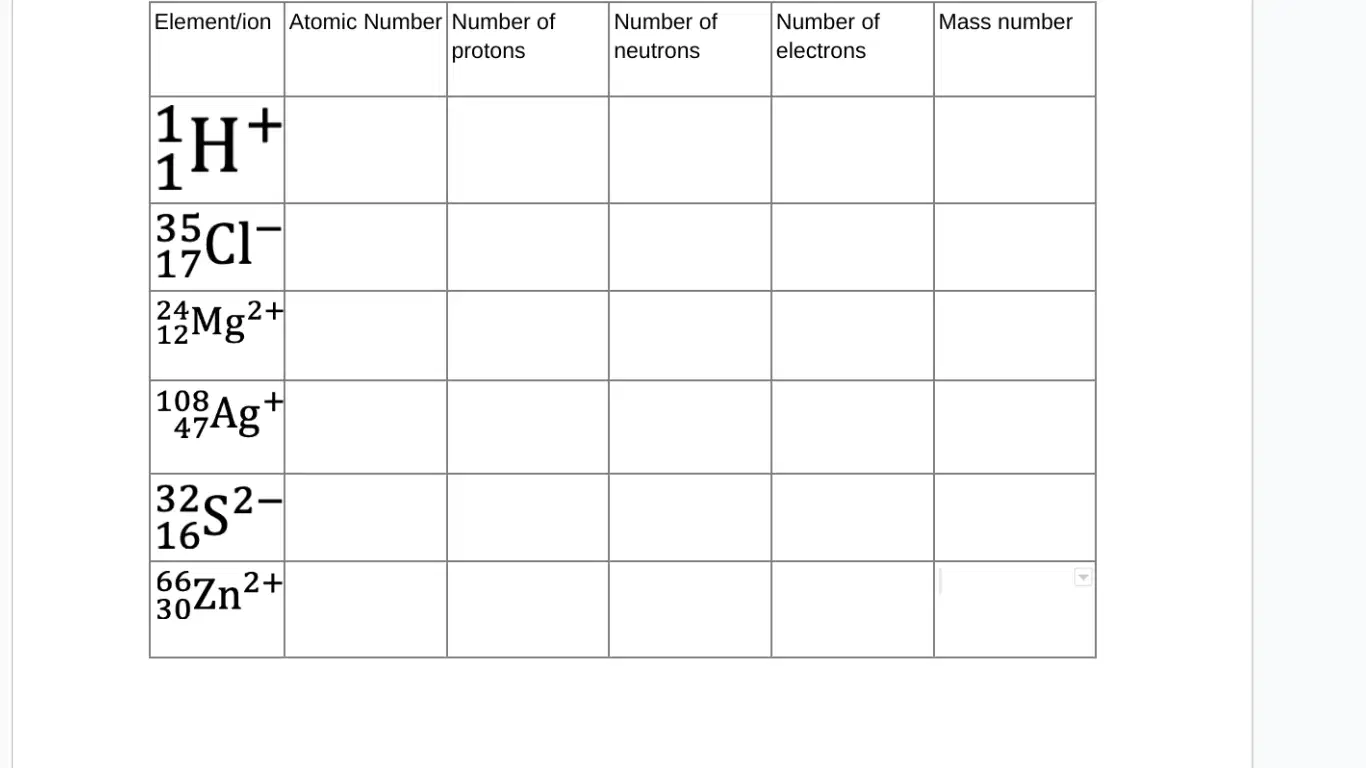

A
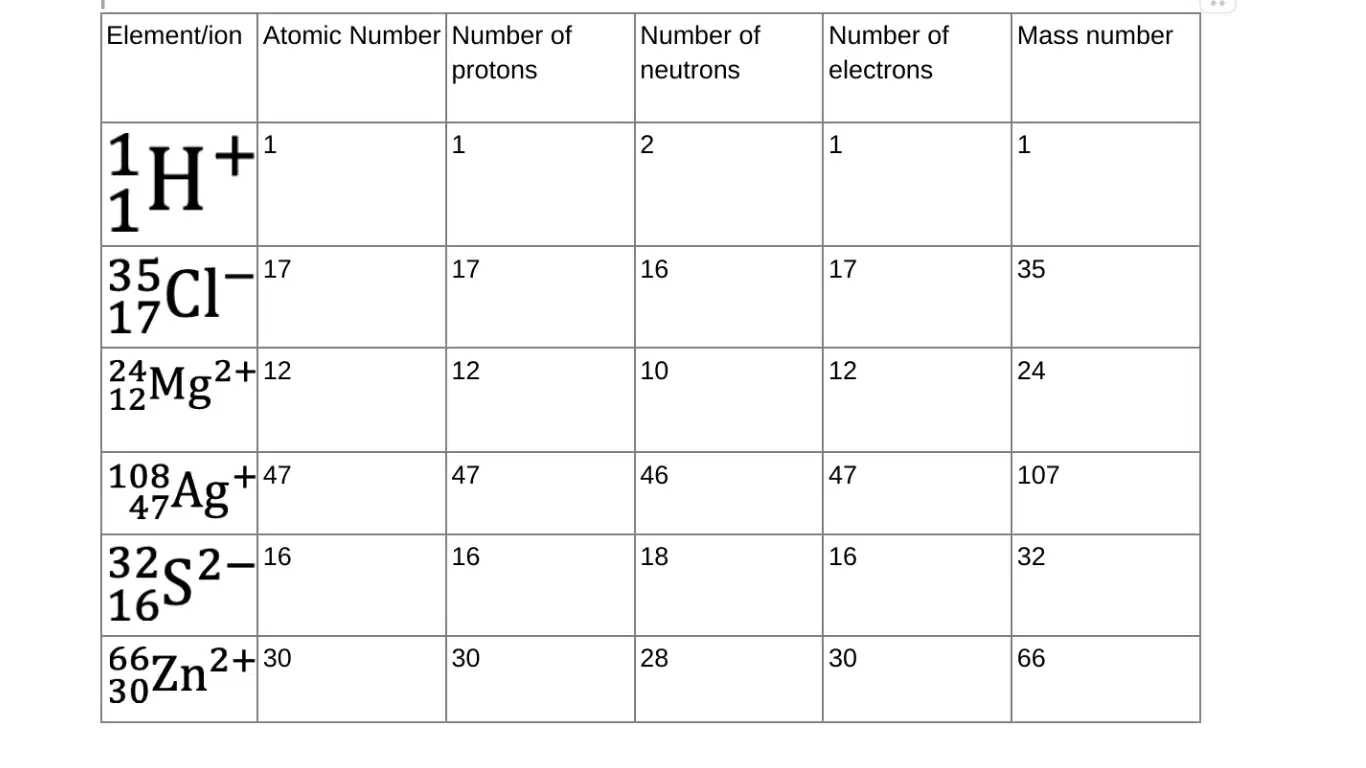
B

