
 Worksheets
Unit 3 New and Early US Government
Total questions: 38
Worksheet time: 19mins
Who was the President of the Constitutional Convention of 1787?
Alexander Hamilton
George Washington
James Madison
Thomas Jefferson
Which state did George Washington represent at the 1787 Convention?
New York
Virginia
Pennsylvania
Massachusetts
Who is known as the 'Father of the Constitution'?
Alexander Hamilton
George Washington
James Madison
Thomas Jefferson
What was the goal of the new Constitution?
To establish a monarchy
To limit the powers of the federal government to those written
To abolish state governments
To promote economic development
What was the Great Compromise?
A compromise between large and small states
A compromise between the North and South
A compromise between the federal government and the states
A compromise between the President and Congress
What did the Three-Fifths Compromise determine?
The representation of enslaved persons in government
The power of the federal government
The balance of power between large and small states
The separation of powers
What were the Federalists' reasons for supporting ratification?
To promote economic development and public improvements
To protect the rights of individuals and states
To establish a monarchy
To abolish state governments
What did the Federalists support?
A weak central government
The Constitution
The Articles of Confederation
The Bill of Rights
What did the Anti-Federalists want?
Stronger State Governments
The Constitution
Less Representation
Proportional Representation
Which document written by George Mason did the Anti-Federalists want included in the Constitution?
Virginia Declaration of Rights
Virginia Statute for Religious Freedom
United States Bill of Rights
Declaration of Independence
Who drafted the amendments that eventually became the United States Bill of Rights?
Alexander Hamilton
George Washington
James Madison
Thomas Jefferson
How many states were needed to ratify the Constitution?
5
9
13
50
When did all 13 states ratify the Constitution?
1787
1789
1791
1793
What are the first three words of the Constitution?
We the People
In God We Trust
Life, Liberty, Pursuit of Happiness
E Pluribus Unum
Which state did James Madison consult when drafting the amendments for the Bill of Rights?
New York
Virginia
Pennsylvania
Massachusetts
What did the Second Continental Congress create to manage the Revolutionary War?
The Constitution
The Articles of Confederation
The First Presidential Election
The Bill of Rights
What did several states require before signing the Constitution?
Protection of civil rights
Abolition of slavery
Establishment of a national bank
Expansion of the federal government
Which document served as the first government of the United States?
The Declaration of Independence
The Articles of Confederation
The Constitution
The Treaty of Paris
Why were former Continental Army officers advocating for a stronger central government?
To protect American settlers
To regulate trade
To receive their back pay and pensions
To organize the frontier
What upset the former soldiers of Shays' Rebellion?
Losing their farms to back taxes
Lack of military force
Unable to settle past the Appalachian Mountains
Not receiving fair pay
What was a major failure of the Articles of Confederation?
The national currency was not worth much
Each state had proportional votes
Congress put in to many taxes into law
7 small states could outvote 6 larger states
Which is NOT a failure of the Articles of Confederation?
Each state had only a single vote
Congress could not tax to raise money
Citizens ignored national laws
Outlawed slavery in the new lands
Which was NOT an achievement of the Articles of Confederation?
Citizens rebelled
Northwest Ordinance 1787
Treaty of Paris 1783
Protected freedoms in the new lands
Which had a stronger national government?
The Constitution
The Articles of Confederation
Which had success fighting the Revolutionary War?
The Constitution
The Articles of Confederation
Which became the supreme law of the land?
The Constitution
The Articles of Confederation
Which people supported the Federalists?
Which people supported the Anti-Federalists?
elite educated families
Anti-federalists believed in ...
decency of the common man
powerful central government
representative democracy
elite class was fit to govern
Anti-federalists believed in ....
participatory democracy
representative democracy
the Federalist Papers
large election districts
The Federalists believed in...
Elitism
individual rights
the common man
direct democracy
The Anti-Federalists voted to ratify the Constitution only if...
The Virginia Declaration of Rights was added
The Virginia Statute of Religious Freedom was added
Economic development was added
Protection for all individuals rights were added
What compromise was when the powers of the government was separated into three branches?
The Great Compromise
The Virginia Plan
The Three-Fifths Compromise
The Connecticut Plan
Which part of Congress has equal representation?
Which part of Congress is based upon state populations?
Who authored the Virginia Declaration of Rights?
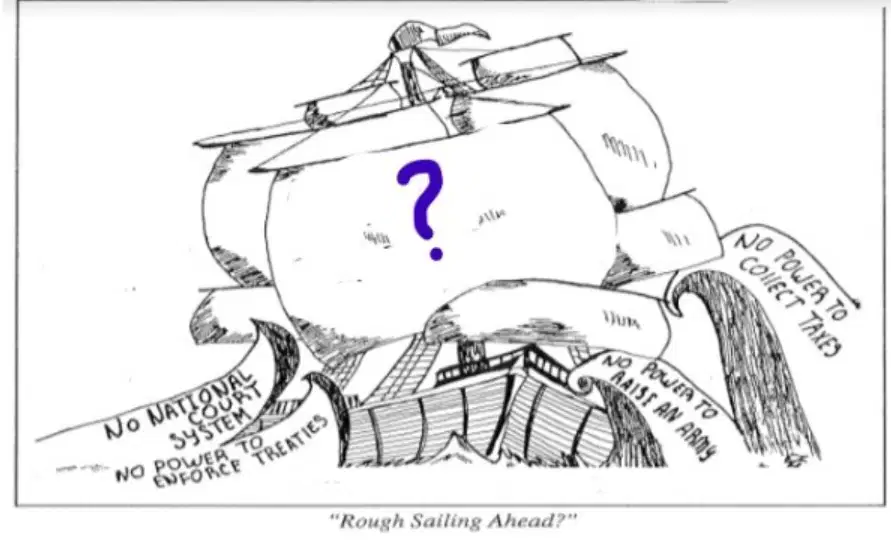
The cartoonist's message is that there will be "rough sailing ahead" because of the adoption of which of the following?
Declaration of Independence
The Mayflower Compact
The Articles of Confederation
The Constitution
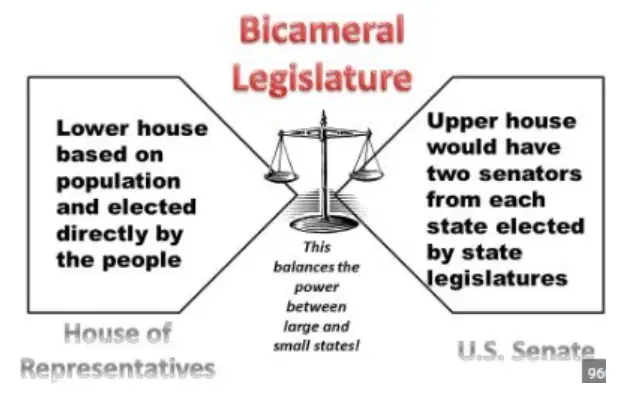
What was the name of the compromise that crated the U.S. bicameral legislative system during the Constitutional Convention?
The Great Compromise
The Crittenden Compromise
The Three-Fifths Compromise
The Executive Compromise

