
Font size
 Worksheets
After WWI
Total questions: 25
Worksheet time: 20mins

President Wilson's created the Fourteen Points because...
he wanted people to acknowledge that the US is a world power
he wanted to make sure Germany was treated harshly
he wanted to prevent future global conflicts
he wanted to stop immigration from Europe
Why did the US refused to ratify the Treaty of Versailles?
The Legislative Branch would not support the USA entering the League of Nations
The Legislative Branch thought the League of Nations was too expensive for the USA
The Executive Branch disliked the members of the League of nation
The Executive Branch would not support the USA entering the League of Nations
What was considered to be the biggest (and only success) of WWI?
The USA became the strongest nation on earth
Russia became more stable
The Self-Determination of Europeans borders
Germany repaid $33 Billion in reparations
Why did the U.S. not want to joinn the League of Nations?
Becuase Wilson did not agree to the terms of the treaty
Because Americans wanted to stay out of European issues
Because America was no longer allies with Europe
Because Wilson did not like how it was written
What is the name for a cease-fire?
Armistice
Veterans Day
Propaganda
Red Scare
Match the following points of Wilson's Fourteen Point Plan with Allied issues during WWI
Freedom of the Seas
The sinking of the merchant ships by German U-Boats
Creation of the League of Nations
The domino effect of nations joining the war
Open Diplomacy
The difficulties the US had remaining neutral
The League of Nations was
An international organization based on encouraging the acceptance of democracy in communist countries
An international organization based on assisting developing countries in need
An international organization based on protecting countries from communism
An international organization based on promoting peace between countries

Americans were isolationists and wanted to ...
join the island nations of the Pacific
avoid involvement in Japanese affairs
avoid involvement in European affairs
avoid getting in debt
Which of the following was not a nation formed after WWI?
Poland
Strong national boundaries strengthen national unity
People should be able to be governed by people of their same ethnicity

moving phalanx(s)


What years did World War I occur in Europe?
1861-1865
1941-1945
1914-1918
1965-1973

What is this political cartoon telling you about the world after WWI?
Pacific Ocean is a safe barrier between US and Europe
Atlantic Ocean will keep US safe from European conflict
Atlantic Ocean will cause conflict in Europe
Atlantic Ocean is no longer a safe barrier between US and European conflict
Which was NOT part of the Treaty of Versailles?
Alsace-Lorraine returned to France
Germany paid reparations.
Germany took full blame for WWI.
Germany was not allowed to trade.
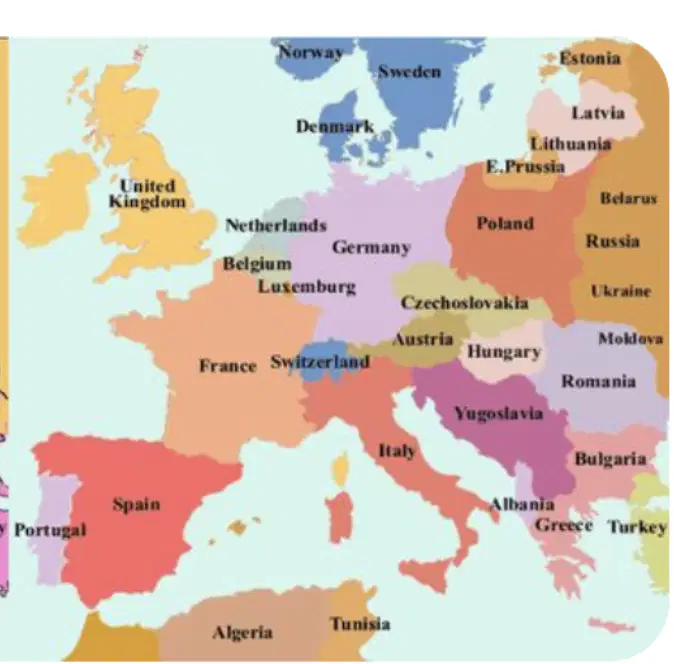
This map represents...
Europe before WWI
Europe after WWI
Wilson's Fourteen Points were successfully adopted at the Treaty of Versailles after WWI.
True
False

