
NEW
Font size
 Worksheets
Q1 BENCHMARK REVIEW SY24
Total questions: 56
Worksheet time: 37mins
Why might a scientist repeat an experiment if she/he didn't make a mistake in the first one? Experiments are repeated to
make sure she/he gets IDENTICAL results.
see if any portion can be skipped or ignored.
prove that your results were incorrect the first time.
check to see if the procedure was correct and nothing was left out.
A hurricane becomes more powerful by evaporating water from
lakes
mountains.
rivers.
oceans.
While at the beach, Sam and Sal recorded the temperatures on land and at sea. They discovered that each morning the ocean and land had a similar temperature. On a sunny day, the sun continues to warm both the ocean and land, but unequally. During the day, which direction will the wind MOST LIKELY blow?
The wind will not blow.
The wind will blow toward land.
It will vary throughout the day.
The wind will blow toward the ocean.
Energy is transferred in solids by conduction, which means that
heat travels in both directions.
heat travels from the cooler object to the hotter object.
heat travels from the hotter object to the cooler object.
heat does not travel between objects of different temperatures.

The main difference between weather and climate is the
time of year on Earth.
amount of time we consider.
where Earth is in its orbit.
amount of sunlight reaching Earth
The ozone layer is in the upper portion of this part of the earth's atmosphere.
ionosphere
mesosphere
stratosphere
troposphere

The Earth system is made up of many spheres. These spheres interact. Imagine humans, part of the biosphere, have built this dam. The water in the lake behind the dam seeps in the ground. Some of the water flows over the dam and is converted into energy. Some water evaporates into the air. What spheres does the water, or hydrosphere, interact with in this example?
geosphere and atmosphere
atmosphere and biosphere
cryosphere and atmosphere
aesthenosphere and cryosphere
Hurricane Katrina brought devastation, homelessness, illness, and even death to the residents of New Orleans. Meteorologists, have been working with the most advanced satellite weather technology to ensure that another "Katrina" situation will not happen anywhere in the United States.
What would be the MOST effective way to alert coastal residents that a hurricane was fast approaching?
newspapers
billboards and flyers
public broadcast media
scientific publications

A cold air mass that moves through the United States and reaches New York, Kansas, and even South Carolina is air that came from the
polar convection region.
arctic convection region.
Canadian convection region.
temperate convection region.
In any marine biome, the major interaction of Earth's spheres is the _________ with the _____________.
biosphere; atmosphere
cryosphere; biosphere
biosphere; hydrosphere
hydrosphere; geosphere
The number of variables being tested in a controlled experiment is _______________.
1
3
It depends on the experiment.
Unlimited
The independent variable in for "What type of dish detergent cleans more grease off of dishes"?
method of cleaning
amount of grease
same type of grease, same type of dish
type of dish detergent
This step to solve a problem must be completed first.
identify the problem
analyze data
hypothesis
research
A hypothesis must be
written as a question
supported
testable
first in the scientific method
Variable that is on the "x" axis.
control variable
dependent variable
independent variable
constant
The amount of matter an object contains.
volume
mass
compounds
meters

What is the outcome (DEPENDENT) variable?
plant height
time in days
sunflower
daisy
A student hypothesized that the amount of sunlight a sunflower plant receives determines the number of sunflower seeds the plant produces. In her experiment, the number of seeds produces is the______
Test (independent) variable
Outcome (dependent) Variable
Control Variable
Control group

Based on the data shown in the graph, which of the statements below mostly closely fits the data.
Students performed worse on test #2 than they did test #9
Students performed better on test#2 than they did on test#9
Students performed better on test#1 than they did on test#7
all of the above
Particles in a _____________ are tightly packed together and are locked in place to the particles around them.
solid
liquid
gas
plasma
Gas particles have the ________ kinetic (movement) energy because they move the fastest.
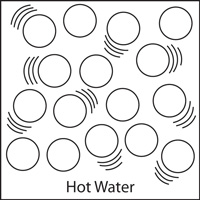
Why does the mirror in the bathroom fog up when you take a hot shower?
The water vapor gas from the shower touches the cold mirror, loses energy and condenses to becomes liquid water on the mirror.
The water vapor from the shower touches the cold mirror, gains energy and starts moving even faster.
Liquid that was behind the mirror moves to the front of the mirror.
The water vapor gas experiences sublimation when it touches the mirror.
Mr. S. sets up an experiment to see how the mass of a ball affects the distance it rolls, after if goes off a ramp. Identify the dependent variable.
Jason thinks that global climate change is not happening because a city in Northern Florida received snow one day in January.
Which statement explains what is wrong with Jason's reasoning?
Northern Florida would need to get snow for at least a week for this to be true.
Jason has confused the weather for one day with the climate of a region.
Jason does not realize that Southern Florida would also need to receive snow to make this true.
The climate of Northern Florida would be unaffected since it's already warm in Florida.

What is the jet stream?
Precipitation in Florida
Weather over a long period of time
Strong winds above the Earth's surface
Football flying over the Earth

Winds are caused by
equal heating
unequal heating

A narrow band of fast moving winds high in the atmosphere that move from west to east
Jet Stream
doldrums
equator
polar easterlies

Which best describes a characteristic of the jet stream?
It forms a boundary between a cold air mass and a warm air mass.
It creates the high winds around the eye of a hurricane.
It forces the hot air along the equator to rise to areas in North
America.
It causes high pressure air masses to rotate clockwise.

sea breezes

Water flowing in a continuous path through the ocean is called
the Coriolis Effect
an ocean highway
an ocean current
an ocean river

Heat transfer is really neat! It always goes from
hot to cold
cold to hot
top to bottom
bottom to top

When the air temperature over the land is warmer than the nearby ocean temperature, energy is transferred from the _____ to the _____.
water; air
water; sun
air; sun
air; water
Surface Ocean currents are primarily caused by
temperature and salinity
wind
convection
continental drift

The temperature in the troposphere _________ as altitude increases
decreases
increases
In what layer is the ozone layer found?
exosphere
stratosphere
mesosphere
troposphere
In what layer is most of the atmosphere's mass found?
troposphere
ionosphere
stratosphere
mesosphere
Where does weather occur?
mesosphere
stratosphere
troposphere
thermosphere
What is an important role of the Ozone Layer?
It protects the mesosphere from the Sun's harmful rays.
It protects the troposphere from the Sun's harmful rays.
It prevents floods, hurricanes, and other storms.
It prevents the thermosphere from becoming too warm.

According to this graph, which two layers are warmer at lower altitude and get steadily colder as altitude increases?
Troposphere and Mesosphere
Stratosphere and Thermosphere
Mesosphere and Thermosphere
Troposphere and Stratosphere
Which atmosphere layer protects living things from the Sun's UV radiation?
Troposphere
Mesosphere
Thermosphere
Stratosphere

The mixture of gases that surrounds Earth is the ______________.
atmosphere
stratosphere

