wayground logo

Free Printable Worksheets

Font size

S
M
L
XL
Worksheets

Quarter 1 Wrap Up

Total questions: 92

Worksheet time: 2hrs 17mins

Name
Class
Date
1.

Theme is

a)

where the story takes place

b)

characters talking

c)

life-lesson

d)

an educated guess

2.

The scared rock climber balanced precariously on the edge of the cliff.

a)

happily

b)

dangerously

c)

gracefully

d)

hopefully

3.

The lost campers sweltered in the heat of the desert sun.

a)

walked

b)

ran

c)

sweated

d)

hiked

4.

We often travel to New England in autumn to see the bright colors of the foliage.

a)

buildings

b)

trees

c)

mountains

d)

leaves

5.

The mood was somber at the funeral of the former president.

a)

serious

b)

fearful

c)

social

d)

lively

6.

The impudent boy was assigned a detention for his inappropriate behavior that occurred during the guest speaker's presentation.

a)

silly

b)

young

c)

rude

d)

unhappy

7.

Cold rain fell all day, making it a dismal Saturday afternoon.

a)

fun

b)

cloudy

c)

gloomy

d)

busy

8.

Conner's constant prevaricating caused most of his teachers not to believe him.

a)

lying

b)

crying

c)

being late

d)

talking

9.

The propitious weather report encouraged the families to go ahead with their picnic.

a)

upcoming

b)

uncertain

c)

current

d)

favorable

10.

Indirect Characterization is:

a)

When an author plainly tells you what a character is like.

b)

When an author uses a characters speech, thoughts, effect on others, actions, and looks to tell the reader what the character is like.

c)

None of these.

11.

The T in STEAL stands for:

a)

Talk

b)

Taste

c)

Thoughts

d)

Text

12.

The E in STEAL stands for:

a)

Effect on others.

b)

Everything the character says.

c)

Effect on self.

d)

Evidence

13.

What is a character trait?

a)

The character's name.

b)

Words used to describe different aspects of the character.

14.

Direct Characterization is:

a)

When the author uses the character's speech, thoughts, effect on others, actions, and looks to tell the reader what the character is like.

b)

When the author plainly states what the character is like.

c)

Neither of these.

15.

The S in STEAL stands for:

a)

Steady

b)

Solidarity

c)

Speech

d)

Synonym

16.

The A in STEAL stands for:

a)

Actions

b)

Adversaries

c)

Attention

d)

Activities

17.

TQEEQEE has how many sentences?

a)

5

b)

6

c)

7

d)

8

18.

Which one of these options gave the viewer the best indirect characterization of Miranda from The Devil Wears Prada?

a)

Looks

b)

Actions

c)

Effect on Others

d)

Speech

e)

Thoughts

19.

Which one of these options gave the viewer the best Indirect Characterization of Maui from Moana?

a)

Looks

b)

Thoughts

c)

Effect on Others

d)

Speech

e)

Actions

20.

Where and when a story takes place.

a)

climax

b)

setting

c)

characters

21.

All of the information the reader need to know

before the story begins. Who are the characters?

What is the problem? What is the setting?

a)

characters

b)

plot

c)

exposition

22.

All of the events in the story leading up to the

climax. The tension in the story is building.

a)

falling action

b)

rising action

c)

exposition

23.

The turning point in the story. The tension is

at its highest point in the story.

a)

conflict

b)

climax

c)

falling action

24.

All of the events after the climax. The tension

of the story comes down.

a)

conflict

b)

falling action

c)

rising action

25.

How is the problem/conflict in the story

solved?

a)

resolution

b)

exposition

c)

conflict

26.

The problem in the story.

a)

conflict

b)

climax

c)

exposition

27.

People or animals that are in the story.

a)

setting

b)

characters

c)

resolution

28.

What is number 1 on the plot diagram?

a)

resolution

b)

falling action

c)

exposition

29.

What is number 2 on the plot diagram?

a)

conflict

b)

falling action

c)

climax

30.

What is number 3 on the plot diagram?

a)

conflict

b)

falling action

c)

rising action

31.

What is number 4 on the plot diagram?

a)

conflict

b)

climax

c)

resolution

32.

What is number 5 on the plot diagram?

a)

rising action

b)

climax

c)

falling action

33.

What is number 6 on the plot diagram?

a)

exposition

b)

resolution

c)

falling action

34.

Conversation between two or more characters in a story.

a)

dialogue

b)

setting

c)

exposition

35.
Before the 1800's people didn't have right or left shoes.  They had shoes of just one shape that they used for both feet.  When people first saw right and left shoes, they laughed.  They called them "crooked shoes."  "What a silly idea," they said.  You can tell that shoes before 1800:
a)
were pretty
b)
didn't look alike
c)
didn't fit very well
36.
Tim looked out the window. The house looked so lonely. Tim's father put the last suitcase in the trunk and started up the car. Thor, his dog, put his head on Tim's lap, like he understood how  Tim was feeling. "It's okay Thor," he said, "Dad says we will like California." What is happening?
a)
Tim is sad because his dog doesn't have a house to live in.
b)
Tim is taking a trip to visit peolpe he doesn't know.
c)
Tim is taking Thor to live with his grandmother.
d)
Tim is moving to California with his family.
37.
Joseph and Caitlin were choosing the players for their teams. It was Caitlin's turn to choose, and only Jason was left. Caitlin said, "Jason."

We can infer that…
a)
Jason was the best player.
b)
Caitlin wanted Jason on her team.
c)
Jason was not a very good player.
d)
Caitlin had a hard time choosing a team member.
38.
Many breeds of dogs are used for work. In many cultures dogs are used to herd sheep. The dogs keep the flock from being attacked by animals such as wolves. They also keep sheep from wandering off. Sheepdogs are known for their loyalty and gentleness. Based on your reading of the text, you can INFER that:
a)
Sheepdogs are not very smart dogs.
b)
Sheepdogs are gentle and loyal.
c)
There are many breeds of dogs.
d)
Wolves are afraid of sheepdogs.
39.
As I walked in the door, I was amazed at the beautiful colors and smells. I knew it would be hard to decide what I would buy with my $3. The chocolate truffles looked delicious, but they were expensive. The jelly beans were not only cheaper, but so colorful! With so much to choose from, I knew I would be here a long time. Where am I?
a)
Gas station
b)
Candy store
c)
Grocery store
d)
Shoe store
40.
Mike had fun hiking in the woods and doing crafts.  He also really enjoyed the campfire sing-a-long and had made a lot of new friends. Still, he was glad that tomorrow he would be going home.
Where is Mike?
a)
at camp
b)
at a slumber party
c)
on a picnic
d)
in California 
41.
Everett held his father's hand as hecrossed the busy parking lot. They walkedinto a grocery store. Everett's dad lifted himinto the seat of the shopping cart. “Here,”said dad, “You can hold my shopping list.”
You can infer that
a)
Everett had never been to a grocery store
b)
Everett's dad does not shop often
c)
Everett's  dad needs help with shopping. 
d)
Everett is very young
42.
Splat! " Oh, rats!" thought Katie as she stooped to clean up the mess. "I hope we have another one. " She looked in the fridge and pulled out the carton. One Left! Breakfast wasn't ruined after all. What did Katie clean up? (provide text evidence to support your answer choice on your white board)
a)
Milk
b)
Juice
c)
Jelly
d)
Eggs
43.
The scout leader looked at the sky and muttered something under his breath. Then he looked at the map. "Let's get moving." He called to the group of tired boys. "The faster the better." Why do you think the scout leader started rushing the boys? (provide text evidence to support your answer choice on your white board)
a)
They were going to be late for dinner
b)
They were going to miss their ride that was waiting for them
c)
It was about to rain
d)
The sun was about to cause it to be too hot for them to stay out much longer
44.
It was 8:30 on Thursday night. Emily stared at the large, empty poster board on her bed. Then she looked at the stack of books about Abraham Lincoln on her desk. Emily began to cry. Why do you think Emily was crying? (provide text evidence to support your answer choice on your white board)
a)
She wanted a different color poster
b)
It was late and she had a lot of schoolwork to complete before she could end her night
c)
She did not want to go to sleep
d)
She wanted a book about George Washington instead
45.
"Ouch!" Lucy had fallen again! she shivered and picked herself back up. Then she spotted her older sister Sarah, gliding backwards. She was so graceful. Sarah made everything look so easy. What is Lucy doing? (provide text evidence to support your answer choice on your white board)
a)
Back flips
b)
Riding a bike
c)
Running
d)
Skating
46.
Ana and Sophie sat in their chairs staring straight ahead for nearly two hours. They did not talk or hardly even move, but they were not bored at all. Where were Ana and Sophie? (provide text evidence to support your answer choice on your white board)
a)
At the movies
b)
In class
c)
At church
d)
At a football game
47.
For the walls, Jenny thought she would use a bright yellow paint. She would pick a border that had mostly bright red and green colors, and maybe a little bit of blue. She already had found some curtains that were sky blue with streaks of red, blue and yellow that she thought would go great with the walls. And finally, she had picked a carpet that was mostly blue with specks of red and yellow. Jenny couldn't wait till she was done decorating her room. It was really going to look awesome.
 The Summary of this passage is:
a)
Jenny likes bright colors.
b)
Jenny was going to paint her room.
c)
Jenny was picking out colors and materials to decorate her room.
d)
Yellow is a good color to paint your walls.
48.
Right now Jason was playing right field. He really wanted to play third base. Earlier this year, coach had put him in left field and second base in a game, but never at third base. Once in practice, coach let him play third base, but he kept missing ground balls. When he did stop one, he made a bad throw to first base. Maybe if he kept practicing, Jason would be good enough to play third base. That was his dream.
The Summary of this passage is:
a)
Jason really wanted to play third base.
b)
Jason was the best player on his team.
c)
Jason had trouble catching ground balls.
d)
Jason was too lazy to practice.
49.
Rachel was on her way to volunteer at the animal shelter.  She was very excited!  She really liked dogs.  Her brother was allergic to dogs, however, so she was rarely around them.  Rachel had a lot of fun playing with the puppies.  But after her shift, itchy bumps appeared on her arms.
It is likely that:
a)
Mosquitoes bit Rachel
b)
Rachel is allergic to dogs, too
c)
Rachel fell in poison ivy
50.
Which of the following has a negative connotation?
a)
A pushy leader
b)
A charismatic leader
51.
Which of the following has a positive connotation?
a)
An aggressive stance
b)
A hostile stance 
52.
Which word has the more positive connotation?
a)
laid-back
b)
lazy 
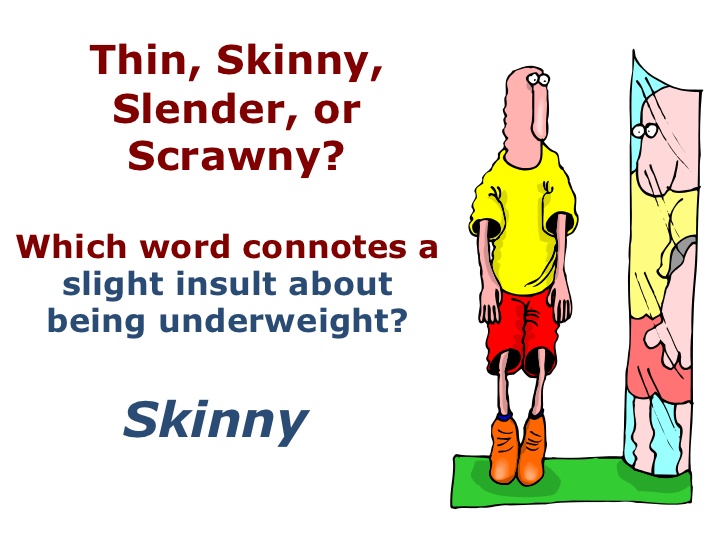
53.
Which word has the more positive connotation?
a)
Bean-pole
b)
Slender 
54.
Which word has the more positive connotation?
a)
Horse
b)
Steed 
55.

Which phrase has negative connotation?

a)

a box filled with documents

b)

a box crammed with documents

56.

Which phrase has a more positive connotation?

a)

a peculiar object

b)

a unique object

c)

a strange object

57.

Which phrase has a more negative connotation?

a)

frown at someone

b)

scowl at someone

58.

Choose the word that best completes the sentence. Hint: Determine the connotation (positive or negative) through context clues.


My friend is very careful about spending money. I admire that, so I call him ______________.

a)

thrifty

b)

stingy

c)

miserly

d)

selfish

59.

Choose the word that best completes the sentence. Hint: Determine the connotation (positive or negative) through context clues.


Although the problem was difficult to resolve, Sandra and John were ________________ in searching for an answer. Their teacher was quite proud.

a)

persistent

b)

stubborn

c)

bullheaded

d)

headstrong

60.
Kevin's interest in model cars has turned into a hobby. If you change the word hobby to obsession, the word now has a _____ connotation.
a)
positive
b)
negative
61.
Which is the most positive?
a)
mature
b)
serious
c)
sophisticated
d)
contemplating
62.
What word is more negative?
a)
Confident
b)
Egotistical
c)
Prideful
d)
Secure
63.
What is the best word to use for this sentence to make it negative?
He is very ______.
a)
Truthful
b)
Honest
c)
Blunt
64.
What is connotation?
a)
Connotation implies or suggests a meaning of a word.
b)
Dictionary meaning of a word.
c)
I don't know!
d)
Unknown meaning
65.

smart

a)

positive meaning (+)

b)

negative meaning (-)

c)

neutral meaning (=)

66.

cunning

a)

positive meaning (+)

b)

negative meaning (-)

c)

neutral meaning (=)

67.

struggle

a)

positive meaning (+)

b)

negative meaning (-)

c)

neutral meaning (=)

68.

ample

a)

positive meaning (+)

b)

negative meaning (-)

c)

neutral meaning (=)

69.

abundant

a)

positive meaning (+)

b)

negative meaning (-)

c)

neutral meaning (=)

70.

As I grazed in the field, I realized that there were not any other animals around. I had a weird feeling that something was wrong. The other animals that are usually making noises are all silent. I see a shadow up in a tree. I think that is is unsafe here, so I am going to run away.


From what point of view is the passage written?

a)

First person

b)

Second person

c)

Third person

71.

As I grazed in the field, I realized that there were not any other animals around. I had a weird feeling that something was wrong. The other animals that are usually making noises are all silent. The rustling from my hooves are the only sound. I see a shadow up in a tree. I feel afraid and uneasy. I think that is is unsafe here, so I am going to run away.


From what/whose perspective is the passage written?

a)

A hunter

b)

An animal looking for friends

c)

An animal being hunted

72.

What is the advantage to first person point of view?

a)

You learn the thoughts and feeling about muliple characters.

b)

You learn about the narrator deeply because we get an insight into their perspective.

c)

There isn't an advantage. We don't get any new information.

73.

I wonder who invented putting water into plastic bottles? Water bottles are disposable which means that they can be thrown away. Landfills are overflowing with garbage because people are too lazy to fill a reusable cup with water. Recycling has been set up, but many people do not recycle all of the water bottles that they use. The earth is being polluted with all the used water bottles.


What is the author's perspective?

a)

People should not drink out of water bottles beacuse they are disposable.

b)

People should drink out of water bottles becuase disposable things are good.

c)

People should never drink water.

74.
First person point of view is when the author writes a text and has the narrator talking about
a)
someone else
b)
themselves
c)
nobody
d)
the author
75.
the author is
a)
the speaker
b)
the person who wrote the story
c)
the person who told the story
d)
a flat character
76.
the narrator is the
a)
person telling the story
b)
the simile
c)
person who wrote the story
d)
a flat character
77.
Third person point of view is when the narrator is talking about
a)
someone else
b)
themselves
c)
the speaker
d)
nobody
78.
A type of narrative perspective in which the  author uses pronouns like ''your" and "you" to address the reader
a)
Second Person
b)
Third Person Limited
c)
First Person
d)
Third Person Omniscient
79.
What POV is this passage?
As I stepped onto the shiny porch of my new house, I thought to myself,"This is gonna be a good day."
a)
Second Person
b)
First Person
c)
Third Person
d)
Third Person Omniscient
80.

In which POV do you see" I, me, and my" used to convey the story?

a)

1st person

b)

2nd person

c)

3rd person objective

d)

3rd person omniscient

81.

In which POV do you see "you and your" used to convey the story?

a)

1st person

b)

2nd person

c)

3rd person limited

d)

3rd person objective

82.

"Spring Break is a fun time of year. We gather with our family and eat delicious food. It is usually warm and my cousins and I play tag and swim! I look forward to it every year!"

The author's point of view in this passage is ..

a)

positive feeling about spring break

b)

negative feeling about spring break

c)

has no opinion about spring break

d)

doesn't care about spring break

83.

"Recess is a great thing to have at school! It gives students a break where they can move around. They are able to eat a snack and breathe fresh air. Maybe a longer recess should be considered!"

The author's view point about recess is that...

a)

recess is good for children

b)

recess is boring

c)

we should not have recess

d)

recess is a bad idea

84.
She ran as fast as she could up the hill. Although she was hot and exhausted, she knew if she kept her pace, she would win the race. 
a)
1st person POV
b)
2nd person POV
c)
3rd person POV
85.
Ms. Arellano ran up the steep hill as fast as she could. Nothing could stop her as long as she kept her pace.
a)
2nd person POV
b)
3rd person POV
c)
1st person POV
86.
She liked ice cream, but he liked cake. So they bought both.
a)
3rd person POV
b)
1st person POV
c)
2nd person POV
87.
What point of view uses the word 
he?
a)
1st person POV
b)
2nd person POV
c)
3rd person POV
88.
They are a loquacious bunch but they are also kind and sweet. The class has gotten to know each other so well this school year. They are like family. 
a)
2nd person POV
b)
3rd person POV
c)
1st person POV
89.
Which point of view is the following:
"There is one mirror in my house. It is behind a sliding panel in the hallway upstairs. Our faction allows me to stand in front of it on the second day of every third month, the day my mother cuts my hair."
from Divergent by Veronica Roth

a)
second
b)
first
c)
third person
90.
Why do we have textual evidence 
a)
To prove a claim
b)
unicorn
c)
because your teacher says so
d)
to express an opinion
91.
Where do you site the page number
a)
A paragraph away from textual  evidence
b)
Before textual evidence
c)
In the middle of the textual evidence 
d)
After the text 
92.
Do you put quotations around textual evidence
a)
True
b)
False