
 Worksheets
Week 8 TEST - PE, KE, Energy Transformations
Total questions: 18
Worksheet time: 2hrs 30mins

Roller coasters are popular attractions at amusement parks. A cart on a roller coaster approaches the highest point on the coaster. As the cart reaches the top, it slows down.
Which statement best describes the energy of the roller coaster as it slows down while traveling to the top of the coaster?
The cart gains both kinetic and potential energy.
The cart gains kinetic energy and loses potential energy.
The cart loses kinetic energy and gains potential energy.
The cart loses both kinetic and potential energy.

In the classroom demonstration shown below, a rubber ball is dropped from Position 1. The ball bounces as shown.
At which of these positions does the ball have both the greatest potential energy and the least kinetic energy?
Position 1
Position 2
Position 3
Position 4

A bicycle rider is traveling up a hill. When the rider reaches the top of the hill, she stops to rest. Then she travels down the hill. The diagram shows the rider in the three different positions.
When the rider is at the top of the hill, her potential energy is the greatest, and her kinetic energy is the least.
As the rider moves up the hill, her kinetic energy increases, and her potential energy decreases.
When the rider goes down the hill, her potential energy increases, and her kinetic energy decreases.
As the rider reaches the bottom of the hill, her kinetic energy and her potential energy decrease.
A marble is given potential energy by being placed at Location W. When the marble is released, it rolls down the track.
At which location does the marble have maximum kinetic energy? Select the correct location on the image.
Which type of energy best describes the motion of a ball rolling down a hill?
Potential
Kinetic
Latent
Mechanical

Energy changes occur when water in a pot is heated on a stove burner.
Which of the following statements describe the energy transformations?
Chemical energy in the natural gas is transformed into thermal energy which heats the water.
Electrical energy in the natural gas is transformed into thermal energy which heats the water.
Light energy in the natural gas is transformed into chemical energy which warms the water.
Thermal energy in the natural gas is transformed into chemical energy which warms the water.

The diagram shows how a cylinder in a car engine causes the car to move.
Which description of the energy conversions in this process is correct?
The chemical energy in the fuel-air mixture is converted to thermal energy, which is then converted to mechanical energy.
The mechanical energy in the fuel-air mixture is converted to electrical energy, which is then converted to thermal energy.
The electrical energy in the fuel-air mixture is converted to mechanical energy, which is then converted to thermal energy.
The thermal energy in the fuel-air mixture is converted to electrical energy, which is then converted to mechanical energy.
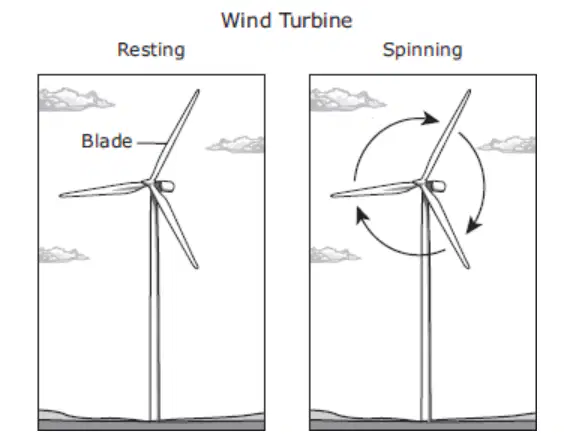
The blades of a wind turbine are at rest until the movement of air causes the blades to spin.
Which energy transformation happens when the blades are spinning as shown?
Electrical to mechanical
Chemical to electrical
Mechanical to electrical
Chemical to mechanical

The main parts of a working clothes dryer are shown in the diagram.
This appliance dries clothes primarily by converting —
electrical energy to heat and mechanical energy
mechanical energy to heat and electrical energy
electrical energy to heat and light
mechanical energy to heat and vaporization
When a lion eats a zebra and then uses the energy from the zebra to run, the lion’s body converts —
chemical energy to mechanical energy
electrical energy to chemical energy
chemical energy to light energy
mechanical energy to chemical energy

A demonstration helps students understand a principle of roller coaster design.
Which answer choice correctly describes the ball’s kinetic and potential energy?
The ball has more potential energy at position X than at position Z.
The ball has more kinetic energy at position Y than at position W.
The potential energy and kinetic energy of the ball are equal at position X.
The potential energy and kinetic energy of the ball are greatest at position Z.

At which position(s) does the pendulum have the greatest kinetic energy?
3
2 and 4
there is no kinetic energy
1 and 5
The Law of Conservation of Energy states -


Students build a circuit that has wires that connects a battery to a switch and a fan.
Which energy transformations happen when the students close the circuit and the blades of the fan begin to spin?
Chemical to mechanical to electrical
Electrical to chemical to mechanical
Chemical to electrical to mechanical
Mechanical to electrical to chemical

The diagram shows a complete circuit with a battery and a buzzer making noise. This circuit works by transforming -
chemical energy to electrical to sound.
electrical energy to thermal to light.
sound energy to electrical to chemical.
mechanical energy to electrical to sound.

