
NEW
Font size
 Worksheets
6th Force and Motion
Total questions: 24
Worksheet time: 24mins
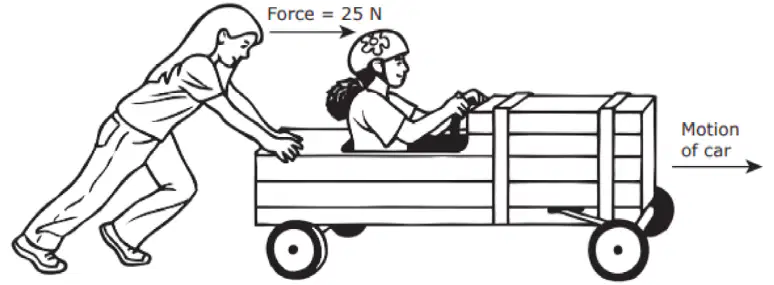
The diagram shows a homemade car being pushed with a force of 25 N
The force causes the car to move at a constant speed of 3 m/s.
What will happen if the force on the homemade car is changed to 35 N?
The car will move backwards.
The speed of the car will not change.
The speed of the car will increase.
The speed of the car will decrease.
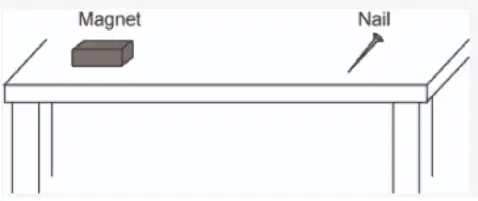
The picture below shows a nail made of magnetic metals that is placed near a magnet.
What will happen to the nail if the magnet is moved closer to it?
The nail will move away from the magnet due to the pushing force by the magnet.
The nail will move toward the magnet due to a pulling force by the magnet.
The nail will stay in its same position because gravity is pushing up on it.
The nail will rise upward due to the force of air resistance.
Which property of an object cannot be changed without changing that object's gravitational force on other objects?
Color
Hardness
Mass
Volume
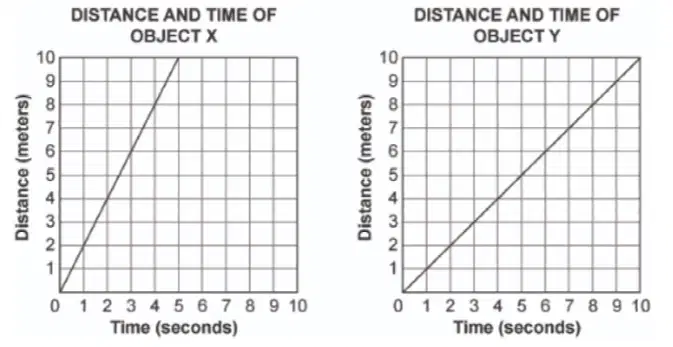
The graphs below show the distance and time traveled by Object X and Object Y.
Which statement is correct about the two objects?
Neither object is traveling at a constant speed, and Object X is traveling at a slower speed than Object Y.
Objects X and Y are traveling at the same speed.
Both are traveling at a constant speed, but Object X is traveling at a
faster speed than Object Y.
Objects X and Y are speeding up over time.
Which of the following is the best explanation of something in the natural world that is currently considered true and has been studied and supported by a large group of scientists?
Scientific law
Scientific fact
Scientific theory
Scientific hypothesis
Two objects have a certain gravitational force between them.
What would happen if the mass of one of the objects suddenly increased?
The mass of the other object would increase.
The distance between the objects would increase.
The gravitational force of the objects would remain constant.
The gravitational force between the objects would increase.
There are many types of forces.
Which statement best compares an electrical force to a gravitational force?
Electrical forces hold small objects near each other and gravitational forces hold large objects near each other.
Electrical forces depend on the type of charge and gravitational forces depend on the mass of the objects and how far apart they are.
Electrical forces are attractions between similar types of charges and gravitational forces are attractions between similar sizes of objects.
Electrical forces require that the objects are in contact with each other and gravitational forces require that the objects are far from each other.
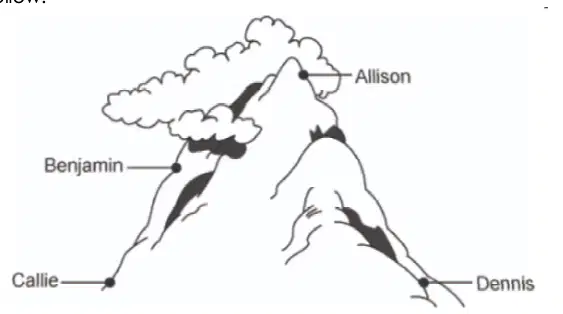
The picture shows four friends climbing a mountain. Use the picture to answer any questions that follow.
If all four friends weigh the same amount, which person feels the least pull of gravity from Earth?
Allison
Dennis
Benjamin
Callie
The acceleration of a falling object does not depend on its mass. How does the mass of an object affect the force of gravity experienced by the object?
The force of gravity increases as its mass increases
The force of gravity decreases as its mass decreases
The force of gravity is the same for all objects because acceleration is the same.
The force of gravity is the same for all objects because the force is determined by Earth's mass
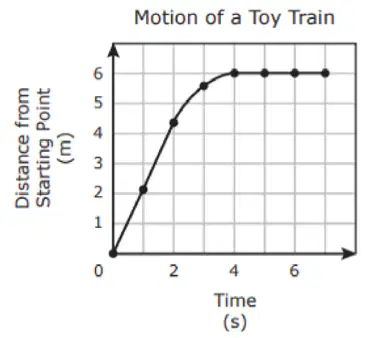
A hobbyist collected data about the motion of a toy train on a straight track and then recorded the data in the graph below.
Which of these accurately describes the motion of the toy train?
The toy train speeds up while going forward and then slows down.
The toy train slows down while going forward and then moves backward.
The toy train moves forward at a constant speed, slows down, and then stops.
The toy train moves forward at an increasing speed, stops, and then
moves forward.
A researcher wanted to compare tire friction on a variety of surfaces. This researcher carefully recorded all procedures and observations used in the investigation. Why should the researcher perform this investigation several times?
to compare different methods
to compare different car models
to determine whether the results can be replicated
to determine whether all tires produce the same amount of friction
Paul designed an experiment to measure the effect of toy car mass on the speed it would travel down a ramp. He predicted that if a car has more mass, then it will travel at a faster speed. He sent toy cars of different masses down the same ramp and measured the speed they traveled.
What did Paul's experiment test?
an observation
a constant
a conclusion
a hypothesis

A cart is moving on a straight track. Dylan studied the effects of velocity and acceleration of this cart during four trials, shown.
Which trial shows a cart with negative acceleration?
1
2
3
4
Every force can be represented as a vector. A vector has two aspects.
Which of the following pairs describes a force?
rate and time
rate and size
size and direction
motion and direction
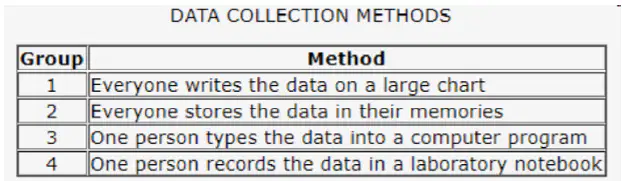
Four groups of students measure a toy car's velocity on different surfaces. They record their data in different ways, as shown in the table shown.
Which group is recording their data in the LEAST reliable way?
Group 1
Group 2
Group 3
Group 4
An athlete is running a 5-km race at an average speed of 8 km/h.
She has to stop and tie her shoe. After tying her shoe she continues running at 8 km/h.
Why would her average speed for the entire race be less than 8 km/h?
The total distance she traveled increased.
The total distance she traveled decreased
The total time she took to complete the race increased.
The total time she took to complete the race decreased.
In baseball, a fly ball happens when a player hits the ball high into the air.
The player on the other team must wait for it to come down to catch it.
Imagine that there were suddenly no gravity on Earth.
How would a fly ball be different?
The fly ball would not go as high.
The fly ball would stick to the bat.
The fly ball would never come down.
The fly ball would come down more slowly.
A vehicle travels 3 meters per second.
How long will it take the vehicle to travel 60 meters?
(distance = rate X time or rate = distance/time)
3 seconds
20 seconds
57 seconds
180 seconds
A rocket burns fuel to create hot gases that explode violently out of the rocket engine.
This explosion creates thrust. Thrust is a force that pushes the rocket upward.
What force must thrust overcome in order to send a rocket up into space?
Gravity acting on the rocket
Gravity acting on the exploding gases
Friction between the rocket and the ground
Friction between the rocket and the exploding gases
Which object has the greatest force of gravity acting on it?
a 5-g object that is flat
a 15-g object that is flat
a 5-g object that is round
a 10-g object that is round
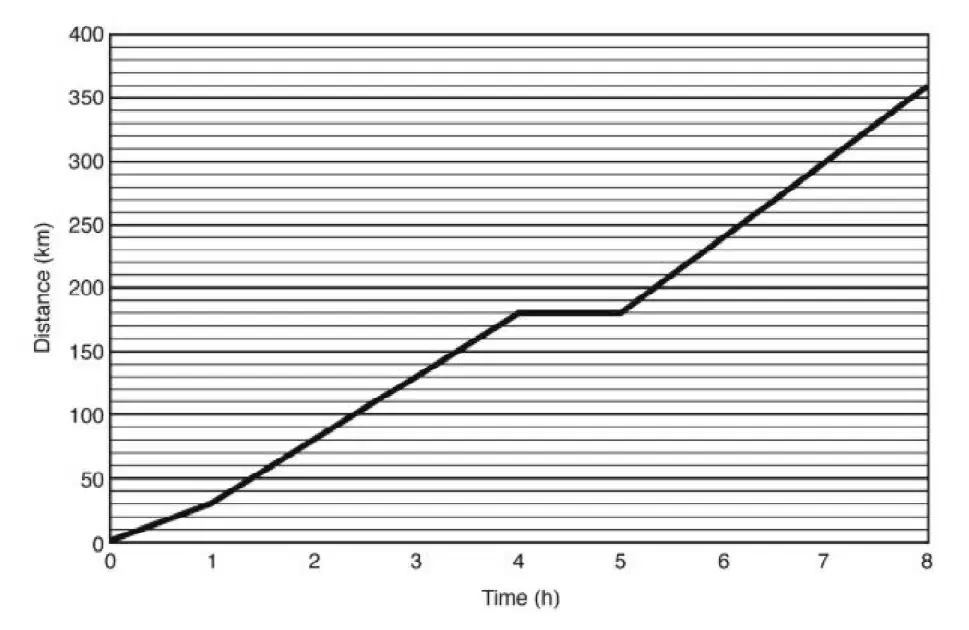
Jackson went on a day cruise along the Florida coast. The graph shows the distance the boat traveled each hour.
Which statement explains why the graph CANNOT be used to determine the boat’s average velocity?
The speed of the boat is not constant.
The direction of the boat is not given.
The boat was stationary for one hour.
The boat’s average speed is unknown.
The following pictures show the positions and directions of a ball at intervals of 1 s.
Which picture shows acceleration due to a change in speed?


Which properties determine the force of gravity between two objects?
mass and distance
mass and volume
volume and density
volume and distance
Merv folded a paper airplane and threw it across the room.
It flew straight, then suddenly turned toward the right before crashing onto the ground.
Which of the following explains why the plane changed direction?
Its speed increased.
A contact force acted on it.
The force of gravity increased.
An unbalanced force acted on it.

