wayground logo

Free Printable Worksheets

NEW

Font size

S
M
L
XL
Worksheets

SPH4U Gravitational Force, Satellite Motion, Coulomb'S

Total questions: 22

Worksheet time: 11mins

Name
Class
Date
1.
Two small balls, A and B, attract each other gravitationally with a force of magnitude F. If we now double both masses and the separation of the balls, what will now be the magnitude of the attractive force on each one?
a)
(a) 16F
b)
(b) 8F
c)
(c) 4F
d)
(d) F
e)
(e) F/4
2.
The reason an astronaut in an earth satellite feels weightless is that
a)
(a) the astronaut is beyond the range of the earth's gravity.
b)
(b) the astronaut is falling.
c)
(c) the astronaut is at a point in space where the effects of the moon's gravity and the earth's gravity cancel.
d)
(d) this is a psychological effect associated with rapid motion.
e)
(e) the astronaut's acceleration is zero.
3.
What is the gravitational force acting on a 59-kg person due to another 59-kg person standing 2.0 m away? We can model each person as a small sphere. (G = 6.67 × 10^-11 N ∙ m²/kg²)
a)
(a) 5.8 × 10^-8 <span style="vertical-align: sub;">N
b)
(b) 8.5 × 10³ <span style="vertical-align: sub;">N
c)
(c) 1.2 × 10^-7 <span style="vertical-align: sub;">N
d)
(d) 9.8 × 10^-10 <span style="vertical-align: sub;">N
e)
(e) 2.0 × 10^-9 <span style="vertical-align: sub;">N
4.
A spaceship with a mass of 2.8 × 10^6 kg is traveling toward two spherical asteroids, each with a mass of 5.0 × 10^16 kg, that are 40 km apart center-to-center. Its path is perpendicular to the line joining the asteroids and is aimed at the midpoint of that line. What is the net gravitational force exerted by the asteroids on the spaceship when the spaceship is 30 km away from that midpoint? (G = 6.67 × 10^-11 N ∙ m²/kg²)
a)
(a) 12,000 N
b)
(b) 8000 N
c)
(c) 16,000 N
d)
(d) 6200 N
e)
(e) 18,000 N
5.
Find the orbital speed of an ice cube in the rings of Saturn. The mass of Saturn is 5.68 × 10²6 kg, and use an orbital radius of 1.00 × 10^5 km. (G = 6.67 × 10^-11 N ∙ m²/kg²)
a)
(a) 19.5 km/s
b)
(b) 27.5 km/s
c)
(c) 13.8 km/s
d)
(d) 9.40 km/s
e)
.
6.
In another solar system, a planet has a moon that is 4.0 × 10^5 m in diameter. Measurements reveal that this moon takes 3.0 × 10^5 s to make each orbit of diameter 1.8 × 10^8 m. What is the mass of the planet? (G = 6.67 × 10^-11 N ∙ m²/kg²)
a)
(a) 1.2 × 10²4 kg
b)
(b) 1.7 × 10²4 kg
c)
(c) 2.4 × 10²4 kg
d)
(d) 3.4 × 10²4 kg
e)
(e) 4.8 × 10²4 kg
7.
A satellite having orbital speed V orbits a planet of mass M. If the planet had half as much mass, the orbital speed of the satellite at the same distance from the center would be
a)

(a) V√2

b)
(b) 2V.
c)
(c) V.
d)

(d) V/√2

e)
(e) V/2.
8.
The innermost satellite of Jupiter orbits the planet with a radius of 422 × 10³ km and a period of 1.77 days. What is the mass of Jupiter? (G = 6.67 × 10^-11 N ∙ m²/kg²)
a)
(a) 1.33 × 10²7 kg
b)
(b) 1.50 × 10²7 kg
c)
(c) 1.72 × 10²7 kg
d)
(d) 1.89 × 10²7 kg
e)
(e) 3.08 × 10²7 kg
9.
Two tiny beads are 25 cm apart with no other charges or fields present. Bead A carries 10 µC of charge and bead B carries 1 µC. Which one of the following statements is true about the magnitudes of the electric forces on these beads?
a)
(a) The force on A is 10 times the force on B.
b)
(b) The force on B is 10 times the force on A.
c)
(c) The force on A is exactly equal to the force on B.
d)
(d) The force on A is 100 times the force on B.
e)
(e) The force on B is 100 times the force on A.
10.
A hydrogen nucleus, which has a charge +e, is situated to the left of a carbon nucleus, which has a charge +6e. Which statement is true?
a)
(a) The electrical force experienced by the hydrogen nucleus is to the left, and the magnitude is equal to the force exerted on the carbon nucleus.
b)
(b) The electrical force experienced by the hydrogen nucleus is to the left, and the magnitude is greater than the force exerted on the carbon nucleus.
c)
(c) The electrical force experienced by the hydrogen nucleus is to the left, and the magnitude is less than the force exerted on the carbon nucleus.
d)
(d) The electrical force experienced by the hydrogen nucleus is to the right, and the magnitude is equal to the force exerted on the carbon nucleus.
e)
.
11.

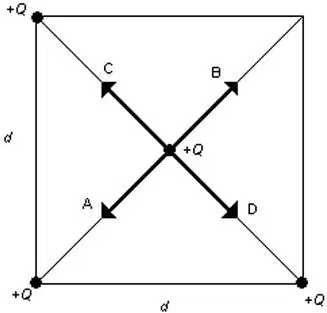
Three equal charges +Q are at three of the corners of a square of side d. A fourth charge +Q of equal magnitude is at the center of the square as shown in the figure Which one of the arrows shown represents the net force acting on the charge at the center of the square?
a)
(a) A
b)
(b) B
c)
(c) C
d)
(d) D
e)
.
12.

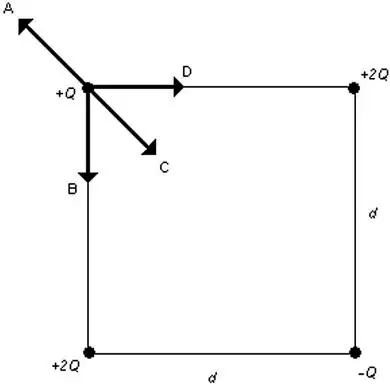
Four point charges of varying magnitude and sign are arranged on the corners of the square of side d as shown in the figure. Which one of the arrows shown represents the net force acting on the point charge with a charge +Q?
a)
(a) A
b)
(b) B
c)
(c) C
d)
(d) D
e)
.
13.

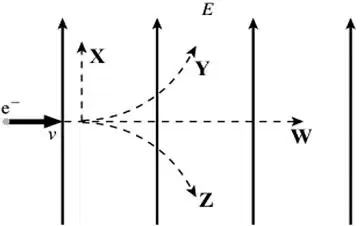
An electron is initially moving to the right when it enters a uniform electric field directed upwards, as shown in the figure. Which trajectory (X, Y, Z, or W) will the electron follow in the field?
a)
(a) trajectory W
b)
(b) trajectory X
c)
(c) trajectory Y
d)
(d) trajectory Z
e)
.
14.

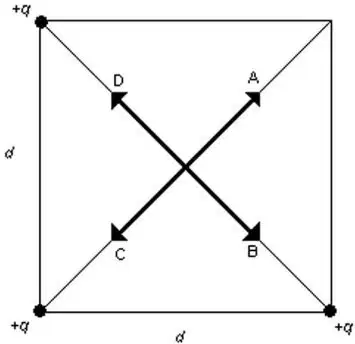
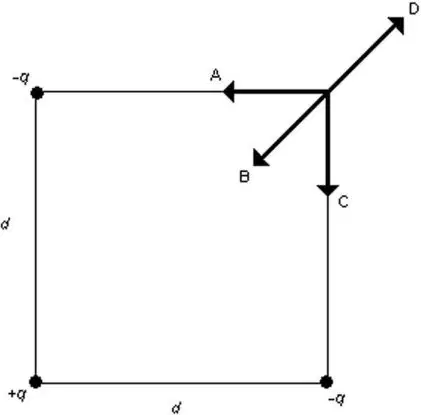
Three equal positive point charges +q are placed at the corners of a square of side d as shown in the figure. Which one of the arrows shown represents the direction of the net electric field at the center of the square?
a)
(a) A
b)
(b) B
c)
(c) C
d)
(d) D
e)
.
15.

Three equal-magnitude point charges of varying signs are placed at three of the corners of a square of side d as shown in the figure. Which one of the arrows shown represents the direction of the net electric field at the vacant corner of the square?
a)
(a) A
b)
(b) B
c)
(c) C
d)
(d) D
e)
.
16.
An asteroid of mass 58,000 kg carrying a negative charge of 15 μC is 180 m from a second asteroid of mass 52,000 kg carrying a negative charge of 11 μC. What is the magnitude of the net force the asteroids exert upon each other, assuming we can treat them as point particles? (G = 6.67 × 10^-11 N ∙ m²/kg², k = 1/4 με。 = 8.99 × 10^9 N ∙ m²/C²)
a)
(a) 0.000040 N
b)
(b) 0.0062 N
c)
(c) 570,000 N
d)
(d) 510,000 N
e)
.
17.
The zirconium nucleus contains 40 protons, and an electron is 1.0 nm from the nucleus. What is the electric force on the electron due to the nucleus? ( e = 1.60 × 10^-19 C, k = 1/4με。 = 9.0 × 10^9 N ∙ m²/C²)
a)
(a) 2.9 nN
b)
(b) 1000 C
c)
(c) 3.7 nN
d)
(d) 6.8 nN
e)
(e) 9.2 nN
18.
Two equally charged tiny spheres of mass 1.0 g are placed 2.0 cm apart. When released, they begin to accelerate away from each other at 414 m/s². What is the magnitude of the charge on each sphere, assuming only that the electric force is present? (k = 1/4με。 = 9.0 × 10^9 N ∙ m²/C²)
a)
(a) 140 nC
b)
(b) 120 nC
c)
(c) 95 nC
d)
(d) 75 nC
e)
.
19.
The three point charges +4.0 μC, -5.0 μC, and -9.0 μC are placed on the x-axis at the points x = 0 cm, x = 40 cm, and x = 120 cm, respectively. What is the x component of the electrostatic force on the -9.0 μC charge due to the other two charges? (k = 1/4με。 = 9.0 × 10^9 N ∙ m²/C²)
a)
(a) -0.55 N
b)
(b) 0.55 N
c)
(c) 0.64 N
d)
(d) 0.41 N
e)
(e) -0.41 N
20.

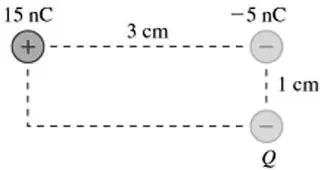
As shown in the figure, three charges are at corners of a rectangle. The charge in the bottom right corner is Q = - 90 nC, and all the other quantities are accurate to two significant figures. What is the magnitude of the net electrical force on Q due to the other two charges?

a)
(a) 3.8 × 10^-2 N
b)
(b) 2.8 × 10^-2 N
c)
(c) 5.3 × 10^-2 N
d)
(d) 7.1 × 10^-2 N
e)
.
21.
A particle with a charge of +4.0 μC has a mass of 5.0 g. What magnitude electric field directed upward will exactly balance the weight of the particle?
a)
(a) 4.1 × 10^4 N/C
b)
(b) 8.2 × 10^4 N/C
c)
(c) 4.4 × 10^4 N/C
d)
(d) 1.2 × 10^4 N/C
e)
(e) 5.1 × 10^4 N/C
22.
Two tiny particles having charges +20.0 μC and -8.00 μC are separated by a distance of 20.0 cm. What are the magnitude and direction of electric field midway between these two charges? (k = 1/4με。 = 9.0 × 10^9 N ∙ m²/C²)
a)
(a) 25.2 × 10^6 N/C directed towards the negative charge
b)
(b) 25.2 × 10^6 N/C directed towards the positive charge
c)
(c) 25.2 × 10^5 N/C directed towards the negative charge
d)
(d) 25.2 × 10^5 N/C directed towards the positive charge
e)
(e) 25.2 × 10^4 N/C directed towards the negative charge