
 Worksheets
Intermolecular Forces
Total questions: 7
Worksheet time: 6mins
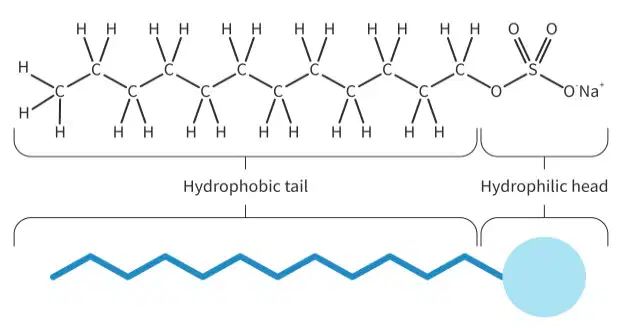
The structure of a soap (surfactant) molecule is given below. Looking at the structure, deduce what solvent(s) the molecule will be soluble in.
Water and oil
Water
Oil
Neither
You have four different samples of compounds that are liquids at room temperature: BCl3, CCl4, NCl3 and OCl2. Identify which correct pairs of molecules are capable of forming a solution.
NCl3 with OCl2 and BCl3 with CCl4
BCl3 with NCl3 and CCl4 with OCl2
BCl3 with OCl2 and NCl3 with CCl4
All of these molecules are capable of forming a solution.
When graphite is used as a writing material, individual layers of graphite transfer from the pencil to the page. What interaction has to be overcome in order for this transfer to occur?
London dispersion forces
Dipole–dipole forces
Covalent bonds
Giant Covalent bonds
You have samples of four different molecular compounds: ammonia (NH3), methane (CH4), silicon tetrahydride (SiH4) and phosphorus trihydride (PH3).
The compound with the highest boiling point is
ammonia (NH3)
methane (CH4)
silicon tetrahydride (SiH4)
phosphorus trihydride (PH3)
You have samples of four different molecular compounds: ammonia (NH3), methane (CH4), silicon tetrahydride (SiH4) and phosphorus trihydride (PH3).
The compound with the lowest boiling point is
ammonia (NH3)
methane (CH4)
silicon tetrahydride (SiH4)
phosphorus trihydride (PH3)
Identify the correct statement regarding London dispersion forces and dipole–dipole forces.
London dispersion forces involve both temporary and induced dipoles, whereas dipole–dipole forces involve a permanent dipole.
Dipole–dipole forces involve both temporary and induced dipoles, whereas London dispersion forces involve a permanent dipole.
London dispersion forces involve both temporary and permanent dipoles, whereas dipole–dipole forces involve an induced dipole.
London dispersion forces involve a temporary dipole, whereas dipole–dipole forces involve both induced and permanent dipoles.
Which intermolecular forces exist between the CO2 molecules in dry ice, CO2 (s)?
London dispersion forces
Covalent bonds
Dipole-dipole interactions
Hydrogen bonds

