wayground logo

Free Printable Worksheets

Font size

S
M
L
XL
Worksheets

G-CHAPTER 3 TEST 2023-2024

Total questions: 240

Worksheet time: 9hrs 7mins

Name
Class
Date
1.
.
.
.
.
What is the name of this kind of triangle?
a)
Right
b)
Isosceles
c)
Scalene
d)
Equilateral
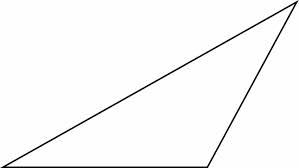
2.
What kind of triangle is this?
a)
Acute
b)
Super
c)
Right
d)
Obtuse
3.
.
.
.
What is the name of this kind of triangle?
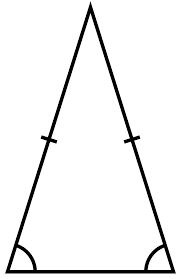
a)
Right
b)
Scalene
c)
Isosceles
d)
Equilateral
4.
What kind of triangle is this?
a)
Acute
b)
Right
c)
Sparkly
d)
Obtuse
5.
How many acute angles must an acute triangle have?
a)
2
b)
1
c)
4
d)
3
6.
A triangle has angle measurements of 26°, 59°, and 95°. What kind of triangle is it?
a)
acute triangle
b)
right triangle
c)
obtuse triangle
d)
none of the above
7.
A triangle has angle measurements of 54°, 52°, and 74°. What kind of triangle is it?

a)
acute triangle
b)
right triangle
c)
obtuse triangle
d)
none of the above
8.
A triangle has angle measurements of 163°, 2°, and 15°. What kind of triangle is it?

a)
acute triangle
b)
right triangle
c)
obtuse triangle
d)
none of the above
9.
A triangle has angle measurements of 74°, 90°, and 16°. What kind of triangle is it?

a)
acute triangle
b)
right triangle
c)
obtuse triangle
d)
none of the above
10.
A triangle has angle measurements of 27°, 72°, and 81°. What kind of triangle is it?

a)
acute triangle
b)
right triangle
c)
obtuse triangle
d)
none of the above
11.
A triangle has side lengths of 19 centimetres, 19 centimetres, and 20 centimetres. Is this triangle equilateral?

a)
equilateral triangle
b)
isosceles triangle  
c)
scalene triangle
d)
none of the above
12.
A triangle has two 71° angles and one 38° angle. Is this triangle isosceles?

a)
yes 
b)
no
13.
a)
yes
b)
no
14.
What type of triangle has only one right angle and two congruent sides?
a)
Right Isosceles Triangle
b)
Obtuse Isosceles Triangle
c)
Right Scalene Triangle
d)
Acute Scalene Triangle
15.
What type of triangle has only one obtuse angle and two congruent sides?
a)
Right Isosceles Triangle
b)
Obtuse Isosceles Triangle
c)
Right Scalene Triangle
d)
Acute Scalene Triangle
16.
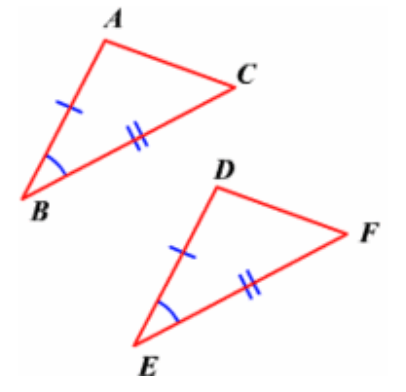
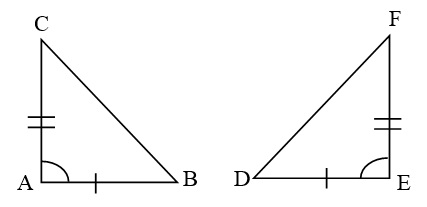
Classify the triangle by angles and sides.
a)
Equiangular Equilateral
b)
Right Isosceles
c)
Right Scalene
d)
Acute Isosceles
17.

A triangle with 3 congruent sides is called a(n) ______

a)

Isosceles Triangle

b)

Equilateral Triangle

c)

Obtuse Triangle

d)

Irregular Triangle

18.

A scalene triangle has _____

a)

3 different angle names

b)

no congruent sides

c)

all sides congruent

d)

3 congruent angles

19.

A triangle with at least one angle greater than 90 degrees is called a(n) ________ triangle

a)

obtuse

b)

left

c)

right

d)

acute

20.
Classify the triangle by angles and sides.
a)
Equiangular Equilateral
b)
Right Isosceles
c)
Right Scalene
d)
Acute Isosceles
21.

Identify the triangle by its sides and angles

a)

Equilateral

b)

Obtuse Equilateral

c)

Acute Equilateral

d)

Acute Isosceles

22.

Identify the triangle by its sides and angles

a)

Right Isosceles

b)

Right Scalene

c)

Obtuse Isosceles

d)

Obtuse Scalene

23.

Identify the triangle by its sides and angles

a)

Obtuse Isosceles

b)

Obtuse Equilateral

c)

Obtuse Scalene

24.

Identify the triangle by its sides and angles

a)

Acute Equilateral

b)

Right Equilateral

c)

Acute Isosceles

d)

Obtuse Isosceles

25.

Identify the triangle by its sides and angles

a)

Obtuse

b)

Acute Isosceles

c)

Obtuse Scalene

d)

Obtuse Isosceles

26.

All acute triangle are Equilateral

a)

True

b)

False

27.

A right triangle can not be equilateral

a)

True

b)

False

28.
What do the angles in an equilateral triangle measure?
a)
30, 60, 90
b)
45, 45, 90
c)
60, 60, 60
d)
35, 55, 90
29.
The Triangle Sum Theorem states that the sum of all angles in a triangle is ______. 
a)
45°
b)
90°
c)
180°
d)
360°
30.
The Triangle Sum Theorem deals with _______ of a triangle
a)
angles
b)
sides
31.
Find the measure of each angle indicated. 
a)
33°
b)
136°
c)
36°
d)
31°
32.
Find the measure of each angle indicated. 
a)
140°
b)
21°
c)
105°
d)
25°
33.
Find the measure of each angle indicated. 
a)
139°
b)
66°
c)
138°
d)
116°
34.
Find the measure of each angle indicated. 
a)
50°
b)
35°
c)
100°
d)
55°
35.
Find the measure of each angle indicated. 
a)
40°
b)
33°
c)
30°
d)
29°
36.
What is the measure of angle BAC?
a)
40
b)
30
c)
35
d)
45
37.
Find the measure of each angle indicated. 
a)
139°
b)
66°
c)
138°
d)
116°
38.
What is the third angle of a triangle whose 1st angle is 79 and the 2nd angle is 43?
a)
43
b)
58
c)
72
d)
101
39.
What is the third angle of a triangle whose 1st angle is 34 and 2nd angle is 101?
a)
32
b)
39
c)
45
d)
54
40.
Find the measure of the indicated angle. 
a)
26
b)
36
c)
85
d)
144
41.
a)
146
b)
34
c)
36
d)
136
42.
Solve for x.
a)
-12
b)
-8
c)
-10
d)
-5
43.
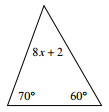
Solve for x.
a)
16
b)
11
c)
50
d)
6
44.
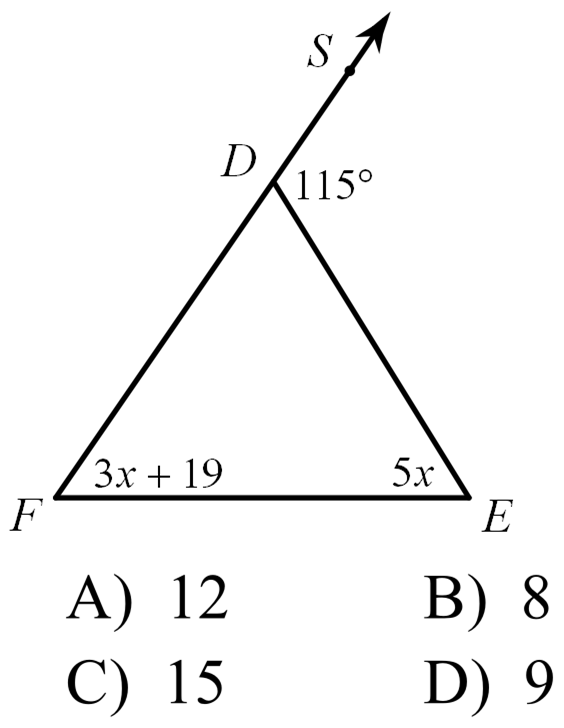
What is the value of x?
a)
15
b)
9
c)
12
d)
11
45.
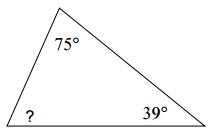
Find the measure of the missing angle.
a)
90o
b)
100
c)
130o
d)
50o
46.
Solve for x.
a)
7
b)
9
c)
-11
d)
-6
47.
a)
11
b)
30
c)
115
d)
120
48.
a)
11
b)
25
c)
35
d)
50
49.
a)
17
b)
25
c)
18
d)
26
50.
a)
19
b)
55
c)
18
d)
65
51.
a)
16
b)
55
c)
18
d)
65
52.

Find the measure of the angle indicated.

a)

87

b)

92

c)

105

d)

93

53.

Find the measure of the angle indicated.

a)

70

b)

50

c)

54

d)

49

54.

Find the measure of the angle indicated.

a)

30

b)

79

c)

99

d)

124

55.

Find the measure of the angle indicated.

a)

80

b)

69

c)

56

d)

64

56.

Find the measure of the angle indicated.

a)

26

b)

127

c)

135

d)

154

57.

Solve for x.

a)

1

b)

2

c)

7

d)

12

58.

Solve for x.

a)

5

b)

15

c)

8

d)

4

59.

Solve for x.

a)

12

b)

6

c)

10

d)

11

60.

Solve for x.

a)

7

b)

1

c)

4

d)

5

61.

Solve for x.

a)

2

b)

5

c)

10

d)

15

62.


Find mNSTFind\ m\angle NST  

a)

150

b)

116

c)

155

d)

70

63.

Find mDGFFind\ m\angle DGF  

a)

90

b)

82

c)

77

d)

56

64.

Find mEFind\ m\angle E  

a)

35

b)

100

c)

31

d)

33

65.

Find mCFind\ m\angle C  

a)

78

b)

82

c)

69

d)

124

66.

Find mGQRFind\ m\angle GQR  

a)

19

b)

135

c)

142

d)

121

67.
What is the measure of angle b?
a)
36o
b)
56o
c)
63o
d)
117o
68.
Find the value of x.
a)
A
b)
B
c)
C
d)
D
69.
Find the value of x.
a)
A
b)
B
c)
C
d)
D
70.

Find angle a

a)

100

b)

80

c)

120

d)

60

71.

Find angle x

a)

100

b)

140

c)

120

d)

60

72.

c =

a)

100

b)

125

c)

80

d)

75

73.

d =

a)

155

b)

125

c)

100

d)

75

74.

e =

a)

b + 25

b)

180 + c

c)

d + 25

d)

100 - b

75.

Use the figure to determine which of the following angles has the greatest measure:   4,  8, 9\angle\ 4,\ \angle\ 8,\ \angle9  

a)

4\angle4  

b)

8\angle8  

c)

9\angle9  

d)

Not enough information

76.

Use the figure to determine which of the following angles has the greatest measure:   1,  3, 4\angle\ 1,\ \angle\ 3,\ \angle4  

a)

1\angle1  

b)

3\angle3  

c)

4\angle4  

d)

Not enough information

77.

Use the Exterior Angle Inequality Theorem to list all angles that satisfy the stated condition: measures are less than  1\angle1  

a)

3, 4, 5, 7, 8\angle3,\ \angle4,\ \angle5,\ \angle7,\ \angle8  

b)

3, 4, 5, 6, 8\angle3,\ \angle4,\ \angle5,\ \angle6,\ \angle8  

c)

2, 6, 7, 8\angle2,\ \angle6,\ \angle7,\ \angle8  

d)

2, 6, 8, 9\angle2,\ \angle6,\ \angle8,\ \angle9  

78.

Use the Exterior Angle Inequality Theorem to list all angles that satisfy the stated condition: measures are less than  3\angle3  

a)

2, 6, 8, 9\angle2,\ \angle6,\ \angle8,\ \angle9  

b)

1, 6, 8\angle1,\ \angle6,\ \angle8  

c)

5, 7, 8\angle5,\ \angle7,\ \angle8  

d)

2, 4, 7, 8\angle2,\ \angle4,\ \angle7,\ \angle8  

79.

Which two angles are the remote interior angles to Angle A?

a)

Angle C and Angle B

b)

Angle D and Angle B

c)

Angle C and Angle D

d)

Angle B and Angle A

80.

Which two angles are the remote interior angles to Angle W?

a)

Angle X and Angle Y

b)

Angle X and Angle Z

c)

Angle Y and Angle Z

d)

Angle Z and Angle W

81.

What angle has a measure less than  m4m\angle4

a)

m1m\angle1  

b)

m6m\angle6  

c)

m8m\angle8  

d)

m2m\angle2  

82.

What angle has a measure greater than m8m\angle8

a)

m5m\angle5  

b)

m6m\angle6  

c)

m3m\angle3  

d)

m7m\angle7  

83.
Less Than
a)
<
b)
>
c)
d)
84.
Greater than
a)
<
b)
>
c)
d)
85.
Which of the following terms best describes Angle d? (remember that it's outside)
a)
Remote interior angle
b)
Corresponding angle
c)
Exterior angle
d)
Interior angle
86.
What is congruency?  
a)
Same size and shape 
b)
Same size
c)
segment 
d)
congruent 
87.
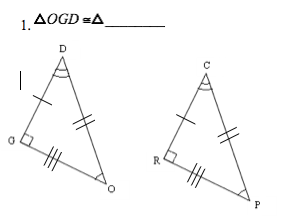
Complete the congruence statement.
a)
CRP
b)
PCR
c)
RPC
d)
PRC
88.
Name the corresponding angle or side.
a)
A
b)
B
c)
C
d)
D
89.
What side corresponds to ED?
a)
TA
b)
NA
c)
TN
d)
RD
90.

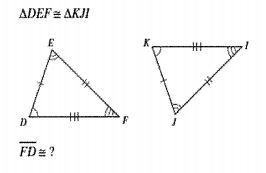
Complete the statement:   FD  \overline{FD}\ \ \cong  _____

a)

IK

b)

KJ

c)

JI

d)

EF

91.
a)

A

b)

B

c)

C

d)

D

92.
∆ABC≅∆XYZ
which is true?
a)
AB≅XY
b)
AB≅YX
c)
AB≅XZ
d)
BC≅CB
93.
PICK THE CORRECT CONGRUENCE STATEMENT
a)
∆TUV ≅ ∆EUV
b)
∆VUT ≅ ∆UVE
c)
∆TUV ≅ ∆UEV
d)
∆UTV ≅ ∆EUV
94.
All corresponding angles in congruent figures are congruent.  
a)
True
b)
False
95.

If ∆LMK ≅ ∆LMT, then ∠K ≅ ____

a)

MT

b)

∠T

c)

∠M

d)

∠L

96.

Choose the correct congruence statement for the figures shown.

a)

∆TUV ≅ ∆EUV

b)

∆VUT ≅ ∆UVE

c)

∆TUV ≅ ∆UEV

d)

∆UTV ≅ ∆EUV

97.

Complete the congruence statement.

a)

CRP

b)

PCR

c)

RPC

d)

PRC

98.

Given  ΔABC  ΔDEF\Delta ABC\ \cong\ \Delta DEF , find the value of x.

a)

17

b)

18

c)

19

d)

20

99.

Determine whether the two figures are congruent.

a)

Yes, corresponding sides are congruent.

b)

Yes, corresponding angles are congruent.

c)

Yes, corresponding sides and corresponding angles are congruent.

d)

No, the two figure are not congruent.

100.
a)

A

b)

B

c)

C

d)

D

101.
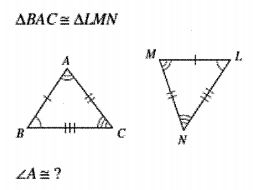
∠A ≅∠?
a)
∠B
b)
∠E
c)
∠D
d)
∠F
102.
What does x equal?
a)
9
b)
11
c)
17
103.
∆ABC≅∆XYZ
which is true?
a)
AB≅XY
b)
AB≅YX
c)
AB≅XZ
d)
BC≅CB
104.
∠E ≅ ∠ __
a)
A
b)
B
c)
C
d)
D
105.
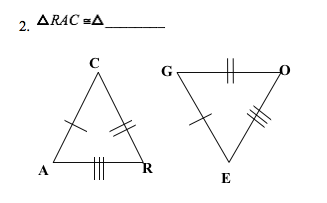
Complete the congruence statement.
a)
OEG
b)
OGE
c)
EGO
d)
GOE
106.
If ∆XYZ ≅ ∆KLM, then
∠Y≅ _____
a)
∠K
b)
∠M
c)
∠L
d)
∠Z
107.
If ΔABC ≅ ΔXYZ, which statement is always true?
a)
AB = YZ
b)
∠C ≅ ∠Z
c)
∠B ≅ ∠C
d)
AC = XY
108.
Complete the congruence statement.
a)
OEG
b)
OGE
c)
EGO
d)
GOE
109.

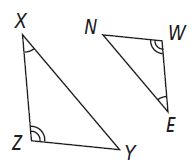
What is the similarity statement for the triangle pair?

a)

ΔXYZ~ΔNEW

b)

ΔXZY~ΔNWE

c)

ΔZYX~ΔENW

d)

ΔYZX~ΔNWE

110.
If ΔABC ≅ ΔXYZ, which statement is always true?
a)
AB = YZ
b)
∠C ≅ ∠Z
c)
∠B ≅ ∠C
d)
AC = XY
111.
If ΔABC ≅ ΔXYZ, which statement is always true?
a)
BC = AZ
b)
∠C ≅ ∠Z
c)
∠B ≅ ∠A
d)
AC = XZ
112.
If ΔDEF ≅ ΔRST, then we can conclude that DE = what?
a)
ST
b)
RS
c)
DF
d)
RT
113.
Which of the following is saying the same thing as ΔXYZ ≅ ΔLMN?
a)
ΔXZY ≅ ΔLNM
b)
ΔXMN ≅ ΔLZY
c)
ΔZYX ≅ ΔLMN
d)
ΔXYZ ≅ ΔLMN
114.
If ΔDEF ≅ ΔRST, then we can conclude that ∠S ≅ ____.
a)
∠F
b)
∠E
c)
∠D
d)
DE
115.
If ∆XYZ ≅ ∆KLM, then
∠Y≅ _____
a)
∠K
b)
∠M
c)
∠L
d)
∠Z
116.
a)
3 inches
b)
5 inches
c)
90 inches
d)
4 inches
117.
Solve for x
a)
8
b)
4
c)
12
d)
6
118.
a)
30 degrees
b)
45 degrees
c)
105  degrees
119.

ΔABD ≅ ΔABC

What is the length of AD?

a)

10

b)

11

c)

14

d)

15

120.

In the figure below, ▵GFE ⩭ ▵DCB.

Determine the perimeter of ▵GFE

a)

63

b)

53

c)

58

d)

68

121.

If ▵ABC ⩭ ▵IHG, what is the

length of AB?

a)

12

b)

8

c)

5

d)

20

122.

If ▵ABC ⩭ ▵RQP, what is

the length of QP?

a)

3

b)

2

c)

6

d)

13

123.

In the figure below, ▵ABC ⩭ ▵KLJ. Determine the length of AB.

a)

19

b)

4

c)

24

d)

9

124.

In the figure above, ▵GFE ⩭ ▵DCB. Determine the perimeter of ▵GFE

a)

15

b)

98

c)

50

d)

63

125.

ΔABE ≅ ΔCDE,If ∠D = 50°, then ∠AEB =

a)

50°

b)

40°

c)

60°

d)

90°

126.

x = ?

a)

60°

b)

55°

c)

15°

d)

65°

127.
x = 
a)
9
b)
11
c)
17
128.

The fronts of the houses are identical. What is the length of side LM?

a)

12 ft

b)

20 ft

c)

32 ft

129.

The fronts of the houses are identical. Side AB is congruent to side AE. What is the length of side AB?

a)

12 ft

b)

20 ft

c)

32 ft

130.
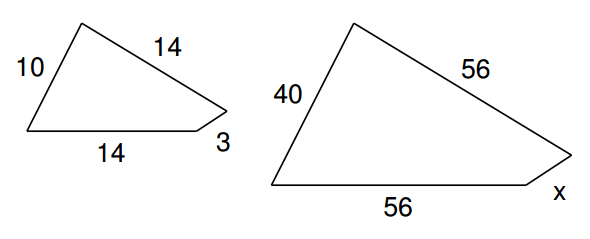
The pair of figures is similar. Find the missing side.
a)
x = 12
b)
x = 3
c)
x = 40
d)
x = 4
131.
The pair of figures is similar. Find the missing side.
a)
x = 20
b)
x = 12
c)
x = 5
d)
x = 4
132.
All corresponding angles in congruent figures are congruent.  
a)
True
b)
False
133.
If ΔABC ≅ ΔXYZ, which statement is always true?
a)
AB = YZ
b)
∠C ≅ ∠Z
c)
∠B ≅ ∠C
d)
AC = XY
134.
If ΔDEF ≅ ΔRST, then we can conclude that DE = what?
a)
ST
b)
RS
c)
DF
d)
RT
135.

EFGH∼MATB

Which angle corresponds to ∠E

a)

∠M

b)

∠T

c)

∠B

d)

∠A

136.

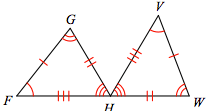
Remember order matters. Which of the following is true?

a)

∆FGH \equiv   ∆VHW

b)

∆HFG \equiv   ∆HWV

c)

∆HGF \equiv   ∆VHW

d)

∆FGH \equiv   ∆VWH

137.
What does x equal?
a)
9
b)
11
c)
17
138.

∠A =

a)

∠M

b)

∠N

c)

∠L

139.

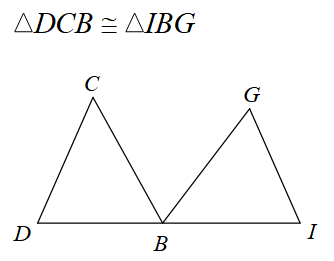
CB = ?\overline{CB}\ =\ ?  

a)

I\angle I  

b)

GI\overline{GI}  

c)

IB\overline{IB}  

d)

BG\overline{BG}  

140.

LK  ?\overline{LK}\ \cong\ ?  

a)

JE\overline{JE}  

b)

JF\overline{JF}  

c)

EF\overline{EF}  

d)

KJ\overline{KJ}  

141.

Remember order matters. Which of the following is true?

a)

∆FGH ≅ ∆VHW

b)

∆HFG ≅ ∆HWV

c)

∆HGF ≅ ∆VHW

d)

∆FGH ≅ ∆VWH

142.
Tell whether the two figures are congruent.
a)
Yes, same size and same shape
b)
No, same shape but different sizes
c)
No, different size and different shapes
143.
∆ABC ≅ ∆LMN. Which statement is NOT true?
a)
LM ≅ AB
b)
∆CAB ≅ ∆NLM
c)
∠C ≅ ∠N
d)
BC ≅ ML
144.
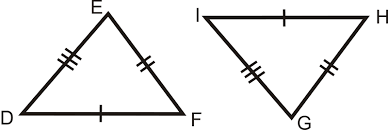
∠E ≅ ∠ __
a)
A
b)
B
c)
C
d)
D
145.
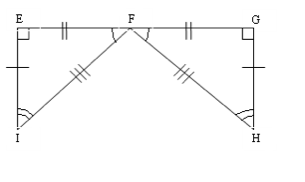
Which segment is congruent to EF? 
a)
HG
b)
HF
c)
GF
d)
IE
146.

Which side of ΔDWY\Delta DWY  corresponds with side AC in ΔABC\Delta ABC  ?

a)

Side WY

b)

Side DW

c)

Side DW

147.

Given that ΔBACΔFED, which angle of ΔFED corresponds to BAC?\Delta BAC\equiv\Delta FED,\ which\ angle\ of\ \Delta FED\ corresponds\ to\ \angle BAC?

a)

EDF\angle EDF  

b)

DEF\angle DEF  

c)

DFE\angle DFE  

148.
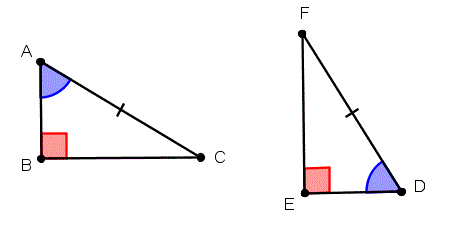
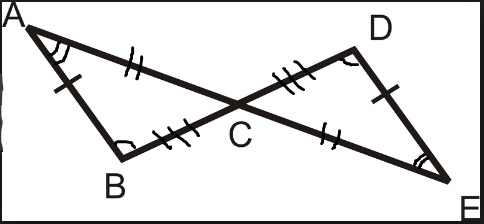
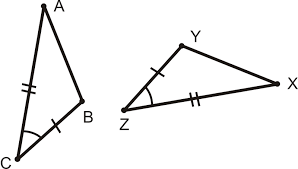
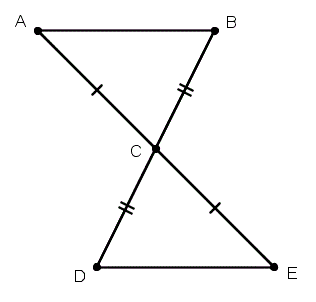
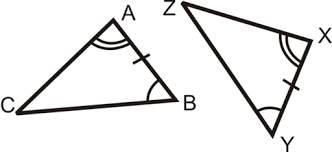
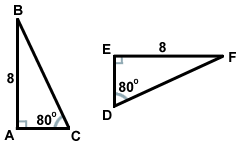
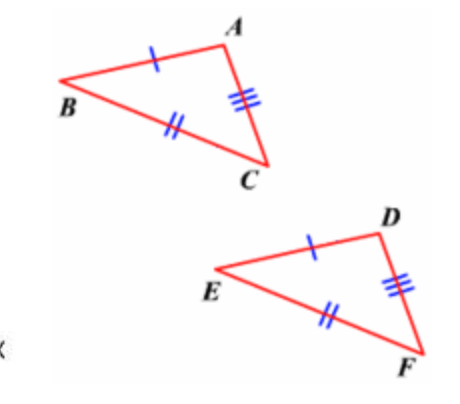
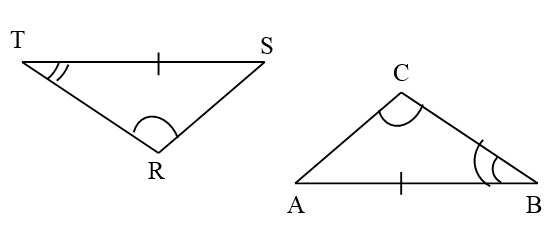
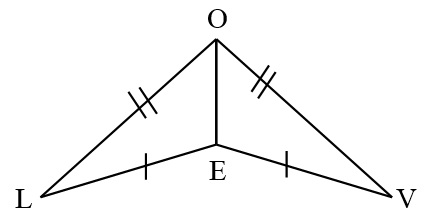
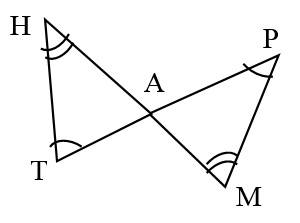
Which triangle congruence theorem can be used to prove the triangles are congruent?
a)
SAS
b)
SSS
c)
ASA
d)
HL
149.
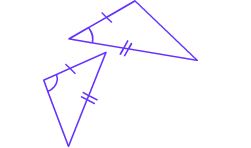
Which triangle congruence theorem can be used to prove the triangles are congruent?
a)
SSS
b)
ASA
c)
AAS
d)
SAS
150.
Which triangle congruence theorem can be used to prove the triangles are congruent?
a)
AAS
b)
SSS
c)
Not enough information given
d)
ASA
151.
Which triangle congruence theorem can be used to prove the triangles are congruent?
a)
AAS
b)
SSS
c)
SAS
d)
SSA
152.
Which triangle congruence theorem can be used to prove the triangles are congruent?
a)
AAS
b)
SAS
c)
HL
d)
ASA
153.
Which triangle congruence theorem can be used to prove the triangles are congruent?
a)
AAS
b)
ASA
c)
SSA
d)
AAA
154.
What does SSS stand for?
a)
Small Small Small
b)
Side Side Side
c)
Small Side Small
d)
Sam's Silly Side
155.

Which triangle congruence theorem is shown?

a)

SAS

b)

ASA

c)

SSS

d)

SSA

156.

Which triangle congruence theorem is shown?

a)

ASA

b)

HL

c)

SSS

d)

SAS

157.
Which triangle congruence proves triangle ABC congruent triangle XYZ?  
a)
ASA
b)
not necessarily congruent
c)
AAA
d)
SSS
158.

What does SAS~ mean?

a)

Salsa And Starbucks Congruence

b)

Sam And Sandy ~

c)

Side Angle Side Congruence

d)

Side Angle Starbucks ~

159.
Which triangle congruence theorem can be used to prove the triangles are congruent?
a)
SAS
b)
SSS
c)
ASA
d)
HL
160.
Which triangle congruence theorem can be used to prove the triangles are congruent?
a)
AAS
b)
SSS
c)
Not enough information given
d)
ASA
161.
Which triangle congruence theorem can be used to prove the triangles are congruent?
a)
SAS
b)
Not enough information
c)
SSS
d)
AAS
162.
Are the triangles congruent, if yes, why?
a)
SSS
b)
SAS
c)
ASA
d)
Not Congruent
163.

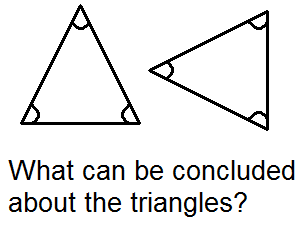
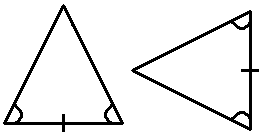
Are these triangles congruent?

a)

Yes - RHS

b)

Yes - SSA

c)

Yes - SAS

d)

No - They are different triangles

164.
Name the postulate, if possible, that makes the triangles congruent.
a)
SSS
b)
SAS
c)
ASA
d)
Not Possible
165.
Name the postulate, if possible, that makes the triangles congruent.
a)
SSS
b)
SAS
c)
ASA
d)
AAS
166.
Name the postulate, if possible, that makes the triangles congruent.
a)
SSS
b)
SAS
c)
ASA
d)
Not Possible
167.
Name the postulate, if possible, that makes the triangles congruent.
a)
SSS
b)
SAS
c)
AAS
d)
Not Possible
168.
Name the postulate, if possible, that makes the triangles congruent.
a)
SAS
b)
ASA
c)
AAS
d)
Not Possible
169.
Name the postulate, if possible, that makes the triangles congruent.
a)
SSS
b)
SAS
c)
AAS
d)
Not Possible
170.
Name the postulate, if possible, that makes the triangles congruent.
a)
SSS
b)
SAS
c)
ASA
d)
Not Possible
171.

Are the two triangles congruent? What theorem would prove them congruent?

a)

Not enough information to prove congruent

b)

Congruent by SSA

c)

Congruent by SAS

d)

Congruent by SSS

172.

Are the triangles congruent, if yes, why?

a)

SSS

b)

SAS

c)

AAA

d)

Not Congruent

173.
a)
Congruent by HL
b)
Congruent by SAS
c)
Congruent by SSS
d)
Not Necessarily Congruent
174.
a)
Congruent by ASA
b)
Congruent by SAS
c)
Congruent by SSS
d)
Not Necessarily Congruent
175.
a)
Congruent by ASA
b)
Congruent by SAS
c)
Congruent by SSS
d)
Not Necessarily Congruent
176.

ΔABE ≅ Δ_____ by _____

a)

ΔCDE , ASA

b)

ΔEDC , AAS

c)

ΔCDE , AAS

d)

Cannot Be Determined

177.

ΔVXW ≅ Δ_____ by _____

a)

ΔYXW , AAS

b)

ΔYWX , AAS

c)

ΔYXW , ASA

d)

ΔYWX , ASA

178.

ΔQTR ≅ Δ_____ by _____

a)

ΔSTR , ASA

b)

ΔSTR , AAS

c)

ΔSRT , AAS

d)

Cannot Be Determined

179.

ΔTVS ≅ Δ_____ by _____

a)

ΔTVU , ASA

b)

ΔVTU , ASA

c)

ΔTVU , SAS

d)

Cannot Be Determined

180.
Name the postulate, if possible, that makes the triangles congruent.
a)
SAS
b)
ASA
c)
AAS
d)
Not Possible
181.
Name the postulate, if possible, that makes the triangles congruent.
a)
SSS
b)
SAS
c)
ASA
d)
AAS
182.
Use the congruency statement to answer the following: 
<F = ___
a)
<H
b)
<I
c)
<G
d)
not congruent to another angle
183.

Identify the correct triangle congruence theorem.

a)

ASA

b)

AAS

184.

Identify the correct triangle congruence theorem.

a)

ASA

b)

AAS

185.

Identify the correct triangle congruence theorem.

a)

ASA

b)

AAS

186.

Identify the correct triangle congruence theorem.

a)

ASA

b)

AAS

187.

Identify the correct triangle congruence theorem.

a)

ASA

b)

AAS

188.

Identify the correct triangle congruence theorem.

a)

ASA

b)

AAS

189.

Identify the correct triangle congruence theorem.

a)

ASA

b)

AAS

190.

Identify the correct triangle congruence theorem.

a)

ASA

b)

AAS

191.

Identify the correct triangle congruence theorem.

a)

ASA

b)

AAS

192.

Identify the correct triangle congruence theorem.

a)

ASA

b)

AAS

193.

Identify the correct triangle congruence theorem.

a)

ASA

b)

AAS

194.

Identify the correct triangle congruence theorem.

a)

ASA

b)

AAS

195.

Identify the correct triangle congruence theorem.

a)

ASA

b)

AAS

196.
Name the postulate, if possible, that makes the triangles congruent.
a)
SSS
b)
SAS
c)
ASA
d)
Not Possible
197.
Name the postulate, if possible, that makes the triangles congruent.
a)
SSS
b)
SAS
c)
ASA
d)
AAS
198.
Name the postulate, if possible, that makes the triangles congruent.
a)
SAS
b)
ASA
c)
AAS
d)
Not Possible
199.
Name the postulate, if possible, that makes the triangles congruent.
a)
SSS
b)
SAS
c)
ASA
d)
Not Possible
200.
Name the postulate, if possible, that makes the triangles congruent.
a)
SSS
b)
ASA
c)
AAS
d)
Not Possible
201.
Name the postulate, if possible, that makes the triangles congruent.
a)
SSS
b)
SAS
c)
ASA
d)
AAS
202.
Name the postulate, if possible, that makes the triangles congruent.
a)
SAS
b)
ASA
c)
AAS
d)
Not Possible
203.
Name the postulate, if possible, that makes the triangles congruent.
a)
SSS
b)
SAS
c)
ASA
d)
Not Possible
204.
Name the postulate, if possible, that makes the triangles congruent.
a)
SSS
b)
SAS
c)
ASA
d)
AAS
205.
What does the word congruent mean? 
a)
Figures or angles that are similar to one another.
b)
Figures or angles that are exactly the same size and shape.
c)
A figure or angle that is equal in size to another figure or angle.
d)
A figure or angle that is equal in shape to another figure or angle.
206.

Determine whether the triangles are congruent or not. If yes, find the correct congruency statement.

a)

Yes ΔRTSΔWVU\Delta RTS\cong\Delta WVU by HL

b)

Yes ΔSRTΔWVU\Delta SRT\cong\Delta WVU by ASA

c)

Yes ΔSRTΔWVU\Delta SRT\cong\Delta WVU by SAS

d)

Yes undefined by SAS

e)

They are not congruent.

207.

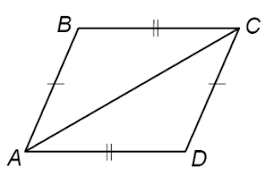
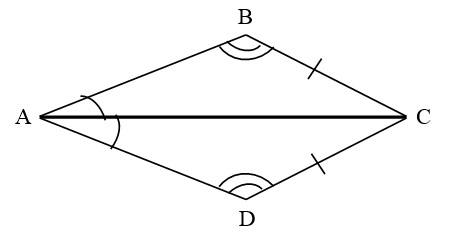
∆ABC and ∆CDA are congruent by the ____ triangle congruency theorem.

a)

SSS

b)

SAS

c)

AAS

d)

ASA

e)

SSA

208.

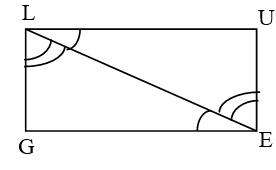
∆JMK and ∆LKM are congruent by the _____ triangle congruency theorem.

a)

HL

b)

SAS

c)

AAS

d)

ASA

e)

SSA

209.

∆JMK and ∆LKM are congruent by the _____ triangle congruency theorem.

a)

SSS

b)

SAS

c)

AAS

d)

Not enough information

e)

SSA

210.

∆ABC and ∆EDC are congruent by the _____ triangle congruency theorem.

a)

SSS

b)

SAS

c)

HL

d)

Not enough information

e)

SSA

211.

∆ABC and ∆EDC are congruent by the _____ triangle congruency theorem.

a)

SSS

b)

SAS

c)

HL

d)

Not enough information

e)

SSA

212.

The triangles are congruent by the _____ triangle congruency theorem.

a)

SSS

b)

SAS

c)

ASA

d)

AAS

e)

SSA

213.

The triangles are congruent by the _____ triangle congruency theorem.

a)

HL

b)

SSS

c)

ASA

d)

AAS

e)

All of these!

214.

The triangles are congruent by the _____ triangle congruency theorem.

a)

Not enough information

b)

SSS

c)

ASA

d)

AAS

e)

SSA

215.

The triangles are congruent by the _____ triangle congruency theorem.

a)

Not enough information

b)

SSS

c)

ASA

d)

AAS

e)

SSA

216.

Which one of these is NOT a valid triangle congruency theorem?

a)

HL

b)

SSS

c)

SSA

d)

AAS

e)

ASA

217.

What is #4 Statement?

a)

All of correct

b)

SP ≌ SP

c)

PS ≌ SP

d)

PS ≌ PS

218.

What is #5 Statement?

a)

∠QPR ≌ ∠STR

b)

∠PQR ≌ ∠STR

c)

∠QRP ≌ ∠TSR

d)

∠QRP ≌ ∠TRS

219.

What is #4 Reason?

a)

Alternate Interior Angles

b)

Vertical Angles

c)

Reflexive Property

d)

Angle Bisector

220.
What is the "statement" for step 2 of the proof?
a)
∆BAC≅∆DAC
b)
BC=DC
c)
∡B≅∡D
d)
∡BAC≅∡DAC
221.
What is the "statement" for step 3 of the proof? 
a)
∡EDA≅∡DCB
b)
∡AED≅∡BEC
c)
DE=CE
d)
∡AED≅∡CED
222.

What is #2 Reason?

a)

Perpendicular Lines

b)

Perpendicular Bisector

c)

Reflexive Property

d)

Segment Bisector

223.
What is the "statement" for step 2 of the proof?
a)
AD=AD
b)
AD=DA
c)
HD=DN
d)
HA = AN
224.
What is the "reason" for step 3 of the proof?
a)
Proof
b)
Def. of Midpoint
c)
Reflexive Property
d)
Vertical angle Theorem
225.
What is the missing piece of information required to prove these triangles congruent?
a)
QY ≅ QY
b)
NY ≅ PY
c)
∠N ≅ ∠P
d)
QY is the perpendicular bisector
226.

What are #3 & #4 Statements?

a)

#3 - Reflexive Property

#4 - Alternate Interior Angles

b)

#3 - Reflexive Property

#4 - Vertical Angles

c)

#3 - Segment Bisector

#4 - Vertical Angles

d)

#3 - Segment Bisector

#4 - Reflexive Property

227.

What is #3 Reason and #4 Statement?

a)

#3 - Reflexive Property

#4 - ∠ACB ≌ ∠ECD

b)

#3 - Definition of Midpoint

#4 - ∠ACB ≌ ∠ECD

c)

#3 - Segment Bisector

#4 - ∠BCA ≌ ∠DCE

d)

#3 - Reflexive Property

#4 - ∠BCA ≌ ∠DCE

228.
When using hypotenuse leg (HL) in a proof, you must first state ...
a)
CPCTC.
b)
there are right triangles.
c)
that vertical angles are congruent.
d)
the reflexive property.
229.
What is statement #1?
a)
BC≅DC
b)
AC≅EC
c)
BC≅DC, AC≅EC
d)
∆BCA≅∆DCE
230.
What is statement #2?
a)
∠ABC≅∠EDC
b)
∠BCA≅∠DCE
c)
BC≅CD
d)
∠E≅∠A
231.
What is reason #3?
a)
SAS
b)
ASA
c)
SSS
d)
AAS
232.
What is reason #1?
a)
Reflexive Property
b)
Definition of Bisect
c)
Prove
d)
Given
233.
What is reason #2?
a)
Definition of Midpoint
b)
Definition of Perpendicular
c)
Definition of Bisect
d)
Definition of Right Triangle
234.
What is statement #3?
a)
FH≅FH
b)
GF≅GF
c)
IH≅IH
d)
GF≅FI
235.
What is statement #4?
a)
∆HFG≅∆IHF
b)
∆FHG≅∆IHF
c)
∆GFH≅∆IFH
d)
∆HFG≅∆IFH
236.
What is reason #4?
a)
ASA
b)
SAS
c)
HL
d)
AAS
237.
What is statement #1?
a)
AB≅DC
b)
AC≅AC
c)
AB∥DC
d)
∠A≅∠C
238.
What is reason #2?
a)
Vertical angles are congruent.
b)
Consecutive angles are congruent.
c)
Alternate interior angles are congruent.
d)
Definition of Bisect
239.
What is statement #3?
a)
AD≅BC
b)
∠B≅∠D
c)
AC≅AC
d)
∠DCA≅∠BAC
240.
What is reason #4?
a)
Reflexive Property
b)
Definition of Midpoint
c)
Vertical angles are congruent.
d)
Given