
 Worksheets
Southwest Asia and North Africa
Total questions: 66
Worksheet time: 3600secs
Which of the following is the Arabian Peninsula?


Which of the following statements about Mecca is incorrect?
It is located on the Arabian Peninsula
It is the birth place of Jesus
It was a trade city before the birth of Islam
It is the holiest city in Islam
Avery, Mia, and Abigail are learning about Bedouins or nomads in their history class. Why did these nomads travel in camel caravans?
for comfort of companionship
for safety from raiders
they didn't
they used horses more because they were better suited to the environment.

a dry, barren area of land, especially one covered with sand, that is characteristically desolate, waterless, and without vegetation.
oasis
desert
coastal plain
mountains

An area in the desert where fresh water is available, and plants grow
desert
oasis
coastal plain
mountains
A piece of land that is surrounded by water on three sides
Peninsula
Dune
Shamal
Simoom
Rohan, Evelyn, and Priya are planning a trip. They are considering a region that is extremely dry. What is the term used to describe such a region?
Arid
Humid
Levant
Hamas

What is a pilgrimage?
A journey or quest to a holy place
A Thanksgiving holiday
A group of religious people
All of the above
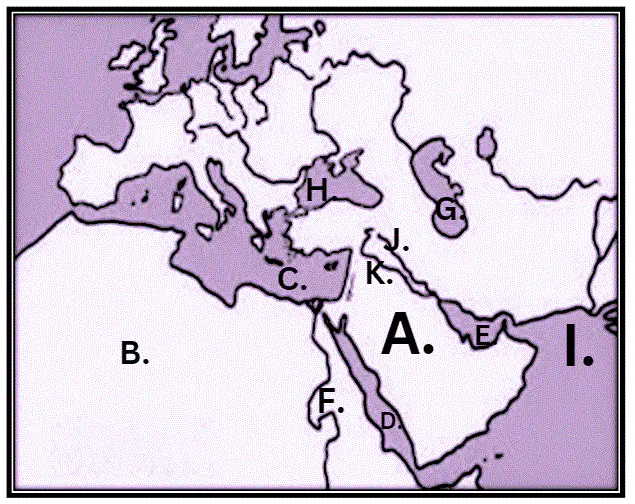
What geographic location is found at location "A?"
(a)
What geographic location is found at location "B?"
(a)
What geographic location is found at location "C?"
(a)
What geographic location is found at location "D?"
(a)
What geographic location is found at location "E?"
(a)
What geographic location is found at location "G?"
(a)
What geographic location is found at location "H?"
(a)
What geographic location is found at location "I?"
(a)
What geographic location is found at location "J?"
(a)
What geographic location is found at location "K?"
(a)
Samuel is learning about the 5 pillars of Islam and wants to understand the concept of Haj. Choose the best description of this important aspect of Islam for him.
Belief in one God.
Fasting during the month of Ramadan.
Charitable giving to the less fortunate.
Taking a pilgrimage to Mecca.
Which sacred texts are associated with Islam?
The Quran and The Sunnah
The Bible and The Torah
The Vedas and The Upanishads
The Tripitaka and The Dhammapada
What are the basic beliefs of Islam?
Polytheism and Eightfold Path
Monotheism and Five Pillars
Atheism and Four Noble Truths
Pantheism and Ten Commandments
Which region's scholars made contributions in the area of science?
Southwest Asia and North Africa
Europe and North America
South America and Australia
Asia and Africa
Who was responsible for the conquest of the Byzantine Empire?
Mehmed II
Alexander the Great
Suleiman the Magnificent
Osman I
What is the primary language spoken in Southwest Asia and North Africa?
Arabic
English
Spanish
French
What is the holiest city in Islam?
Mecca
Jerusalem
Rome
Delhi
Which Islamic empire was known for its cultural achievements and architectural wonders?
Umayyad Caliphate
Abbasid Caliphate
Ottoman Empire
Mughal Empire
Which Islamic architectural structure is primarily used for prayer?
Minaret
Mosque
Madrasa
Caravanserai

What religion did the Ottoman Empire help spread throughout their empire?
Buddhism
Christianity
Shintoism
Islam
What city did the Ottoman Empire conquer in 1453 putting an end to the Byzantium Empire?
Rome
Constantinople
Athens
Vienna
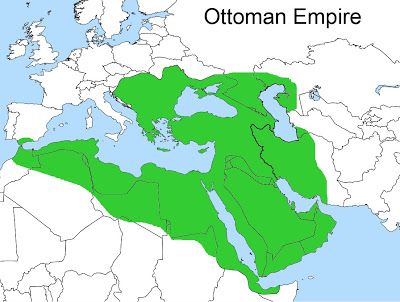
Which continents did the Ottoman Empire have some control over? Click all that apply.
Europe
Asia
Africa
North America
South America

left it alone
Which Language spread as a result of the Islamic people?
Which of the following best describes the medical advancements done by Islamic culture?
Which technology, first developed by the Chinese, enabled the Ottoman Empire to expand militarily into western Asia, Europe, and northern Africa?
woodblock printing
wheelbarrow
gunpowder
magnetic compass

This tool was used by Arabs scholars to figure out their location on earth so they would know which way to face for prayer.
monocle
astrolabe
microscope
telescope

What was the capital of the Ottoman Empire?
Baghdad
Istanbul
Cairo
Ankara
After the Tigris and Euphrates Rivers merge, they empty into the _______.
Persian Gulf
Caspian Sea
Black Sea
Red Sea
The climate of the Arabian Peninsula
Savannah
Desert
Mountainous
Tropical
The seas that surround the Arabian Peninsula are the Arabian Sea, Persian Gulf and...
Caspian Sea
Black Sea
Red Sea
Mediterranean Sea

What geographic land-form do the countries of Oman, Yemen and Saudi Arabia form?
Archipelago
Peninsula
Mountain
Plain
A book listing the actions of Muhammad that is provides and example of how to live is
The Caliph
The Sunnah
The Five Pillars of Islam
Medina
The holiest book of Islam is
The Ka'aba
The Haddith
The Sunnah
The Qu'ran
A Muslim place of worship?
Mecca
Souk
Jihad
Mosque
A caravan is
A muslim holy place
An area with water in the desert
A group of people traveling together often for trading or religious purposes
A traditional form of dress for Muslims

How many times a day are Muslims expected to pray?
3
4
5
6

What is the name of the month in which Muslims fast?
July
Ramadan
September
Siyam

Who did God reveal his message to during Ramadan?
Isaac
Abraham
Moses
Muhammad

What is the 5th Pillar of Islam about?
Fasting
Pilgrimage
Charity
Belief

What city do Muslims travel to during the Hajj (pilgrimage)
Medina
Ramadan
Mecca
Istanbul
This Pillar says Muslims should not eat from sunrise to sunset everyday for one month.
Faith
Pilgrimage
Fasting
Prayer
Who was the emperor of the Byzantine empire that created a code of laws known as Justinian Code?
Justinian
Muhammad
Mehmed II the Conqueror
Suleiman the Magnificent

A merchant is someone who...
grows crops
leads warriors
teaches about religion
trades goods
The contribution to Math that Muslims are best known for is
Founder of Geometry
Pythagorean Theorem
Inventors of Algebra
Pascal;s Triangle
What contribution did Muslims make to astronomy?
Muslim astronomers discovered the planet Mars
Muslim astronomers discovered multiple galaxies
Muslim astronomers discovered the expanded universe
Muslim astronomers proved that the moon affects ocean tides
Which ancient trade route ran from Asia to Europe?
Indian Ocean Marine Time System
Silk Road
Trans-Siberian Trade Route
West African Trade Route
The spread of Islam through the Islamic Empire and the areas that they traded in is an example of...
Cultural Diffusion
Trade Centers
Nomadic Lifestyles
Military Conquests
Which would be a good example of the diffusion of Islamic influences throughout different territories?
Europeans lost Greek and Latin writings from the ancient world
Christianity prevailed as the main religion in Western Europe
Judaism and Christianity had historical connections to Islam
Arabic became the language of trade in much of Asia and Africa
In what geographical location did Islam originate?
Constantinople
Arabian Peninsula
Istanbul
Baja Peninsula
What faith do Muslims follow?
Hindu
Catholicism
Judaism
Islam
Muslims follow only one god, Allah. What is this an example of?
Polytheism
Deism
Monotheism
Atheism

