
 Worksheets
Tuesday 10/10/23
Total questions: 6
Worksheet time: 5mins
What is an adaptation?
a trait or characteristic that helps an organism survive and reproduce in its environment.
a process by which an organism evolves over time.
a behavior that an organism learns.
a change in an organism's DNA.
How does natural selection affect populations?
by creating variation in individuals that allows them to better adapt to changing environmental conditions
by increasing the rate of beneficial mutations which allow individuals to increase their rate of reproduction
by reducing variation between individuals in a population thereby making the population more homogeneous and likely to survive
by acting on variations between individuals that make some better adapted to their environment and more likely to survive and reproduce

A researcher conducts an investigation on fiddler crabs to understand the importance of claw size in mating. The male fiddler crabs have one normal-sized claw and one giant claw that they wave to attract female fiddler crabs. The female fiddler crabs have two small, same-sized claws. The researcher places 15 male crabs with different sized claws into an enclosure with conditions similar to those in their natural habitat. The researcher then releases 15 female crabs into the enclosure. The graph shows the percentage of male crabs of different claw size that successfully mated for three successive trials.
The percentage of males with larger claws will increase in the population.
The percentage of males with smaller claws will continue to decrease in the population.
The percentage of males with smaller claws will evolve to have claws that attract more female crabs.
The percentage of males with varying claw sizes will remain constant, as both traits are selected for by female crabs.
The percentage of male and female crabs with smaller claws will decrease, as smaller claws are selected against in mating.
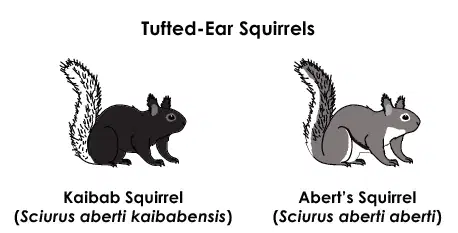
Two subspecies of tufted-ear squirrels have been observed near the Grand Canyon. Scientists believe that these two squirrels evolved from a common population of squirrels that lived in the ponderosa pine forests that once grew in what is now the Grand Canyon. The Kaibab squirrel is found on the north side of the canyon, and the Abert’s squirrel is found on the south side.
Which statement explains the formation of the two subspecies from the original population of tufted-ear squirrels?
Similar selection pressures on each side of the canyon caused fur color mutations to occur in the two populations.
As the canyon formed and the ponderosa forests disappeared, the original population was split into two isolated populations.
The original population was able to find similar habitats in many small pockets of connected forests remaining around the Grand Canyon
Natural land bridges connecting the two sides of the canyon allowed gene flow to occur between the populations after the ponderosa forests disappeared.
The sand goby is a small fish found in Europe’s Baltic Sea. During mate selection, females overwhelmingly choose males with large body sizes. In some parts of the Baltic, algae overgrowths are causing the water to become increasingly cloudy. In the cloudy water, females have trouble identifying the larger males.
What can you predict will happen if female sand gobies continue to have difficulty identifying large males during mate selection?
There will be a change in how often genes for large size occur in the population.
There will be an increase in resource competition between large and small males.
There will be an immigration of a new sand goby population from a different habitat.
There will be a mutation in the genes for eyesight that will improve vision in the females.
From an evolutionary perspective, what is the significance of reproductive isolation developing between two populations within a species?
Speciation due to reproductive isolation results in extinction of the ancestral species.
When two populations cannot interbreed, the flow of genetic information between them stops.
Over time, reproductive isolation leads to increasing competition between the populations.
When the size of breeding populations decreases, the mutation rate decreases resulting in greater fitness.

