
 Worksheets
Unit 4 Review
Total questions: 10
Worksheet time: 5mins
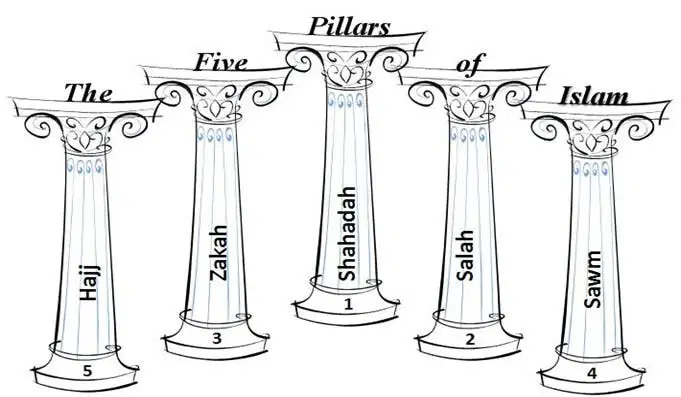
In the Islamic faith, there are 5 Pillars – Shahada, Salah, Zakat, Sawn and Hajj. They refer to which of the following ideas/practices?
Leadership, Fellowship, Community, Faith, Poor
Faith, Prayer, Alms, Fasting, Pilgrimage
Reincarnation, Soul, Prayer, Karma, Dharma
Right speech, Right action, Right thoughts, Right Effort, Right Livelihood
A ___ society is when land is owned by the nobility, and less powerful nobles are required to swear loyalty to the more powerful. In Japan, the ___ awarded the land to the nobility.
Agricultural/Daimyo
Egalitarian/Samurai
Feudal/Shogun
Noble/King
How did the feudal system contribute to so many private armies in Japan?
Because the king had family members that were against him and started their own armies to overthrow him.
Because several noble families hated the emperor and had allied with Korea, Philippines, Russia and China.
Because the Shogun gave lands to the Daimyos who provided the soldiers.
Because the emperor gave the Shogun the power to create as many armies as he wanted.
Who were the Samurai and what code did they follow?
Elite nobility/Buddhism
Trained farmers/Chivalry
Elite soldiers/Bushido
Shogun's family/Shinto
Why is the Tang Dynasty significant in China?
They expanded the empire, took control of central Asia and developed the meritocracy.
They closed the Silk Road, only traded with Japan and Korea and fought a major war with the Kievan Rus.
They expanded the Silk Road, built a navy and sailed to Africa, expanded Buddhism and Confucianism.
They discovered 7 planets, invented paper, glass and fireworks, expanded into Korea.
After several weak Chinese emperors had failed at governing during the Tang Dynasty, the Song Dynasty enjoyed a golden age but eventually collapsed because their bureaucrats did not have military experience.
What was a bureaucrat?
An administrative government worker
A farmer loyal to his "noble" land-owner
A low ranking soldier
A follower of Confucius
Between 1185 – 1603, Japan created a relationship between lords and the people who owned and/or worked the land. This relationship is known as . . .
Communism
Totalitarianism
Feudalism
Capitalism
How were the Silk Road and the Gold-Salt Trade similar?
They were both in the southwestern hemisphere.
They both helped their empires/dynasties become very wealthy.
New products and ideas were exchanged as merchants interacted with each other.
They both endured for 5,000 years or more.
Both B and C.
How are Hinduism and Islam different?
Hinduism is polytheistic and has no founder; Islam is monotheistic and was founded by Muhammed.
Hinduism has one major holy book; Islam has 5 major holy books.
Hinduism was contained in India for thousands of years; Islam traveled as far west as Spain and as far east as Japan.
Hinduism believes in a yearly pilgrimage to Mecca; Islam believes in a daily pilgrimage to a local shrine.
The leader of Muslim civil and religious matters; regarded as the successor of Muhammad
Sunni
Shi'a
Caliph
Sharia

