
 Worksheets
Evaluate - Day 3 - Cell Transport Quiz
Total questions: 16
Worksheet time: 2hrs 40mins
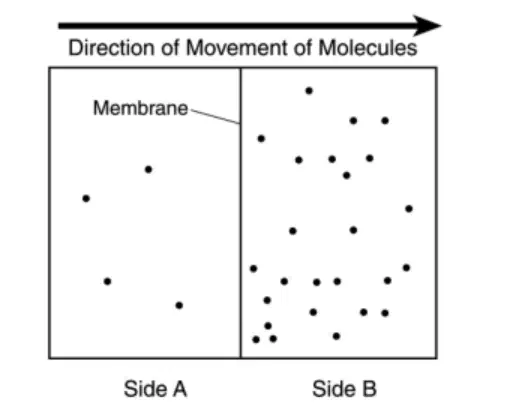
4. When the concentration of dissolved particles is the same throughout a solution, the system is said to be in (a) .
Determine the parts of the cell membrane.
Phospholipid Bilayer
Protein Channel
Phospholipid
Passive transport (a) require energy because it moves (b) the concentration gradient, from (c) .
Active transport (a) require energy because it moves (b) the concentration gradient, from (c) .

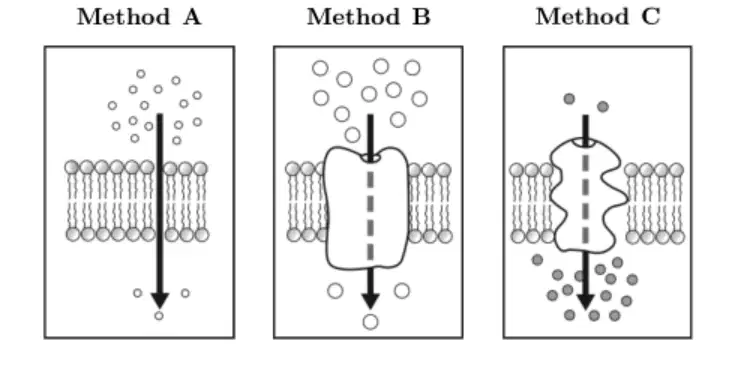
What is the correct description of the transport in the image?
small molecules crossing the lipid bilayer (diffusion)
large molecules crossing through a protein (facilitated diffusion)
many molecules coming into the cell using a membrane vesicle (endocytosis)
many molecules coming out of the cell using a vesicle to fuse with the membrane (exocytosis)
Organize these options into the right type of transport:
does NOT require energy
requires energy
molecules move WITH the gradient
molecules move AGAINST the gradient
molecules move from high concentration to low
molecules move from low concentration to high
Drag and label the parts of the phospholipid bilayer.
hydrophilic
hydrophobic

In the cell pictured, where would water move?
Into the cell, causing it to swell
Out of the cell, causing it to shrink
In and out of the cell equally, causing the shape to stay the same

In the cell pictured, which way would water move?
Into the cell, causing the cell to swell
Out of the cell, causing the cell to shrink
In and out of the cell equally, keeping the shape the same

In the cell pictured, which way would water move?
Into the cell, causing the cell to swell
Out of the cell, causing the cell to shrink
In and out of the cell equally, keeping the shape the same

What type of solution is this healthy looking red blood cell in?
Isotonic
Hypertonic
Hypotonic

The cell below is in a _____________ solution.
Hypertonic
Hypotonic
Isotonic


