wayground logo

Free Printable Worksheets

Font size

S
M
L
XL
Worksheets

Unit 1 Test: Patterns in the Sky

Total questions: 73

Worksheet time: 37mins

Name
Class
Date
1.
Seasons on Earth are primarily caused by
a)
the tilt of Earth's rotational axis
b)
the distance from the Earth to the Sun
c)
the tilt of the Earth's magnetic axis
d)
the dates of the solstices and equinoxes
e)
the orbit of the Moon around the Earth
2.
Which of the following about the ecliptic plane is false?
a)
The sun appears to move about 1° eastward along the ecliptic plane every day.
b)
The ecliptic plane is tilted 23.5° degrees with respect to the equator.
c)
The moon can never leave the ecliptic plane, but the moon moves twelve times faster than the sun along it
d)
The major planets of the Solar System stay close to the ecliptic plane, but not always exactly on it
3.
What celestial line is a product of the Earth's orbit around the Sun (or seen as the Sun's path through Earth's skies)?
a)
The Ecliptic Plane
b)
The Celestial Meridian
c)
The Celestial Equator
d)
The Lunar Plane
e)
The Galactic Disk
4.
Where on Earth would you be if the Sun sets and stays down for six continuous months, beginning on September 20th?
a)
North Pole
b)
Arctic Circle
c)
Tropic of Cancer
d)
Equator
e)
Tropic of Capricorn
5.
What statements about the length of a day are false? Choose two.
a)
At the north pole, there is six months of daylight, and then there is six months of night
b)
At the equator, every day is exactly twelve hours long and then there is twelve hours of night
c)
The solar day is four minutes longer than the sidereal day
d)
The solar day is four minutes shorter than the sidereal day
e)
The sidereal day includes both the Earth's rotation *and* revolution around the Sun.
6.
When the Sun rises, it is located in the constellation Gemini. When the Sun sets later that same day, what constellation will it be in?
a)
Aries
b)
Taurus
c)
Gemini
d)
Leo
7.
What is the name of the shape the path of the sun makes, at noon, throughout the course of a year?
a)
Octagon
b)
Analemma
c)
Ellipse
8.
What do we call the points where the sun crosses the celestial equator? Hint: This is also the days the sun passes directly over Earth's equator.
a)
prime meridians
b)
equinoxes
c)
zeniths
d)
solstices
e)
none of these
9.
What does "zenith" mean?
a)
Directly overhead
b)
On the horizon
10.
What is the northernmost latitude where the sun can be at the zenith?
a)
Arctic Circle
b)
Tropic of Cancer
c)
Equator
d)
Tropic of Capricorn
e)
Antarctic Circle
11.
What is the southernmost latitude where the sun can be in the zenith?
a)
Arctic Circle
b)
Tropic of Cancer
c)
Equator
d)
Tropic of Capricorn
e)
Antarctic Circle
12.
When will the sun be at zenith at noon in Hallsville, TX?
a)
on the vernal equinox
b)
on the autumnal equinox
c)
on the summer solstice
d)
on the winter solstice
e)
never
13.
Solar Noon is defined to be the point where the Sun crosses your local...
a)
zenith
b)
meridian
c)
apex
d)
horizon
14.
The length of the day is measured from one ________ to the next.
a)
Sunrise
b)
Sunset
c)
Noon
15.
What is the point in the sky where the Celestial Meridian, the Celestial Equator, and the Ecliptic Plane all meet? Hint: We consider this day to be the first day of the solar year.
a)
Vernal Equinox
b)
Autumnal Equinox
c)
Ecliptic
d)
Summer Solstice
e)
Winter Solstice
16.
On what days will every latitude have equal daylight and darkness?
a)
Solstices
b)
Equinoxes
17.

The sun's lowest position in the sky for the northern hemisphere - closest to the horizon - occurs at the
a)
summer equinox
b)
summer solstice
c)
winter equinox
d)
winter solstice
18.
The two days when the Sun rises due east and sets due west are the
a)
equinoxes
b)
solstices
c)
solar days
d)
tidal days
19.
The sun rises north of east in the northern hemisphere. The day length will be
a)
longer
b)
shorter
20.
The sun rises north of east in the northern hemisphere. The sun will rise...
a)
to a high height, closer to zenith, in the southern skies
b)
to a high height, closer to zenith, in the northern skies
c)
to a low height, closer to the horizon, in the southern skies
d)
to a low height, closer to the horizon, in the souther skies
21.
The sun rises north of east in the northern hemisphere. We will receive...
a)
more direct sunlight and more concentrated solar energy throughout the day
b)
less direct sunlight and less concentrated solar energy throughout the day
22.
The sun rises north of east in the northern hemisphere. The day will be...
a)
generally warmer, closer to the June solstice
b)
generally cooler, closer to the June solstice
c)
generally warmer, closer to the December solstice
d)
generally cooler, closer to the December solstice
23.
June 20-22
a)
Summer Solstice (N Hemisphere)
b)
Winter Solstice (S Hemisphere)
c)
Spring Equinox (N Hemisphere)
d)
Autumnal Equinox (N Hemisphere)
e)
Winter Solstice (N Hemisphere)
24.
September 20-22
a)
Autumnal Equinox (N Hemisphere)
b)
Spring Equinox (S Hemisphere)
c)
Spring Equinox (N Hemisphere)
d)
Summer Solstice (N Hemisphere)
e)
Winter Solstice (N Hemisphere)
25.
At apogee, the Moon is at its farthest from Earth and thus appears smaller than normal. Because of this it can produce only annular solar eclipses, not total solar eclipses.
a)
True
b)
False
26.
A solar eclipse can only happen during a:
a)
new moon
b)
solstice
c)
first quarter moon
d)
full moon
27.
A lunar eclipse can only happen during a
a)
new moon
b)
equinox
c)
full moon
d)
perigee
28.
If you are entirely in the Moon's shadow, then you will witness
a)
nighttime
b)
a total solar eclipse
c)
a total lunar eclipse
d)
a partial solar eclipse
e)
a partial lunar eclipse
29.
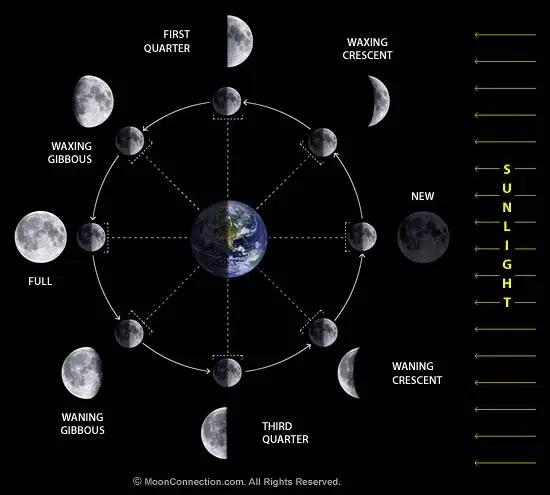
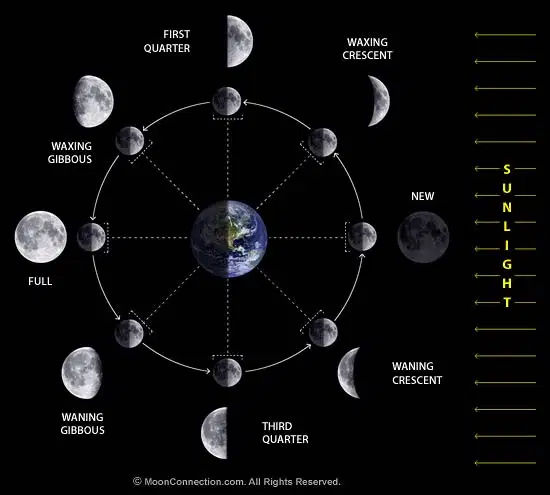
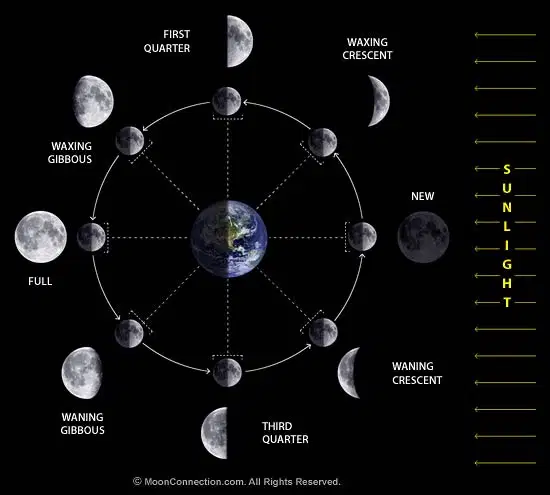
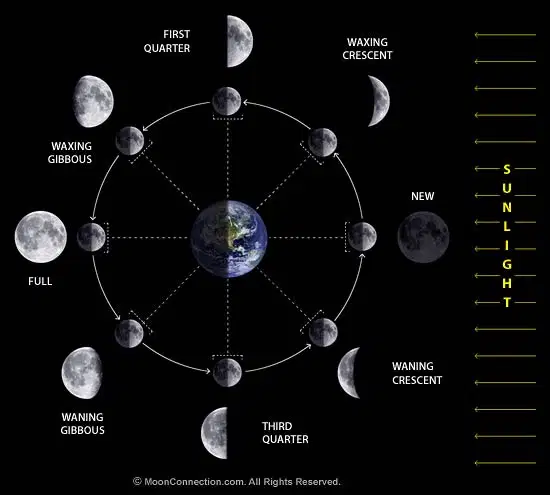
If the Moon rose tonight at 6 PM (sunset), then tomorrow it will rise about what time?
a)
the same time
b)
7 PM
c)
5 PM
d)
dawn
30.
Which statements about the first quarter moon are false? Choose two
a)
it rises about noon
b)
from Earth, it appears 25% sunlit
c)
it is the "half moon" in the evening sky
d)
it is highest in the sky at sunset
e)
it will produce a Spring tide
31.
If a new moon fell on March 2nd, what is the Moon's phase on March 14th? Hint: This is 12 days later
a)
waxing gibbous
b)
waxing crescent
c)
first quater
d)
full
e)
waning gibbous
32.
What conditions are necessary for a total solar eclipse?
a)
new moon on equator at perigee
b)
full moon on ecliptic at perihelion
c)
new moon on ecliptic at perigee
d)
new moon on ecliptic at apogee
33.

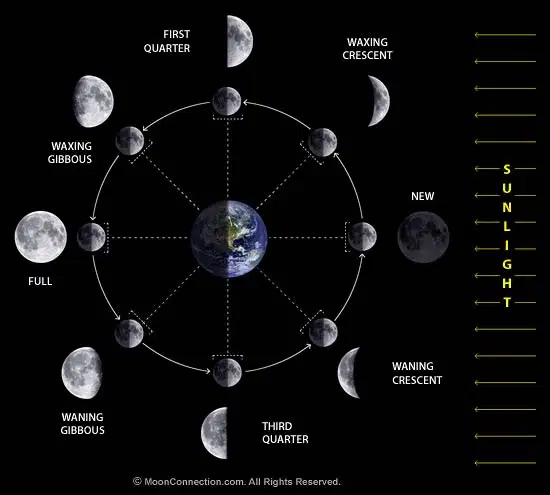
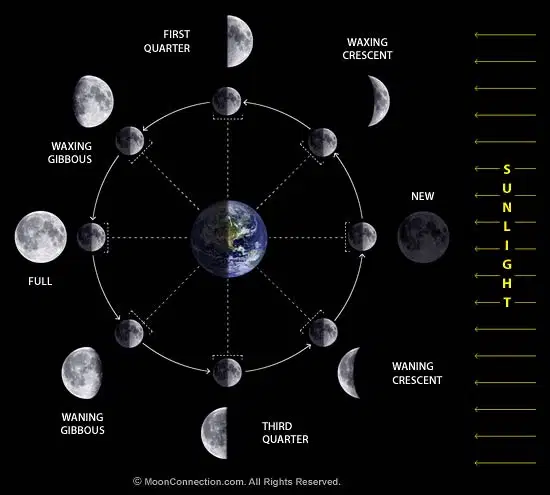
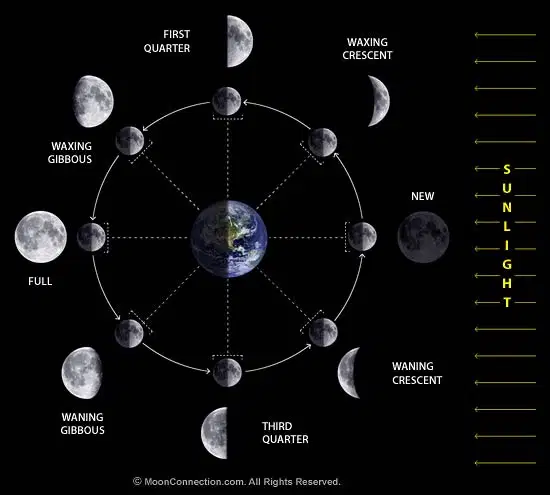
Driving just after sunrise, you observe a Moon in the sky. Which of the below phases could the moon be in to be seen at that time?
a)
waning gibbous
b)
third quarter
c)
waning crescent
d)
waxing crescent
e)
first quarter
34.
When the moon is directly opposite the Sun in the sky, its phase is
a)
new
b)
waxing or waning crescent
c)
first or third quarter
d)
full
35.
The waxing gibbous phase of the Moon
a)
rises at midmorning
b)
sets at dawn
c)
crosses the meridian before midnight
d)
is visible at noon
36.
What conditions are necessary for an annular solar eclipse? Check everything you need.
a)
a new moon
b)
moon on ecliptic
c)
moon at apogee
d)
Earth in moon's shadow
e)
a full moon
37.
Some type of solar eclipse will happen about
a)
every month at new moon
b)
every week at full moon
c)
every month at full moon
d)
every six months at new moon
38.
If the Moon rises exactly at sunset today, what phase will it be in?
a)
Full
b)
New
c)
Waxing Crescent
d)
1st Quarter
e)
Waxing Gibbous
39.
From Earth, the Sun and Moon have about the same angular diameter (aka.. size).
a)
True
b)
False
40.
Going from full moon to third quarter moon takes about a week
a)
True
b)
False
41.
The first quarter moon will rise about noon and set about midnight.
a)
True
b)
False
42.
As it orbits the Earth, the Moon appears to move eastward about its own diameter every hour.
a)
True
b)
False
43.
Which of the following Moon phases will generate a Neap tide? Choose 2.
a)
1st Quarter
b)
3rd Quarter
c)
New
d)
Waxing Crescent
e)
Waxing Gibbous
44.
The third quarter phase of the Moon rises about...
a)
Midnight
b)
Dawn/Sunrise
c)
Midmorning
d)
Noon
e)
Midafternoon
45.
The third quarter phase of the Moon sets about...
a)
Noon
b)
Dawn/Sunrise
c)
Midmorning
d)
Midafternoon
e)
Dusk/Sunset
46.
The third quarter phase of the Moon crosses the meridian (is overhead)about...
a)
Dawn/Sunrise
b)
Midmorning
c)
Noon
d)
Midafternoon
e)
Dusk/Sunset
47.
The third quarter phase of the Moon creates what type of tides?
a)
Spring
b)
Neap
c)
Somewhere in between
48.
The third quarter phase of the Moon creates what type of eclipse?
a)
Solar
b)
Lunar
c)
Neither
49.
The northern pole star today is not the same one that the ancient Egyptians used when they build the pyramids.
a)
True
b)
False
50.
Different constellations are visible at different times of the year for our position on Earth.
a)
True
b)
False
51.
There are 12 constellations of the astronomical Zodiac.
a)
True
b)
False
52.
Most of the constellations will seem to contain 3 to 5 solar system planets on any given night.
a)
True
b)
False
53.
The planets are always close to the ecliptic plane.
a)
True
b)
False
54.
Sidereal (star) days are 4 minutes shorter than solar days. If a star rises at 9 PM tonight, then in one month the star will rise at what time?
a)
7 PM
b)
8 PM
c)
9 PM
d)
10 PM
e)
11 PM
55.
From the north pole, all northern hemisphere constellations appear circumpolar.
a)
True
b)
False
56.
From the South Pole, Polaris would appear directly overhead.
a)
True
b)
False
57.
Over the course of a night, Polaris moves less than any other visible star in the sky.
a)
True
b)
False
58.
Where on Earth are all the stars visible over the course of the year?
a)
Equator
b)
North Pole
c)
Arctic Circle
d)
Tropic of Cancer
e)
Tropic of Capricorn
59.
All the stars we see are the same distance from Earth.
a)
True
b)
False
60.
The star Vega in Lyra will one day serve as the North Star.
a)
True
b)
False
61.
About how many stars are visible on a clear, dark night with the naked eye alone?
a)
a few dozen
b)
a few hundred
c)
a few thousand
d)
tens of thousands
62.
Into how many constellations is the celestial sphere divided?
a)
88
b)
22
c)
44
d)
57
e)
92
63.
What are constellations?
a)
groups of galaxies gravitationally bound and close together in the sky
b)
groups of stars making an apparent pattern in the celestial sphere
c)
groups of stars gravitationally bound and appearing close together in the sky
d)
apparent groupings of stars and planets visible on a given evening
64.
Where on Earth would you be if Polaris was at your zenith?
a)
north pole
b)
arctic circle
c)
equator
d)
tropic of Cancer
e)
tropic of Capricorn
65.
You not a particular star is directly overhead. When will it be directly overhead again?
a)
in 1 hour
b)
in 12 hours
c)
in 23 hours 56 minutes
d)
in 24 hours 4 minutes
66.
Why won't Polaris always be the pole star?
a)
the sideral day is shorter than the solar day
b)
Earth's precession shifts the celestial pole
c)
the moon follows the ecliptic instead of the equator
d)
the solar winds are blowing Earth farther away from the Sun
67.
The zodiac constellations lie along the
a)
ecliptic plane
b)
celestial equator
c)
lines of longitude
d)
lines of latitude
68.
The angle of Polaris above the northern horizon can be used to find your ______ on Earth.
a)
latitude
b)
longitude
c)
right ascension
d)
zenith
e)
none of these
69.
What do we call constellations and stars that circle the north pole without setting?
a)
transpolar
b)
zodiac
c)
circumpolar
d)
ecliptic
e)
none of these
70.
What is Earth's precession?
a)
the path Earth takes around the Sun
b)
the wobble of Earth's axis
c)
the point where Polaris rises each night
d)
the point where the Sun rises
e)
the movement of the stars across the night sky
71.
How long is the Earth's precession cycle?
a)
26000 years
b)
365.24 days
c)
29.5 days
d)
18 years, 11.3 days
e)
1 day
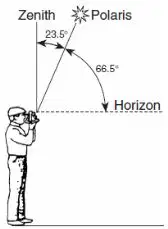
72.
Look at the following illustration. What is this person's latitude?
a)
b)
66.5°
c)
23.5°
d)
90°
e)
More information is needed
73.
How well do you feel the Planetarium did in introducing the topics for this unit?
(Not well = 1, Very well = 5)
a)
1
b)
2
c)
3
d)
4
e)
5