wayground logo

Free Printable Worksheets

NEW

Font size

S
M
L
XL
Worksheets

Speed, Acceleration, and Gravity

Total questions: 34

Worksheet time: 43mins

Name
Class
Date
1.
Speed equals distance divided by
a)
time
b)
velocity
c)
size
d)
motion
2.
The rate at which velocity changes is called
a)
speed
b)
direction
c)
acceleration
d)
motion
3.
Which of these is an example of negative acceleration (or deceleration)?
a)
a bird taking off for flight
b)
a baseball released by a pitcher
c)
a car approaching a red light
d)
an airplane following a straight flight path
4.
A train that travels 100 kilometers in 4 hours is traveling at what average speed?
a)
50 km/h
b)
100 km/h
c)
2 km/h
d)
25 km/h
5.
If the speed of an object does not change, the object is traveling at
a)
constant speed
b)
average speed
c)
increasing speed
d)
decreasing speed
6.
If you know a car traveled 300 km in 3 hours, you can find its
a)
acceleration.
b)
direction.
c)
average speed.
d)
velocity.
7.
A measurement of how fast an object is moving
a)
Velocity
b)
Speed
c)
Vector
d)
Acceleration
8.
Acceleration is defined as the CHANGE in 
a)
time it takes for one place to move to another place. 
b)

in gravity

c)
distance divided by the time interval 
d)
velocity divided by the time interval 
9.

A roller coaster accelerates from an initial speed of 6.0 m/s to a final speed of 70 m/s over 4 seconds. What's the acceleration?

a)

24 m/s2

b)

18 m/s2

c)

16 m/s2

d)

16 m/s

10.

final speed minus initial speed, divided by time

a)

acceleration

b)

speed

c)

relative motion

11.

If a truck travels at a steady velocity, will there be any acceleration?

a)

Yes

b)

No

12.

Calculate the average acceleration of a car given the following information:

Initial velocity 10 m /sec   
Final velocity  55 m /sec 

The change in velocity took 3 seconds 

a)

18.33 meters per second squared 

b)

21.67 meters / second squared 

c)

15 meters / second squared 

13.

The acceleration of objects falling on Earth due to gravity is

a)

9.8 m/s

b)

9.8 m/s2

c)

9.8 g/mL

d)

9.8 g/m/m

14.

What does it mean for an object to be in free fall?

a)

Only air resistance acting on the object.

b)

Gravity is the only force acting on the obejct.

c)

Any object that is in downward motion.

15.
A negative acceleration means that your object is _____. 
a)
not accelerating
b)
not moving
c)
speeding up 
d)
slowing down 
16.

Define acceleration due to gravity.

a)

The force of gravity acting on an object.

b)

The velocity of an object under the influence of gravity.

c)

The acceleration experienced by an object due to gravity.

d)

The force of gravity.

17.

True or False: Air resistance is the force that opposes the motion of objects through the air.

a)

True

b)

False

18.

True or False: Objects fall to the ground at the same rate because the acceleration due to gravity is the same for all objects.

a)

True

b)

False

19.

The force of attraction between two objects.

a)

propulsion

b)

gravitational force

c)

propelling

20.
Gravity attracts all objects towards one another.
a)
False
b)
True
c)
It depends
21.
Any object with mass has gravity.
a)
True
b)
Sometimes
c)
False
d)
Never
22.
The force of gravity acting on an object is the object's ______.
a)
mass
b)
matter
c)
weight 
d)
friction 
23.
The amount of matter in an object is 
a)
pressure
b)
weight
c)
mass
d)
force
24.
Which of the following never changes no matter where in the universe?
a)
weight
b)
force
c)
mass
d)
pounds
25.
A person would weigh less on on the Moon than on the Earth because . . .
a)
Moon has more mass, and therefore more gravity
b)
Moon has less mass, and therefore more gravity
c)
Moon has more mass, and therefore less gravity
d)
Moon has less mass and therefore less gravity
26.
Gravity attracts all objects towards one another.
a)
False
b)
True
c)
It depends
27.
Every object in the universe attracts every other object.
a)
True
b)
False
28.
Is the force of gravity on the diver a push or a pull?
a)
push
b)
pull
29.

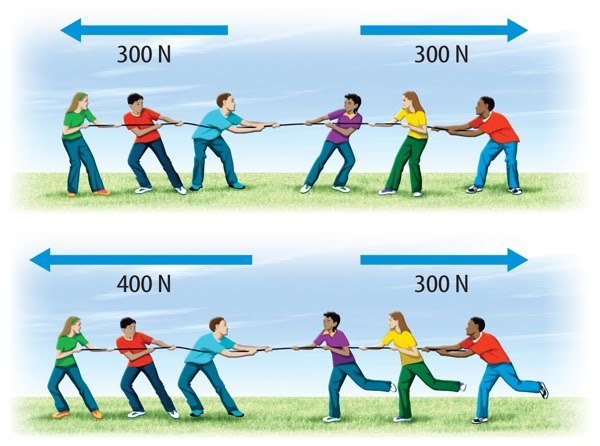
Which one is balanced?

a)

top

b)

bottom

c)

both

d)

Neither is balanced

30.

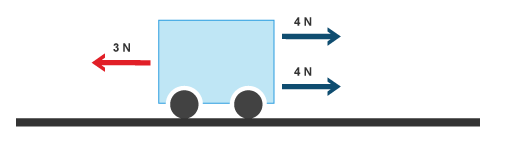
What is the net force on the object pictured?

a)

3 N

b)

5 N

c)

4 N

d)

9 N

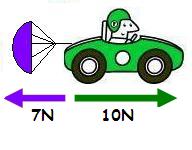
31.
What is the net force?
a)
17 N Right
b)
3 N Right
c)
3 N Left
d)
17 N Left
32.
Which direction will the object move?
a)
Up
b)
Down
c)
Right
d)
Left
33.
Calculate the net force shown in the  diagram?
a)
41 N
b)
25 N
c)
16 N
d)
9 N
34.
What is the net force?
a)
65 N left
b)
65 N right
c)
35 N left
d)
35 N right