
 Worksheets
Test Corrections - Cells & Levels of Org
Total questions: 20
Worksheet time: 58mins
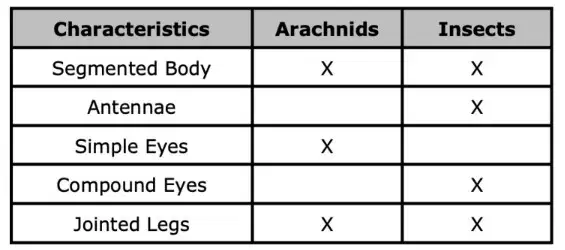
A table of arachnid and insect characteristics is shown. Which characteristic could be used to distinguish between arachnids and insects?
Antennae are present.
Legs are jointed
Body is segmented
Eyes are present
Plant cells have a strong, rigid outer layer known as the cell wall. The function of the cell wall is to
convert energy from sunlight into chemical energy.
regulate the movement of substances in and out of the cell.
contain the genetic material for the cell.
protect and support the cell.
Which of the following examples best represents the levels of organization in a gray whale from least (smallest) to most complex (largest)?
A Gray whale ⇒ respiratory system ⇒ lungs ⇒ lung cell ⇒ lung tissue
Lung cell → lung tissue ⇒ lungs ⇒ respiratory system ⇒ gray whale
Lung cell ⇒ respiratory system ⇒ lung tissue ⇒ lungs ⇒ gray whale
Lung tissue ⇒ lungs ⇒ lung cell ⇒ respiratory system ⇒ gray whale
Which table correctly describes the functions of the cell structures listed?


Which cellular structures are found in both plant and animal cells? Select THREE correct answer choices.
Cell Membrane
Nucleus
Vacuole
Chloroplast
Cell Wall
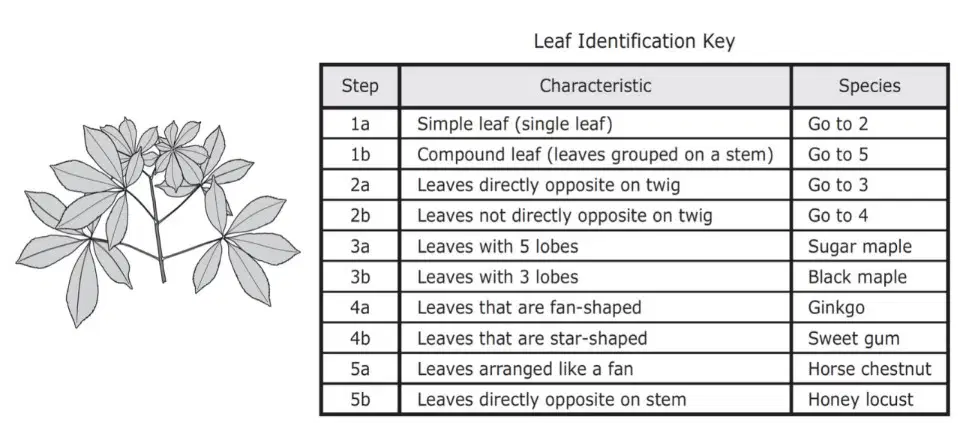
Based on the identification key, which type of tree is the sample from?
Horse chestnut
Ginkgo
Sugar maple
Black maple
The combination of a heart, arteries, veins and capillaries is -
an organ system.
a tissue.
an organism.
a cell.

Based on the collected data shown in the table, which part of the cell theory is best supported?
Cells are the basic unit of living things.
Organisms can be unicellular or multicellular.
All cells come from preexisting cells.
Plants transport water upward from the roots to the stems and leaves through specialized structures called xylem. The xylem is made of a collection of many cells that join together to form microscopic tubes throughout the plant. Based on this description, xylem is classified as-
a tissue.
an organism.
an organ system.
an organ.
The stomach, small intestine, and large intestine are all organs. When these organs work together to process food, they form functional unit known as
an organism.
a tissue.
a cell.
an organ system.
The smallest structures in organisms that can perform all of the basic functions of life are
organs.
cells.
tissues.
organ systems.
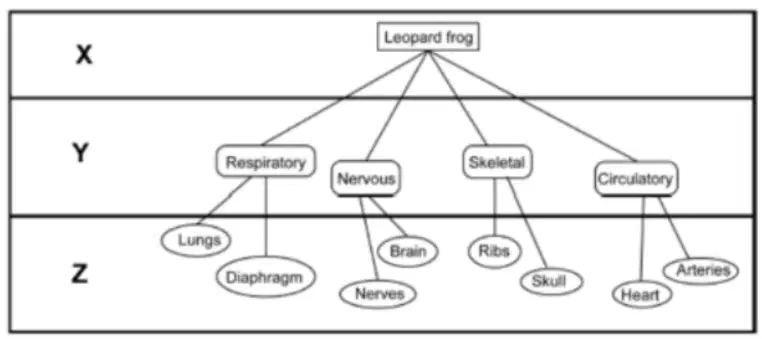
Provided is a level of organization diagram. Which terms correctly label each level in the diagram?
(X) Organ system
(Y) Organs
(Z) Cells
(X) Cells
(Y) Organs
(Z) Organism
(X) Organism
(Y) Organ System
(Z) Organs
(X) Organs
(Y) Organ System
(Z) Organism
Which cellular structure regulates the movement of substances in and out of plant and animal cells?
Cell Membrane
Cell Wall
Cytoplasm
Nucleus

What body system is structure X most similar to in a multicellular organism?
The nervous system, since X controls all of the cells functions.
The digestive system, since X stores food and waste.
The circulatory system, since X moves fluids throughout the cell.
The integumentary system, since X protects the cell.
Plants use energy from sunlight, water, and carbon dioxide to produce a simple sugar called glucose. This process is called PHOTOSYNTHESIS. Which organelle does this in plant cells?
Vacuole
Nucleus
Chloroplasts
Cell membrane

According to the Cell Theory, which of the following is a correct statement about the mushrooms (which are fungi) and the person (which is an animal)?
They reproduce in the same way.
They are made from cells.
They undergo photosynthesis.
They quickly evolve.
A school's cafeteria kitchen has a large, walk-in refrigerator where food is stored for lunch later in the week. Which cell organelle has a function that is similar to the refrigerator?
Vacuole
Nucleus
Chloroplast
Mitochondrion
In an organism, the brain directs the body how to respond to stimuli (things that are changing. ex: temperature, amount of light, etc.) from the environment. In a cell, this function is performed by the -
vacuole.
chloroplasts.
mitochondria.
nucleus.
Schwann studies animals and concluded that all animals are made of cells. Schleiden studied plants and concluded that all plants are made of cells. What statement was developed most directly from these conclusions and is part of the modern cell theory?
Organisms are composed of one or more cells.
Cells come from pre-existing cells.
Cells in multicellular organisms are eukaryotic.
Cells contain heredity information.
What is the main function of mitochondria?
Protein production
DNA storage
Lipid production
Energy production

