wayground logo

Free Printable Worksheets

Font size

S
M
L
XL
Worksheets

Matter

Total questions: 76

Worksheet time: 3570secs

Name
Class
Date
1.
Boiling an egg can be said to show....
a)
no change.
b)
a physical and a chemical change.
c)
a poor choice for breakfast.
2.
Baking a cake is an example of a...
a)
Physical Change
b)
Chemical Change
3.
Breaking a window or crumpling a piece of paper are examples of a....
a)
Physical Change
b)
Chemical Change
4.
True or False: A PHYSICAL CHANGE does NOT create a different kind of matter.
a)
True
b)
False
5.
True or False: A CHEMICAL CHANGE is a change in some properties of matter WITHOUT forming a different kind of matter.
a)
True
b)
False
6.
Temperature measures...
a)
The amount of matter in an object.
b)
how fast or slowly molecules are moving.
c)
the amount of space an object takes up.
7.
Lemonade is an example of a...
a)
Mixture
b)
Solution
8.
Lucky Charms and milk is an example of a...
a)
Mixture
b)
Solution
9.
Measured with a balance...
a)
Mass
b)
Volume
10.
Liquid form is measured with a graduated cylinder...
a)
mass
b)
volume
11.
Amount of space an object takes up...
a)
Mass
b)
Volume
12.
Amount of matter in a solid, liquid, or gas...
a)
mass
b)
volume
13.
Substance that fills its container but will not "spill" into more space unless more of the substance is added...
a)
solid
b)
liquid
c)
gas
14.
Substance that fills its container and can "spill" out into more space...
a)
solid
b)
liquid
c)
gas
15.
Substance with a DEFINITE shape and DEFINITE volume...
a)
solid
b)
liquid
c)
gas
16.
Substance with a DEFINITE volume, but NO definite shape...
a)
solid
b)
liquid
c)
gas
17.
Substance with NO definite volume or shape...
a)
solid
b)
liquid
c)
gas
18.
The idea that everything is made up of small particles called atoms...
a)
Big idea
b)
Atomic Theory
c)
Einstein's Theory
19.
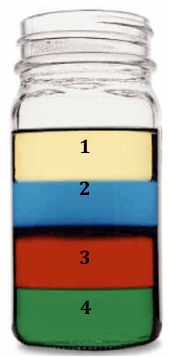
Put the liquids in order from most dense to least dense?
a)
4, 3, 2, 1
b)
1, 2, 3, 4
c)
3, 4, 2, 1, 
d)
4, 3, 1, 2
20.

Volume is a measurement of:

a)

the amount of particles a substance has.

b)

the space an object occupies

21.
Water in its solid form is _____________.
a)
a vapor
b)
ice
c)
a liquid
d)
boiling
22.
Liquid matter takes the shape of _______.
a)
a gas
b)
water
c)
a pet
d)
Its container
23.
A watermelon has more matter than a grape, so it has more
a)
mass
b)
eat
c)
solid
d)
greater
24.
I am the smallest whole particle of matter. 
a)
atom
b)
compound
c)
molecule
d)
mixture
25.
The amount of matter something contains. 
a)
volume
b)
mass
c)
density
d)
measurement 
26.
The amount of space something takes up
a)
density
b)
volume
c)
mass
d)
matter
27.
Which state of matter has particles that are tightly packed?
a)
liquid
b)
gas
c)
solid
28.
When you see steam, fog or clouds, which state of matter is it?
a)
solid
b)
liquid
c)
gas
29.
What can causes ice to transform from a solid to a liquid?
a)
The air.
b)
The cold.
c)
Shape
d)
Heat
30.
A physical change does not need energy to occur.
a)
True
b)
False
31.
Smashing a piece of candy into smaller pieces is an example of a:
a)
Physical change
b)
Chemical change
32.
Burning wood to ash is an example of a:
a)
Physical change
b)
Chemical change
33.
Water freezing to ice is an example of a:
a)
Physical change
b)
Chemical change
34.
Chopping wood is an example of a:
a)
Physical change
b)
Chemical change
35.
Changing the way matter looks without changing it into NEW matter is a:
a)
Chemical change
b)
Physical change
c)
Energy change
d)
BOTH a chemical and a physical change
36.
Which change can occur when  you add heat energy to water?
a)
The water can change from a liquid to a solid
b)
The water can change from a gas to a liquid
c)
The water can change from a liquid to a gas
d)
The water can change from a solid to a liquid
37.
What causes a change in the state of matter?
a)
physical properties
b)
chemical energy
c)
temperature
38.
Cutting an orange is a physical change.
a)
True
b)
False
39.
Example for Physical Property
a)
Taste
b)
explodes
40.
If you saw a glass of water and later the water was gone what happened to the water? Remember that your in the science lab.
a)
Ms. Klenk was very thirsty and drank the water.
b)
evaporation
c)
precipitation
d)
solubility
41.
What are the states of matter?
a)
solid, liquid, and juice
b)
solid and liquid
c)
solid and gas
d)
solid, liquid, and gas
42.

What is the difference between matter and non-matter?

a)

Matter is tangible, while non-matter is intangible.

b)

Matter can be seen and touched, while non-matter cannot be seen or touched.

c)

Matter can be measured, while non-matter cannot be measured.

d)

Matter has mass and occupies space, while non-matter does not have mass or occupy space.

43.

What is non-matter?

a)

Anything that has mass but does not occupy space

b)

Anything that does not have mass but occupies space

c)

Anything that does not have mass or occupy space

d)

Anything that has mass and occupies space

44.

What is the difference between a mixture and a solution?

4 lines
45.

Which phase has a fixed shape?

a)

Solid

b)

Liquid

c)

Gas

46.

Which phase has no definite volume nor shape?

a)

Solid

b)

Liquid

c)

Gas

47.

Which is a physical change?

a)
Mixing salt and water
b)
Burning wood
c)

Cutting paper with scissors

48.

Which is a Chemical change?

a)
Burning of wood
b)
Melting of ice
c)
Cutting a piece of paper
49.

Match the following

a)

Graduated container

1.

Measures liquids

b)

Balance

2.

Measures mass

c)

Water displacement

3.

Can measure irregularly shaped objects

50.

Match the following

a)

mass

1.

amount of material in a substance

b)

matter

2.

substance that has both mass and volume

c)

mixture

3.

2 substances physically combined

d)

volume

4.

amount of space an object takes up

51.

Match the following

a)

gas

1.

no definite shape or volume

b)

liquid

2.

no definite shape, definite volume

c)

solid

3.

definite shape and volume

52.

The process of a liquid changing to gas is called

a)
condensation
b)
melting
c)

vaporization

53.

A change in matter that does not form a new substance is

a)

physical change

b)

chemical change

c)

physical property

54.

Condensation happens when

a)

gas changes to liquid.

b)

liquid changes to gas.

c)

water vapor changes to ice

55.

Melting happens when

a)

solids turn into liquids

b)

liquids turn into gas

c)
addition of water
56.

Freezing is what happens when

a)

a liquid changes to solid

b)

gas changes to liquid

c)

solid changes to liquid

57.

Which of the following is not a matter?

a)

a candle's heat

b)

a candle

c)

air inside a balloon

d)

a melting ice cream

58.
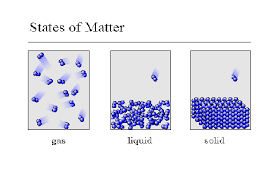
What does this picture represent? 
a)
solid
b)
liquid 
c)
gas
d)
plasma
59.

What does this picture represent?

a)

solid

b)

liquid

c)

gas

d)

plasma

60.
If the tops were removed from the cylinders, the following would happen:
a)
The solid would fly out of the container
b)
The liquid would fly out of the container.
c)
The gas would fly out of the container.
d)
They ALL would fly out of the container.
61.
Water can be a solid, liquid, and a gas.
a)
True
b)
False
liquid
62.

Particles move quickest in which state of matter

a)

solid

b)

liquid

c)

gas

d)

solid, liquid and gas

63.

The particles in the picture are tightly held together with little movement. They have shape and energy. Therefore, the picture represents _________.

a)

solid

b)

liquid

c)

gas

d)

plasma

64.
The milk in the glass has volume and takes the shape of its container. Therefore, it is assumed that milk is a ______________.
a)
solid
b)
liquid
c)
gas
d)
plasma
65.

Which state of matter has tightly packed particles?

a)

solid

b)

liquid

c)

gas

66.

A gas

a)

has a definite shape but no definite volume

b)

has a definite volume but no definite shape

c)

has fast-moving particles

67.

A physical property is a feature of an object that you can observe with your senses and measure with a tool.


Which is a physical property that you can measure?

a)

the color of a ball

b)

the freezing point of water

c)

the texture of a sweater

d)

the smell of something burning

68.

Which of the following represent chemical changes?

a)

chopping wood

b)

milk turning sour

c)

breaking a pencil

d)

fruit ripening

e)

roasting a marshmellow

69.

Which of the following represent physical changes?

a)

fruit ripening

b)

milk turing sour

c)

chopping wood

d)

mixing food color and water

e)

melting butter

70.

Sammy poured oil and water into a glass and mixed the liquids. He let the liquids sit in the glass for 8 hours and the 2 liquids separated as shown in the picture.


What happened to the 2 liquids?

a)

The oil is more dense than water, and it dissolved in the water

b)

The oil is less dense than water, and it dissolved in the water

c)

The oil is more dense than water and cannot dissolve in water

d)

The oil is less dense than water and cannot dissolve in water

71.

Tim has two beakers of liquid at room temperature. He places both beakers on a hot plate. The liquid in Beaker A boils before the liquid in Beaker B.


Which statement explains why the liquid in Beaker A boils before the liquid in Beaker B?

a)

Beaker A has a lower boiling point

b)

Beaker B has a higher freezing point

c)

The liquid in Beaker A has less mass

d)

The liquid in Beaker B has a lower density

72.

Which term describes when a substance is changed from a liquid to a gas?

a)

Condensation

b)

Evaporation

c)

Filtration

d)

Precipitation

73.
__________ are the building blocks of life.
a)
solids
b)
gases
c)
atoms
d)
nutrients
74.
What are the three states of matter?
a)
solid, volume, mass
b)
density, volume, mass
c)
solid, liquid, gas
d)
density, gas, volume
75.
The amount of space something takes up
a)
density
b)
volume
c)
mass
d)
matter
76.
Something that takes up space and has mass.
a)
volume
b)
matter
c)
mass
d)
density