
 Worksheets
The Plastic Tide
Total questions: 15
Worksheet time: 20mins

How many elements are in the periodic table?
18
108
118
111
Los cuatro ESTADOS DE MATERIA son / The four STATES OF MATTER are:
(a) (b) (c) (d)

Determine if the model is an atom or a molecule.
Determina si el modelo es un átomo o una molécula.
Molecule
Atom

Determine if the model is an atom or a molecule.
Determina si el modelo es un átomo o una molécula.
Atom
Molecule
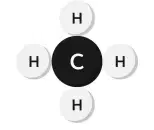
Determine whether the model represents an atom or a molecule.
Determina si el modelo es un átomo o una molécula.
atom
molecule
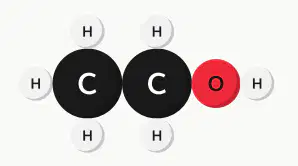
¿Cuál de las siguientes es la fórmula
¿para el etanol?
Ethanol is a substance that can be used in
as fuel. Its molecular structure is shown
on the right.
Scientists want to label fuel with the
formula.
Which of the following is the formula
for ethanol?
C2H5OH
C3H7OH
2C5HOH1
CHOH
Scientists are using ammonia in a new cleaning product. They know that the formula for
ammonia is NH3.
Which model represents ammonia?
Los científicos utilizan amoníaco en un nuevo producto de limpieza. Saben que la fórmula para
el amoníaco es NH3.
¿Qué modelo representa el amoníaco?


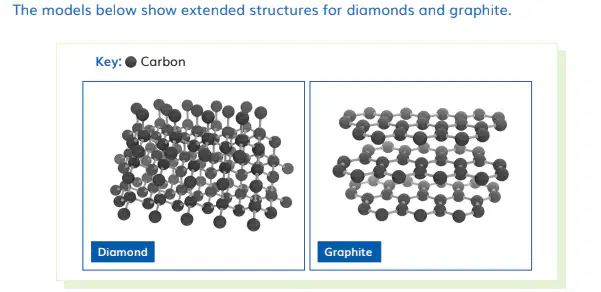
¿Cuál de las siguientes estructuras extendidas se construye a partir del mismo átomo que el diamante
¿y grafito?
Which of the following extended structures is built from the same atom as diamond
and graphite?


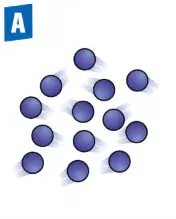
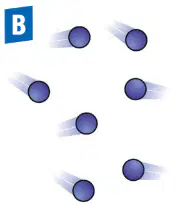
¿Cuál es el estado de la materia de los átomos de la imagen?
What is the state of matter of the atoms in the picture?
Solid
Liquid
Gas
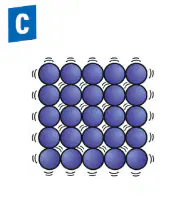
¿Cuál es el estado de la materia de los átomos de la imagen?
What is the state of matter of the atoms in the picture?
Solid
Liquid
Gas
¿Cuál es el estado de la materia de los átomos en la imagen?
What is the state of matter of the atoms in the picture?
Solid
Liquid
Gas
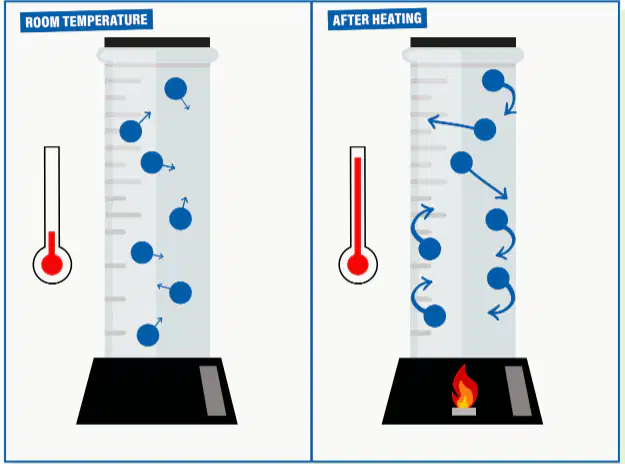
Un alumno calienta agua para investigar la relación entre la energía térmica y el movimiento de las partículas.
¿Qué relación causa-efecto puede observarse en esta investigación?
A student heats water to investigate the relationship between thermal energy and particle motion.
Which cause-and-effect relationship can be observed in this investigation?
As thermal energy decreases, particle motion increases.
A medida que disminuye la energía térmica, aumenta el movimiento de las partículas.
As thermal energy increases, particle motion decreases.
A medida que aumenta la energía térmica, disminuye el movimiento de las partículas.
As thermal energy increases, particle motion increases.
Al aumentar la energía térmica, aumenta el movimiento de las partículas.
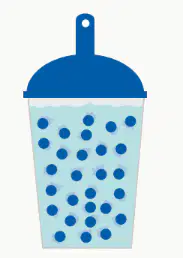
¿Qué modelo muestra lo que le ocurrirá a la partícula de la paleta
movimiento y energía térmica cuando el polo entra en el congelador?
Which model shows what will happen to the popsicle’s particle
motion and thermal energy when the popsicle goes into the
freezer?


Joel is a clothes designer. He decides to look into polyester, which is a synthetic material, as a possible material to use in a new line of kids’ clothing. He wants to use a material that would be a good choice for children and has as little negative effect on the environment as possible. He reads the following information on polyester.
Polyester clothing was introduced to the United States in 1951. The synthetic material became popular quickly because it was so easy to take care of. Polyester clothes are easy to clean, dry quickly, and don’t require ironing. On top of that, polyester is also inexpensive and long-lasting. Polyester production occurs with the help of a chemical reaction involving coal, oil, air, and water. Approximately 70 million oil barrels are used annually to produce polyester clothing around the globe. The production of polyester requires double the energy of most cottons, but less energy than nylon. In 2015, polyester production processes were responsible for the emission of 282 billion kg of CO2.
Joel decides to not use polyester for his new clothing line.
Which reason might he provide to support his choice?
A. The costs for polyester production are too high for Joel to justify.
B. Polyester clothing isn’t suitable for young children, as it stains easily.
C. Polyester production releases high amounts of CO2, which is bad for the environment.
D. The chemical reaction used to form polyester might irritate his clients’ skin.
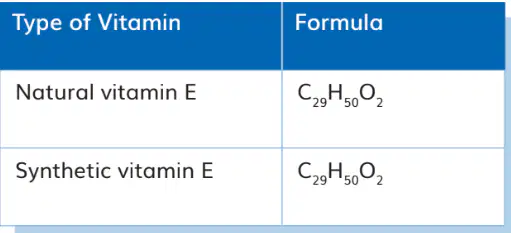
The chemical formulas for natural and synthetic Vitamin E are shown below.
Which is true about the synthetic version
of Vitamin E? Select one answer.
Las fórmulas químicas de los vitamina E sintética se muestran a continuación.
Lo que es cierto sobre la versión sintética
de vitamina E? Seleccione una respuesta.
It is stronger than the natural form.
Es más fuerte que la forma natural.
It is made in a lab.
Se fabrica en un laboratorio.
It has a different chemical formula
than the natural form.
Tiene una fórmula química diferente
que la forma natural.

