
Font size
 Worksheets
DNA/RNA and Protein Synthesis
Total questions: 29
Worksheet time: 33mins
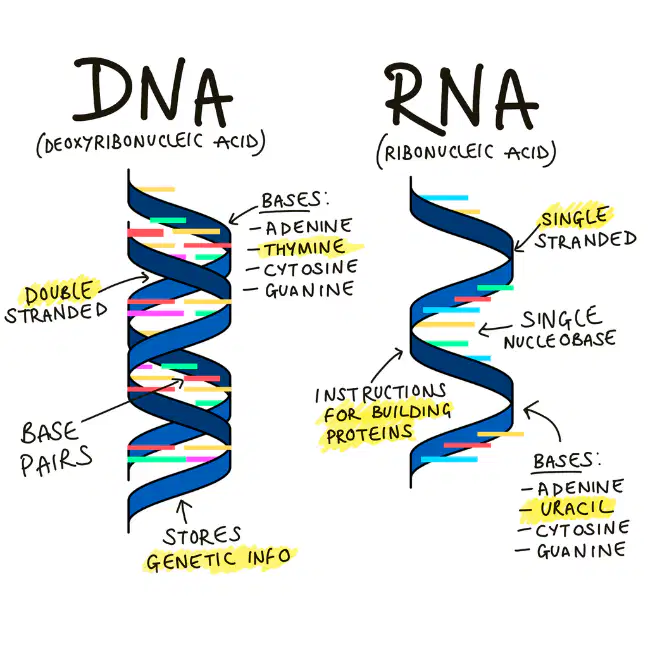
Which of the following are differences in the structure between RNA and DNA?
Choose 3
DNA uses deoxyribose sugar, RNA uses sugar ribose
DNA pairs Adenine with Uracil, RNA pairs Adenine with Thymine
DNA is a double helix, RNA is a single helix
DNA pairs Adenine with Thymine, RNA pairs Adenine with Uracil
Which organelle is the location where protein is made?
Ribosome
Nucleus
Cytoplasm
Nucleotide
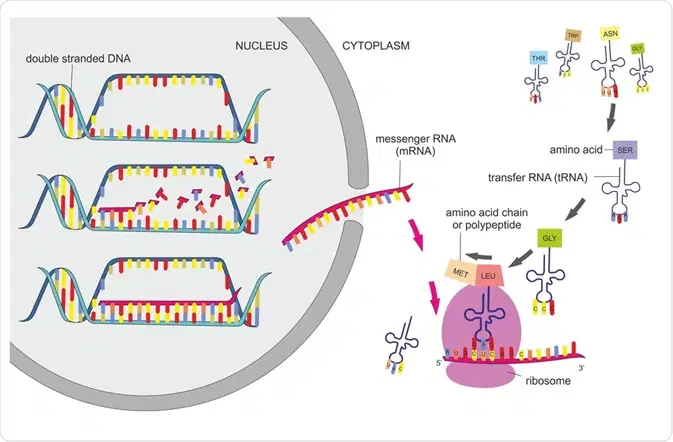
During transcription, this type of RNA is responsible for copying the DNA and bringing it out of the nucleus.
tRNA
mRNA
rRNA
dRNA

These building blocks consist of a sugar, phosphate, and nitrogen base.
Ribose
Nucleotide
Gene
Protein

Which of the following is the complementary mRNA sequence to this DNA strand during Transcription? AACTGAA
UUGACUU
TTGACTT
AACTGAA
AACUGAA
Cytoplasm to Nucleus
Membrane to cytoplasm
nucleus to cytoplasm
cytoplasm. tRNA brings amino acids to ribosome

What brings the amino acids to the ribosome to assemble a protein?
DNA
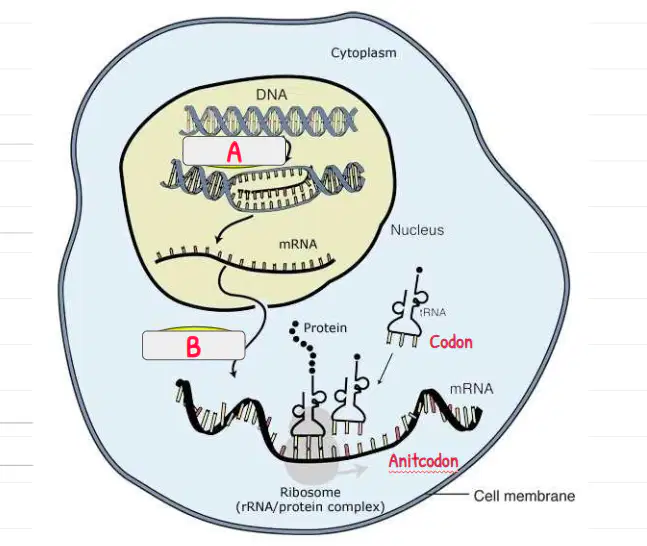
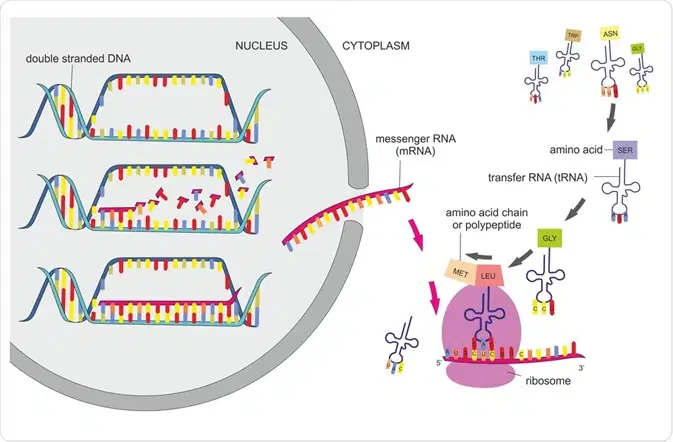
Which process is A?
transcription
DNA replication
translation
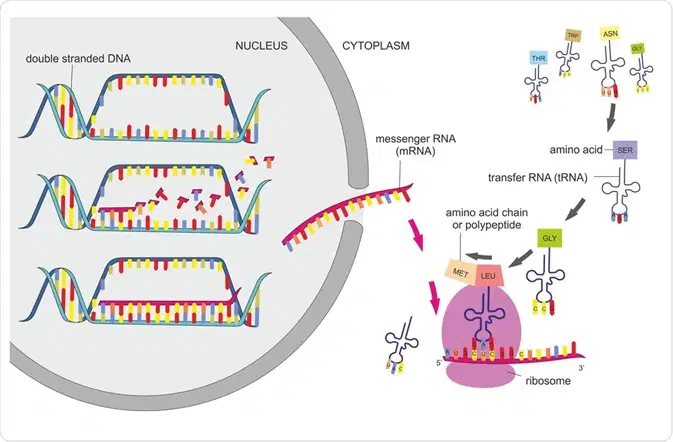
Which process is B?
transcription
DNA replication
translation

During Translation, mRNA are _______ that match with tRNA which are _____to form the amino acid.
anticodons; Codons
Codons; anticodons
Amino Acid; DNA
Mitochondria; chloroplast

Use your codon chart to match the mRNA CUU to the correct amino acid
VAL
TYR
LEU
PHE

Use your codon chart to match the mRNA ACU to the correct amino acid.
Thr
Ala
Val
Gly
Amino Acids are built up to make_______
DNA/RNA
mRNA/tRNA
Lipids/glycerol chain
Proteins/polypeptides
During Transcription, DNA is transcribed to ____
mRNA
tRNA
rRNA
a Protein

During translation, _____ brings proteins from the cytoplasm to the ribosome.
ER
DNA
mRNA
tRNA
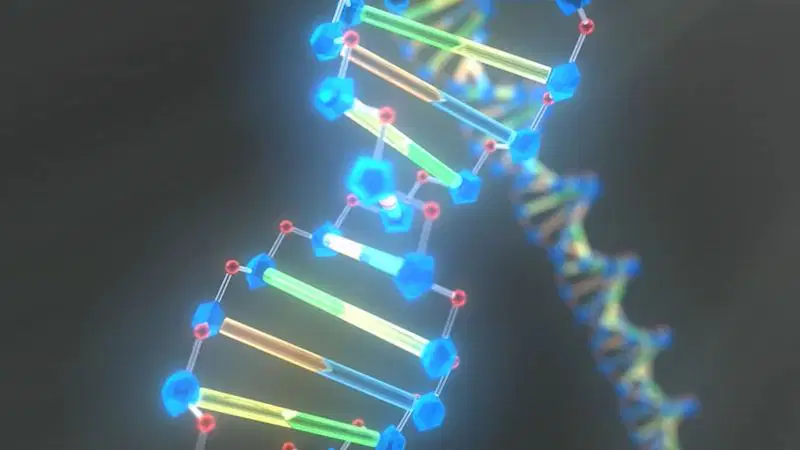
What are the four nitrogen bases?
adenine, thymine, guanine, cytosine
adenine, lysine, prolene, guanine
arganine, cytosine, lysine, purine
lysine, cytosine, lucine, guanine

Which correctly describes the image?
Nucleotide; B is sugar;A is phosphate; C is the nitrogen base that can be adenine, cytosine, thymine, or guanine
Nucleotide; A is sugar; B is phosphate; C is the nitrogen base that can be adenine, cytosine, thymine, or guanine
Lipid; B is Nitrogen; A is phosphate; C is the sugar base that can be adenine, cytosine, thymine, or guanine
Carbohydrate; B is sugar; A is phosphate; C is the nitrogen base that can be adenine, cytosine, thymine, or guanine

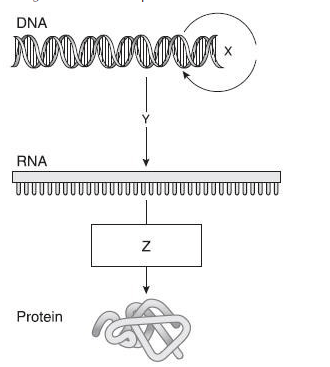
A diagram of a cellular process is shown below. Which of the following identifies the process shown?
X-Transcription;
Y-mRNA leaves the nucleus; Z = Translation, tRNA brings amino acids to the Ribosome to make proteins
X-Translation;
Y-mRNA leaves the nucleus; Z = Transcription, tRNA brings amino acids to the Ribosome to make proteins
X-Transcription;
Y-tRNA leaves the nucleus; Z = Translation, mRNA brings amino acids to the Ribosome to make lipids
X-Translation;
Y-mRNA leaves the nucleus; Z = Transcription, tRNA brings amino acids to the Ribosome to make lipids


The picture below shows an enzyme unwinding and unzipping DNA.
What is the name of this enzyme?
DNA Helicase
DNA Ligase
DNA polyermase
RNA Polymerase
During DNA replication, what would be the complementary strand to the original DNA segment of GCT AAT?
CGA TTA
CGA TAA
GGA UUA
GGU TTU
What is the role of DNA polymerase in the process of DNA replication?
It carries genetic information to the ribosomes
It produces a complimentary copy of a strand of DNA
It constructs RNA chains using a template from DNA genes
It retrieves amino acids from the cytoplasm for protein construction
Which of the following best explains why DNA replication is considered “semi-conservative”?
Replication always produces two DNA molecules, each having two brand new strands
Replication always produces two DNA molecules, one having two old strands and one having two new strands
Replication always produces two DNA molecules, each having one old strand and one new strand
Replication always produces one brand new DNA molecule with two new strands and the original molecule is completely destroyed

