
 Worksheets
CPR Training
Total questions: 14
Worksheet time: 7mins
CPR stands for __________ ____________ ________________.
Chocolate Pieces Required
Cardio Pulmonary Resucitation
Care Protect Revive
Careful Powerful Resucitation
Your heart beats and pumps blood around ____ to _____ times perminute.
30 to 50
60 to 80
110 to 120
120 to 180
Before doing compressions on the heart, you must first make sure the victim has:
no pulse or heartbeat
no complaints
no disease
no medications
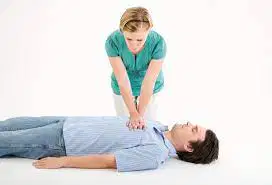
The reason why you lock your elbows, and take the position that is illustrated in the photo is so that:
your arms can pump faster
you don't break any ribs
you use your body weight instead of arm strength
you can sense their breathing better
How many compressions are you supposed to do?
around 120 per minute
around 80 per minute
around 200 per minute
around 120 per hour
For how long should you do compressions befor stopping to check for a heartbeat again?
30 seconds
1 minute
2 minutes
5 minutes
How deep should the compressions be on an adult?
around 1 inch
around 2 inches
around 5 inches
around 8 inches
When you discover a person whose heart beat has stopped, your first priority should be:
call 911
do compressions
look for an AED
look for a nurse
When using the AED, the pads must be placed on the right chest and left side. Why?
to make it more comfortable for the victim
to avoid ripping hair off their body
to make sure an electric charge goes through the heart
because the heart is located on the right side of the chest cavity
When doing CPR on a child, don't ______________________.
compress as deep
use both hands
use as much force as an adult
all of the above
The AED goes through 3 phases:
a)
b)
c)
a) checking heart rate to see if the shock is needed,
b) charging,
c) sending a shock
a) talking,
b) analyzing your compressions,
c) sending an electrical charge
a) adding oxygen,
b) checking electric waves in the heart,
c) analyzing your compressions
all of the above
If you make a mistake in doing CPR, you can not be sued because you tried to do the right thing.
This is called the ______________________.
Hippocratic oath
innocent before proven guilty
good Samaritan law
golden rule
The purpose of CPR is to:
get blood pumping throughout the body
wake up the person
stimulate brain waves
increase oxygen
To make sure you are doing enough compressions, you can do them to the beat of ________________.
Baby Shark
Taylor Swift songs
a love song
Heart attack by Chemical Romance

