
NEW
Font size
 Worksheets
10-minute Quiz : Chapter 39 Dynamic equilibrium
Total questions: 10
Worksheet time: 10mins

Consider the chemical equilibrium established in dilute potassium manganate solution (green) at room temperature and pressure. Which of the following statements about the solution is/are correct?
(1) The solution turns purple after a short time.
(2) The pH of the solution is greater than 7.
(3) The rate of consumption of MnO₄²⁻(aq) is equal to the rate of formation of MnO₄⁻(aq).
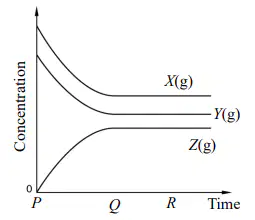
Consider the concentration-time graph for a chemical system involving three gases X, Y and Z in a fixed-volume closed container kept at a certain temperature. Which of the following statements concerning this system is/are correct?
(1) At point P, X(g), Y(g) and Z(g) are all present in the system.
(2) At point Q, the system reaches a state of dynamic equilibrium.
(3) At point R, the reaction involving these three gases stops.
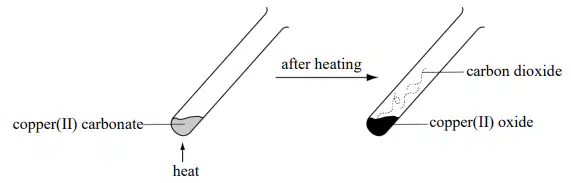
Refer to the experiment on the thermal decomposition of copper(II) carbonate. Upon heating, the green copper(II) carbonate decomposes completely to black copper(II) oxide and colourless carbon dioxide. Which of the following statements correctly explains the result?
D. This reaction is occurring in an open system.
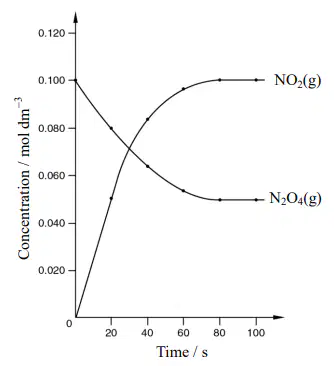
Consider the concentration-time graph for the following reversible reaction:
N₂O₄(g) ⇌ 2NO₂(g)
Which of the following statements concerning this reaction is correct?
C. The reaction reaches the state of dynamic equilibrium at the 30ᵗʰ second.
In an experiment, 1.0 mol of hydrogen iodide is introduced into a 1.0 dm³ sealed tube maintained at 400°C. The hydrogen iodide decomposes reversibly to form hydrogen and iodine according to the following equation:
2HI(g) ⇌ H₂(g) + I₂(g)
Which of the following statements concerning this reaction is correct?
Equal numbers of moles of N₂(g) and H₂(g) are introduced into a fixed-volume closed container kept at a certain temperature. N₂(g) and H₂(g) undergo a reversible reaction to form NH₃(g), as described by the following equation:
N₂(g) + 3H₂(g) ⇌ 2NH₃(g)
Which of the following correctly shows the relationship regarding the concentrations of N₂(g) and H₂(g) in this reaction when equilibrium is reached?
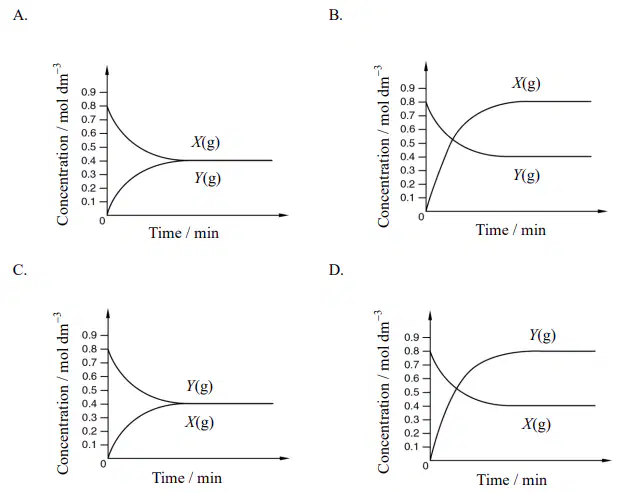
In a reversible reaction, X(g) decomposes to Y(g) at a given temperature according to the following equation:
X(g) ⇌ 2Y(g)
Given that the concentration of X(g) at the start of the reaction and at equilibrium are 0.8 M and 0.4 M respectively. Which of the concentration-time graphs correctly shows the variation of the concentration of both X(g) and Y(g) over time?
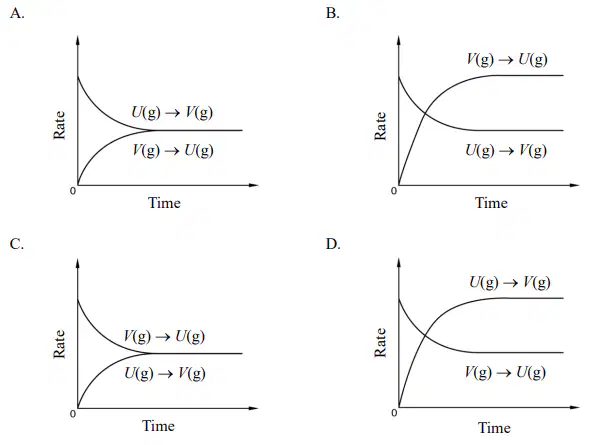
In a reversible reaction, U(g) decomposes to give V(g) in a fixed-volume closed container under certain conditions, as described by the following equation:
U(g) ⇌ V(g)
Which of the graphs shows the possible changes in rates of the forward and backward reactions over time for this reversible reaction?

