
Font size
S
M
L
XL
 Worksheets
Chapter 2 Test: How the English Colonies Began
Total questions: 40
Worksheet time: 41mins
Name
Class
Date
1.
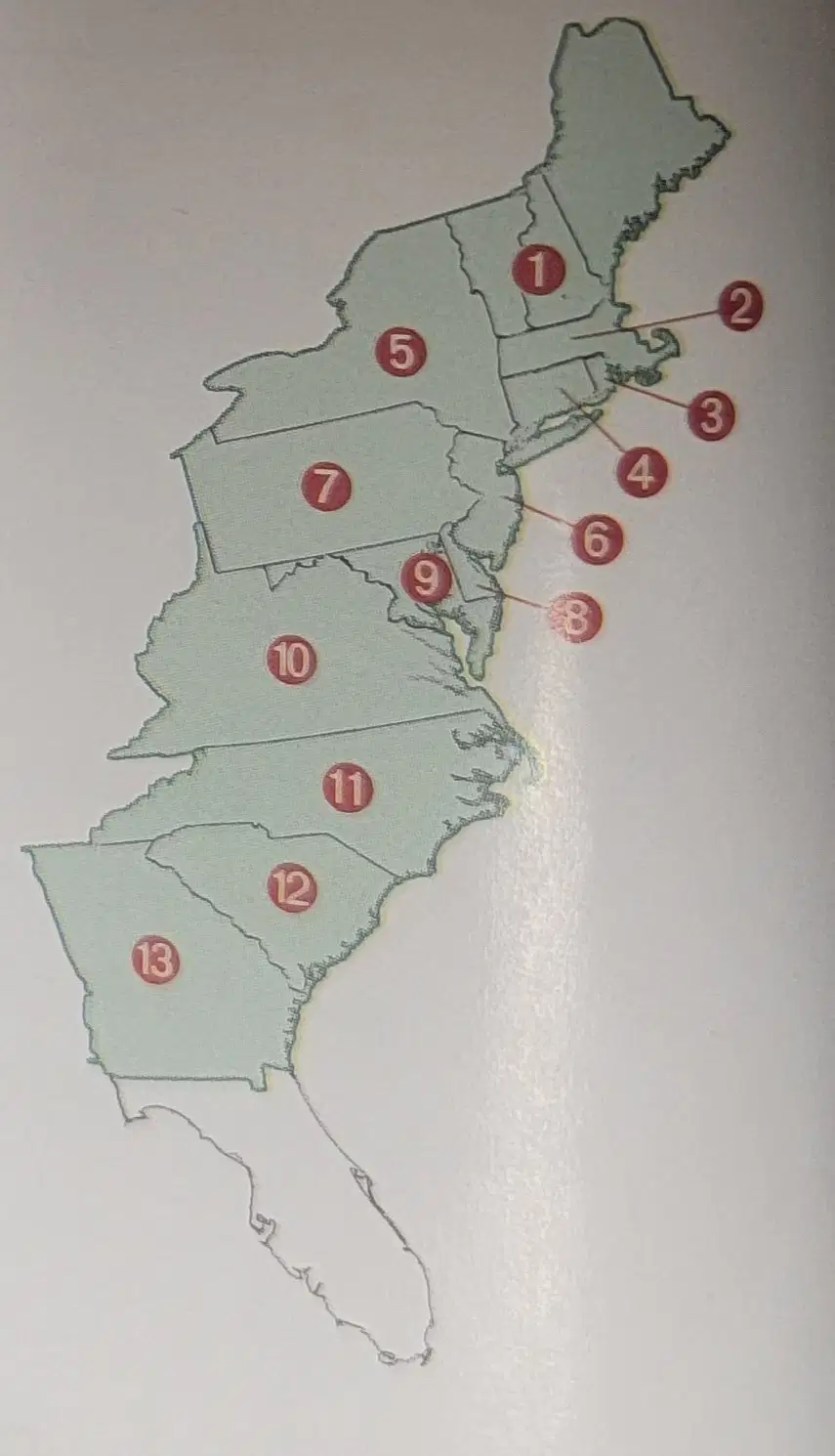
Where was Roanoke located?
(a)
2.
(SS.8.A.2.2)
How did geography influence settlement patterns in the first English colonies?
a)
because New England had the shortest growing season, most colonies settled in this region
b)
because forested land was difficult to clear, colonists first settled along the coastline and rivers
c)
because the growing season in the Southern colonies was the longest, few people settled there
d)
although the climates of the colonies were different, their populations were all about the same
3.
(SS.8.A.2.1)
In 1651, William Bradford wrote: "Their condition was not ordinary; their ends were good and honorable; their calling lawful, & urgent; and therefore they might expect the blessing of God in their proceeding."
Which conclusion can be drawn from the passage?
a)
settlers came to Plymouth to find gold and silver
b)
settlers came to Plymouth for their moral and religious beliefs
c)
settlers came to Plymouth to be released from debtor's prison
d)
settlers came to Plymouth to defend England from Spain and France
4.
(SS.8.A.2.4)
What do John White, John Smith, William Bradford, and John Winthrop have in common?
a)
they refused to give food and shelter to all the colonist
b)
they came to the New World in search of fame and riches
c)
they led some of the first English colonies of the New World
d)
they believed they were setting an example of righteousness for the entire world to follow
5.
(SS.8.A.2.2)
Captain John Smith stated, "Here are the mountains, hills, plains, valleys, rivers, and brooks, all running most pleasantly into a faire Bay...with fruitful and delightsome land".
Based on his statement, why did the colonists choose to settle in Jamestown in 1607?
a)
the Native Americans had agreed to let the colonists have this area
b)
the area had all the resources the colonists needed for mining gold
c)
rivers and brooks created the possibility of developing maritime industries
d)
fresh water, fertile land, and good harbors offered the possibility of successful farming
6.
(SS.8.CG.3.1)
What was the importance of the Mayflower Compact?
a)
it was the first example of a written constitution
b)
it established religious toleration in the colonies
c)
it established the practice of self-government in the colonies
d)
it established rules for electing representatives to a colonial assembly
7.
(SS.8.A.2.2)
The following statement describes the geography of New England: " The excellent coastline provided natural harbors and forests provided timber. Whale and fishing beds in nearby waters made whaling and fishing profitable. New England's thin, rocky soil prevented the growth of cash crops."
Which conclusion about the economy of colonial New England can be drawn from this passage?
a)
New Englanders preferred farming to fishing and whaling
b)
think forests and rich, fertile soil encouraged manufacturing
c)
good coastlines and rocky soil encouraged the farming of cash crops
d)
excellent harbors and forests encouraged the development of shipbuilding
8.
(SS.8.A.2.1)
Which statement summarizes the reasons for the founding of Jamestown and Plymouth?
a)
both colonies were established as safe places for imprisoned debtors
b)
both colonies were founded to provide religious freedom to all settlers
c)
the colonists at Jamestown expected riches, while the Pilgrims wanted to practice their religion
d)
the colonists at Jamestown came to convert the Native Americans, while the Pilgrims came to establish trade
9.
(SS.8.A.2.3)
In colonial times, how were Africans treated different from other groups who came to North America?
a)
they did not have to work in the fields
b)
they could not be punished for disobedience
c)
they often returned to their native homes
d)
they were taken to the colonies against their will
10.
(SS.8.A.2.7)
How did Native Americans affect the first English settlements in North America?
a)
friendly Indians helped the colonists adapt to their new lands
b)
most colonists married Native Americans and adopted their lifestyle
c)
colonist were attacked by angry Native Americans before they landed
d)
English colonists obtained most of their food and clothes from Native Americans
11.

(SS.8.A.2.2)
The map shows colonial America in 1740. Which pair of colonies allowed greater religious freedom?
a)
Colonies 2 and 12
b)
Colonies 3 and 7
c)
Colonies 2 and 11
d)
Colonies 3 and 10
12.
(SS.8.A.2.4)
In 1624, Captain John Smith wrote, "From May to September, those that escaped sickness lived upon sturgeon [a fish] and sea crabs. Fifty in this time we buried. Captain John Smith, by his own example and strong leadership, set some men to mow, others to bind and thatch, some to build houses, so that in a short time we had lodgings to protect us from the cold. His motto became known as, If you do not work, you will not eat. This made even the laziest of men get up and do their share of the work!
Based on the passage, why was Captain John Smith so strict with the Jamestown settlers?
a)
he wanted to persuade the colonists to return to England
b)
he wanted to make sure that the London Company made a profit
c)
he wanted to make sure the settlers survived in their new environment
d)
he wanted to test whether everyone in the colony would obey his orders
13.
(SS.8.A.2.3)
Which is an example of subsistence farming in colonial times?
a)
growing tobacco in Virginia
b)
growing rice in South Carolina
c)
dairy farming outside of Philadelphia
d)
growing food for one's family in North Carolina
14.
(SS.8.A.2.4)
Which contribution did George Calvert (Lord Baltimore), make to the social development of the colonies?
a)
he helped the colonists survive their first year in Jamestown
b)
he welcomed debtors who had been put in prison in England
c)
he helped finance the Puritan expeditions to Massachusetts Bay.
d)
he made Maryland a home for Catholics facing persecution in England
15.
(SS.8.A.2.2)
In the 1600s, why were colonists in New England generally better educated than elsewhere?
a)
New Englanders had more free time than other colonists
b)
Puritans believed each person should be able to read the Bible
c)
colonists in New England depended more on the labor of slaves
d)
the most wealthy people from England preferred to settle in New England
16.
(SS.8.CG.2.4)
In 1620, the colonists arriving at Plymouth signed the Mayflower Compact. It stated, "We...do [agree] and combine ourselves together into a body politic, for our better order and preservation and...to enact...just and equal laws...from time to time, as shall be thought most convenient for the general good of the colony, unto which we promise all due submission and obedience."
Which action by a colonist would break this promise?
a)
sharing English farming methods with local Indian leaders
b)
searching for gold when it was unlikely any would be found
c)
sailing back to England after receiving news of a sick relative
d)
refusing to help with military duties when asked by colony leaders
17.
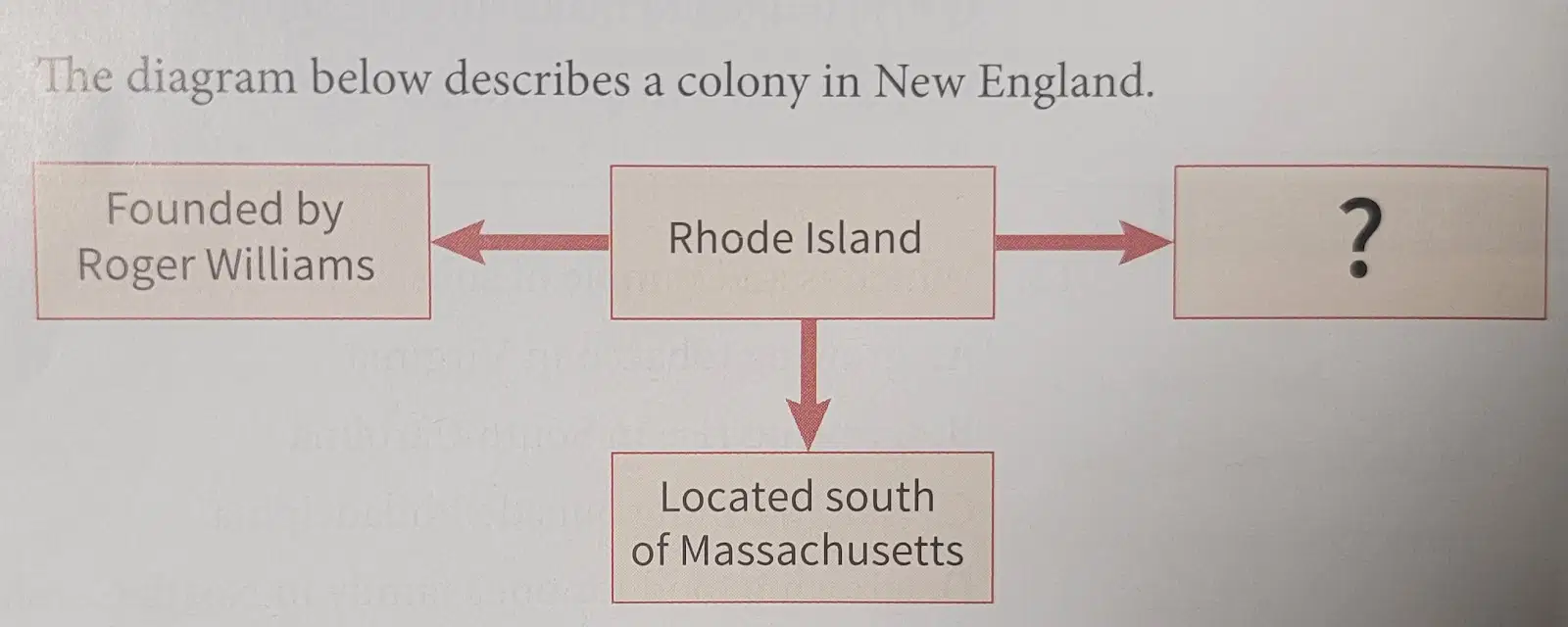
(SS.8.A.2.2)
Which phrase belongs in the blank box in the diagram?
a)
introduced slavery to the English colonies
b)
put eleven men and women to death as witches
c)
was the first colony to practice religious toleration
d)
founded by English investors seeking to make a profit
18.
(SS.8.A.2.4)
Which individual started a colony for Quakers and provided its colonists with a Frame Government?
a)
Captain John Smith
b)
William Bradford
c)
Roger Williams
d)
William Penn
19.
SS.8.A.2.2
Where would a whaler or shipbuilder be most likely to live in colonial times?
a)
South Carolina
b)
New England
c)
Caribbean Islands
d)
Middle Colonies
20.

Look at the map below. Which is the most likely reason that the population of the Southern colonies grew much more than the populations of New England or the Middle Colonies between 1700-1760?
a)
People from the middle colonies moved to the southern colonies because factory life was too difficult
b)
The Southern colonies imported more slaves during this period to assist with agricultural work
c)
Many people died in New England due to the long, cold winters
d)
People moved to the southern colonies to enjoy a more rural lifestyle
21.
Which region of the 13 colonies was the most diverse?
a)
The Middle Colonies
b)
New England
c)
Southern Colonies
22.
Which region of the 13 colonies was the most urban?
a)
The Middle Colonies
b)
New England
c)
Southern Colonies
23.
Which region of the 13 colonies grew cash crops on large plantations?
a)
The Middle Colonies
b)
New England
c)
Southern Colonies
24.
T/F: Many people moved to the New England in search of religious freedom
a)
True
b)
False
25.
T/F: The king/queen of England funded each of the 13 colonies from taxes imposed on British subjects.
a)
True
b)
False
26.
Which colony did not belong in New England?
a)
Massachusetts
b)
New Hampshire
c)
Delaware
d)
Connecticut
27.
Which colony did not belong in Middle Colonies?
a)
New York
b)
New Jersey
c)
Pennsylvania
d)
Connecticut
28.

Which colony does #2 represent?
a)
Massachusetts
b)
New Jersey
c)
New Hampshire
d)
Maryland
29.

What colony does #9 represent?
(a)
30.

What colony does #5 represent?
(a)
31.
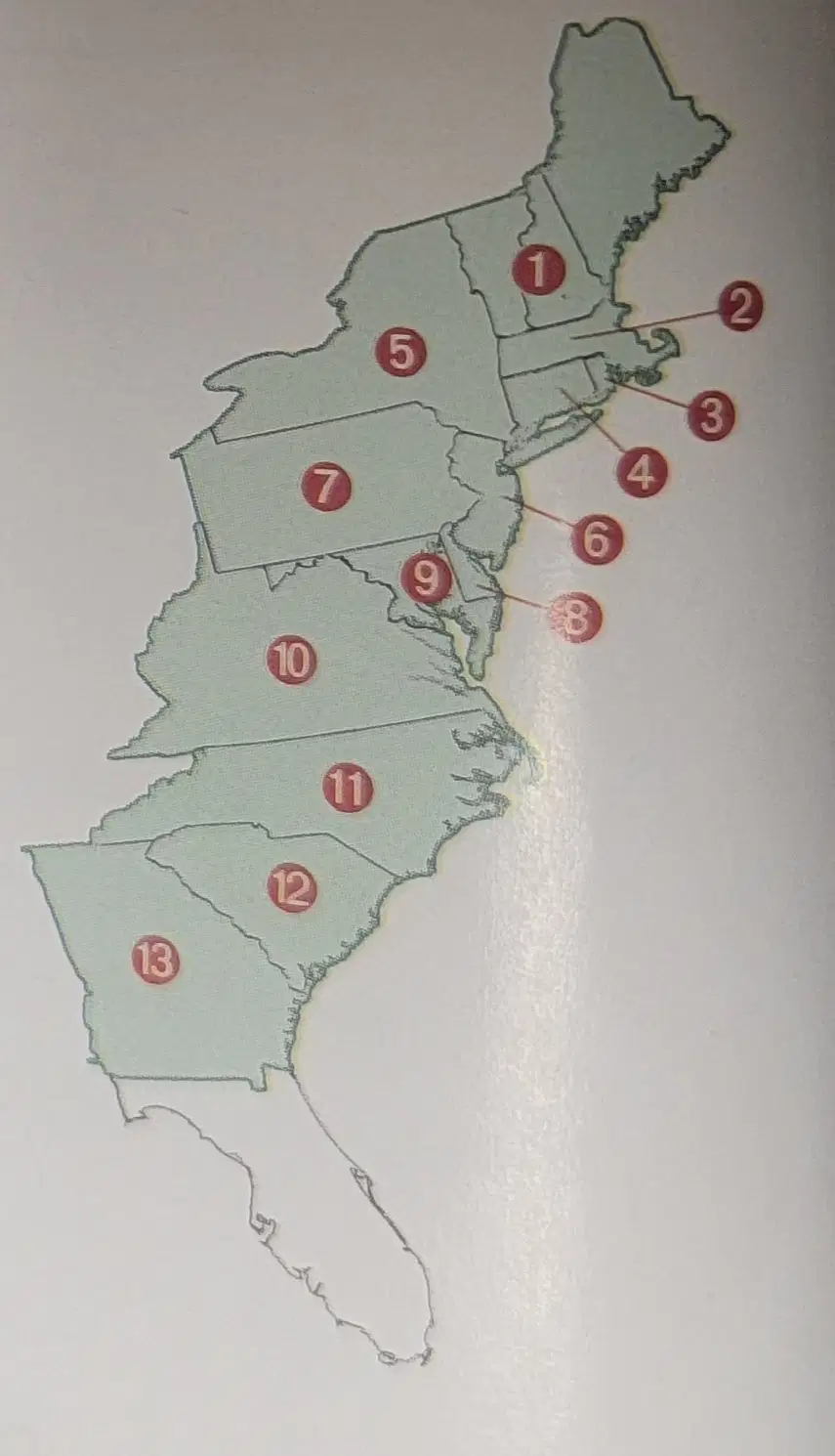
What colony does #7 represent?
(a)
32.

What colony does #1 represent?
(a)
33.

What colony was Jamestown located in?
a)
2
b)
10
c)
11
d)
8
34.
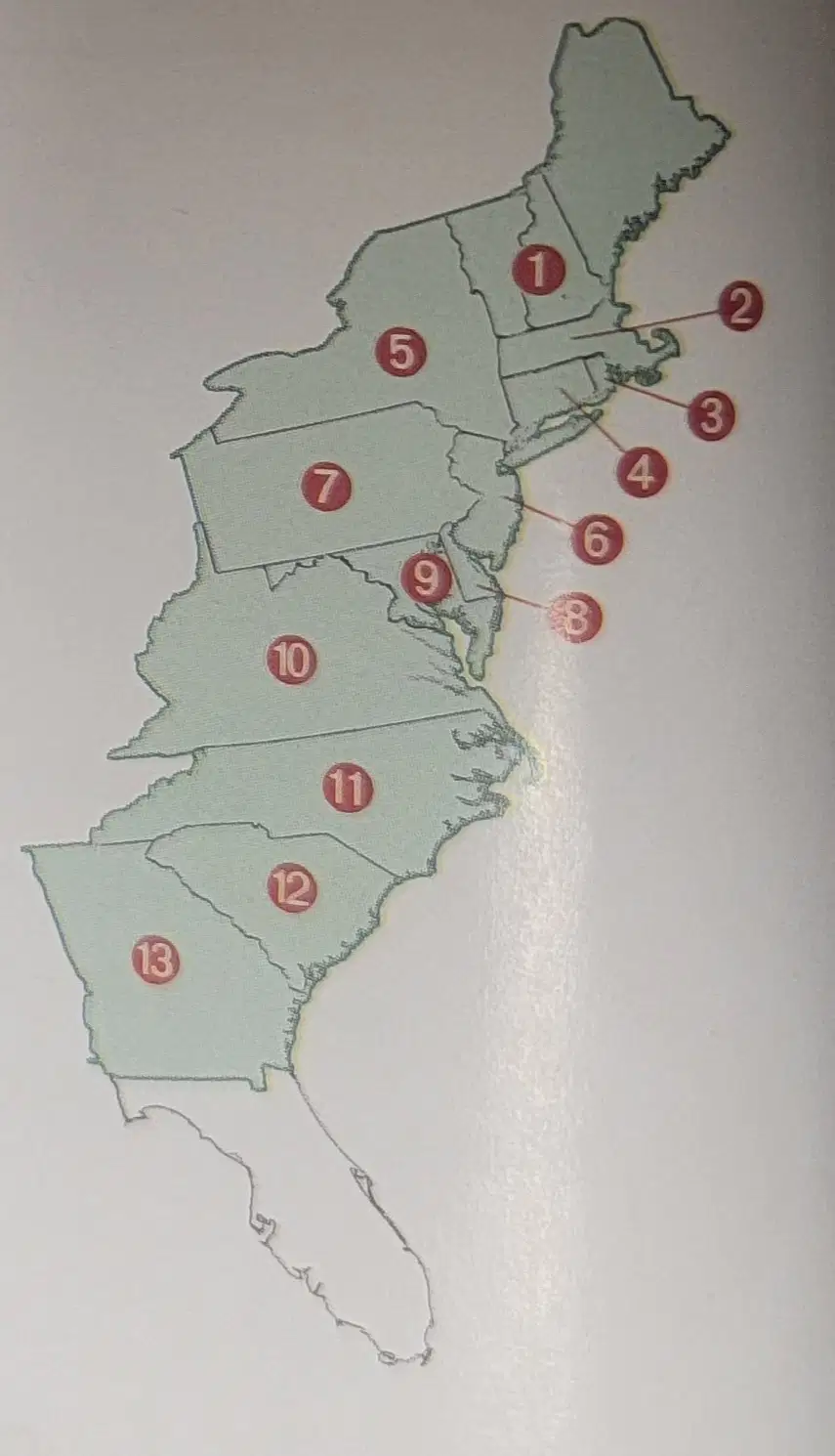
Where did the Pilgrims land? (write the NAME of the colony- NOT the number)
(a)
35.
What term matches "a large group of Protestants who live strict religious lives"
a)
Separatists
b)
Puritans
c)
self government
d)
religious toleration
36.
T/F: Roanoke was the first permanent English settlement
a)
True
b)
False
37.
T/F: Learning how to grow tobacco was a primary reason for the success of Jamestown.
a)
True
b)
False
38.
Which was NOT part of the Fundamental Orders of Connecticut?
a)
creation of a court
b)
males had the right to vote
c)
blueprint of a constitution
d)
abolishment of slavery
39.
T/F Quakers believed that everyone was equal.
a)
True
b)
False
40.
T/F: Georgia was the first colony to have religious toleration
a)
True
b)
False
Reset

