
 Worksheets
Economics Unit 3 Test
Total questions: 35
Worksheet time: 18mins
Name
Class
Date
1.
1) Unlimited liability means that
a)
shareholders of a company receive dividends only if the company earns a profit.
b)
the owner of the business bears complete legal responsibility for all debts and damages arising from doing business.
c)
a business cannot lose more than a preset amount.
d)
credit can be obtained more easily than in a business that has limited liability.
2.
2) One of the advantages of purchasing a franchise is that the
a)
franchisee pays a fee and a percentage of the revenues taken in.
b)
franchisee signs a contract with the franchiser.
c)
franchiser often provides advertising.
d)
risk of losing money is small.
3.
3) In the United States, which type of business accounts for the greatest share of revenues?
a)
sole proprietorship
b)
partnership
c)
corporation
d)
shareholders
4.
4) In a limited partnership
a)
all partners are equal.
b)
a bank limits the partnership's liability.
c)
some partners bear no risk.
d)
a general partner manages the business.
5.
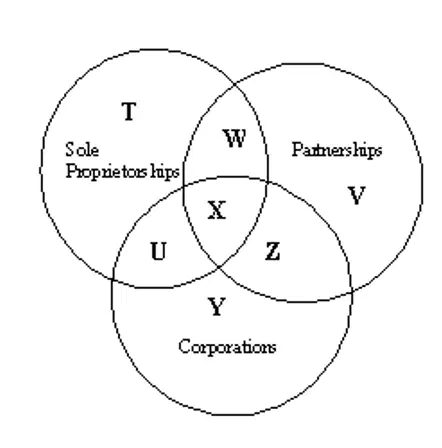
5) DBQ: Which letter represents the proper location on the diagram for “owners earn dividends”?
a)
W
b)
X
c)
Y
d)
Z
6.
6) The board of directors of a corporation is responsible for
a)
running the company’s day-to-day operations.
b)
hiring officers to run the business.
c)
determining the price of the company’s shares.
d)
paying dividends to shareholders.
7.
7) A partnership set up for a specific purpose for a short period of time is known as a
a)
joint stock company.
b)
acting board of directors.
c)
joint venture.
d)
committee.
8.
8) The most common type of business organization is a
a)
sole proprietorship.
b)
joint venture.
c)
partnership.
d)
limited partnership.
9.
9) The biggest disadvantage of a sole proprietorship is that
a)
the proprietor receives all the profits.
b)
the proprietor has unlimited liability.
c)
the operation of the business is more complicated.
d)
business decisions can be made quickly.
10.
10) In a limited partnership, the limited partners
a)
have an active voice in the management.
b)
are equal to the general partner.
c)
only contribute funds or property to the business.
d)
have unlimited liability for debts.
11.
11) A corporate charter is granted by
a)
the federal government.
b)
the state where the corporation is established.
c)
stockholders.
d)
a franchisor.
12.
12) Holders of preferred stock are guaranteed
a)
voting rights.
b)
a certain amount of dividend each year.
c)
nothing.
d)
double the dividend paid on common stock.
13.
13) A type of business organization owned by many people but treated by law as though it were one person is called a
a)
sole proprietorship.
b)
partnership.
c)
corporation.
d)
franchise.
14.
14) What type of stock gives the investor voting rights?
a)
common stock
b)
preferred stock
c)
dividend
d)
corporate charter
15.
15) Who hires the management to run a corporation?
a)
owners
b)
partners
c)
board of directors
d)
president and vice president
16.
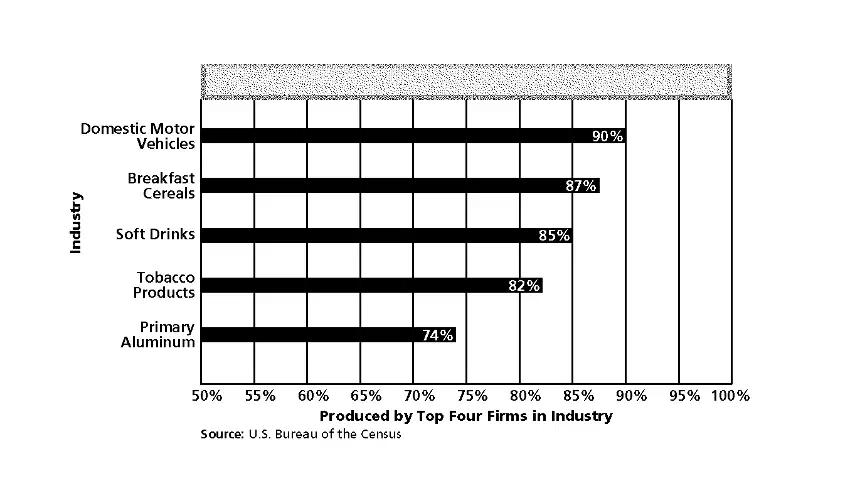
16) DBQ: Based on the graph, the top 4 companies in the soft drink industry produced what percentage of all soft drink output?
a)
90%
b)
87%
c)
85%
d)
82%
17.
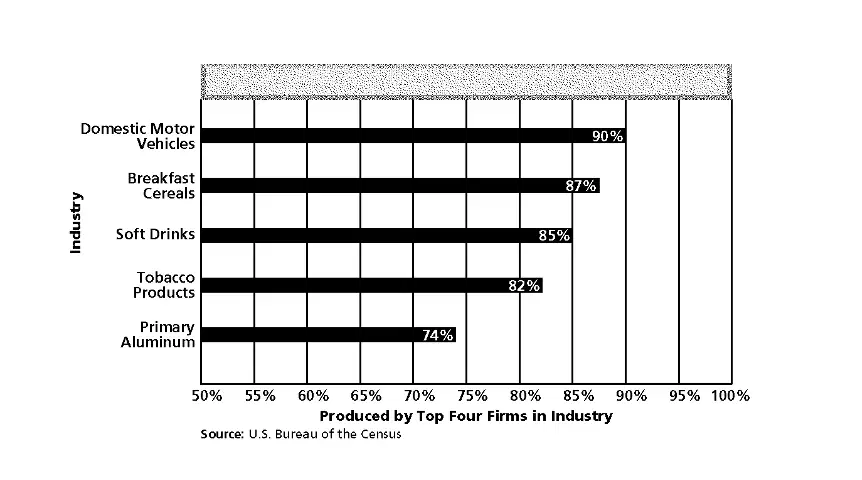
17) DBQ: Based on the graph, what market structure best describes the breakfast cereal market?
a)
perfect competition
b)
monopoly
c)
oligopoly
d)
monopolistic competition
18.
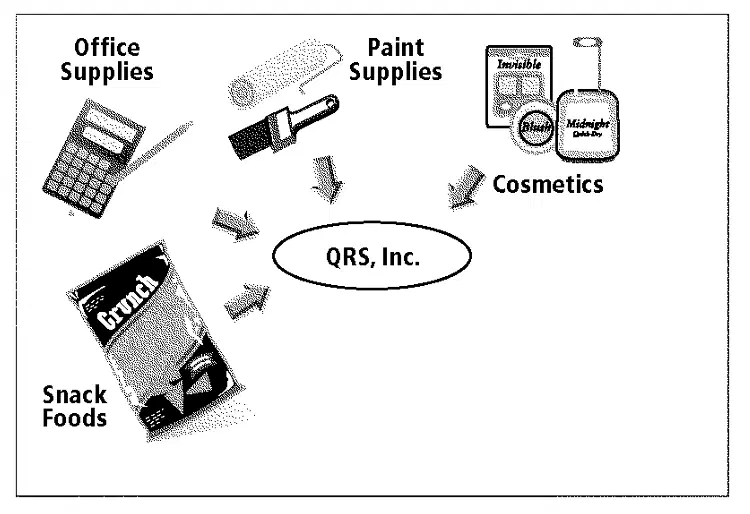
18) DBQ: What type of merger does the illustration depict?
a)
horizontal merger
b)
vertical merger
c)
diagonal merger
d)
conglomerate merger
19.
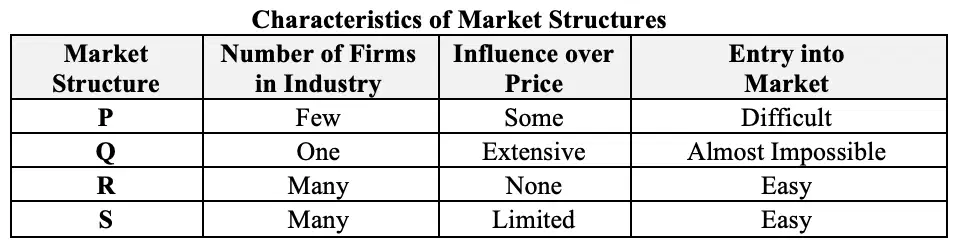
19) DBQ: “Pure monopoly” should replace what letter in the table?
a)
P
b)
Q
c)
R
d)
S
20.
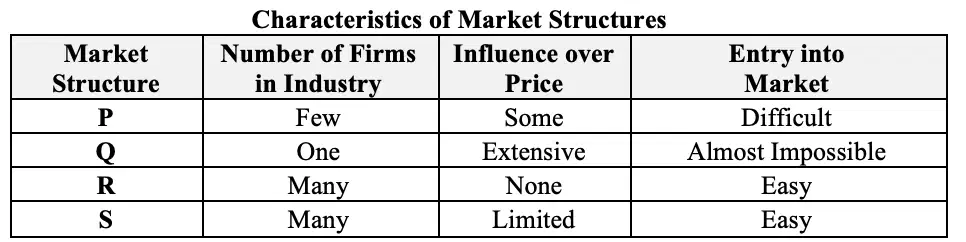
20) DBQ: “Perfect competition” should replace what letter in the table?
a)
P
b)
Q
c)
R
d)
S
21.
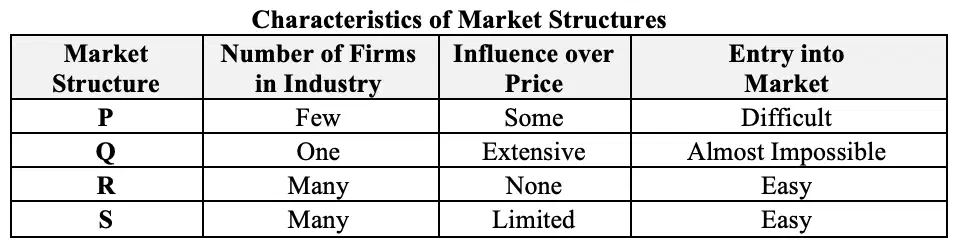
21) DBQ: “Oligopoly” should replace what letter in the table?
a)
P
b)
Q
c)
R
d)
S
22.
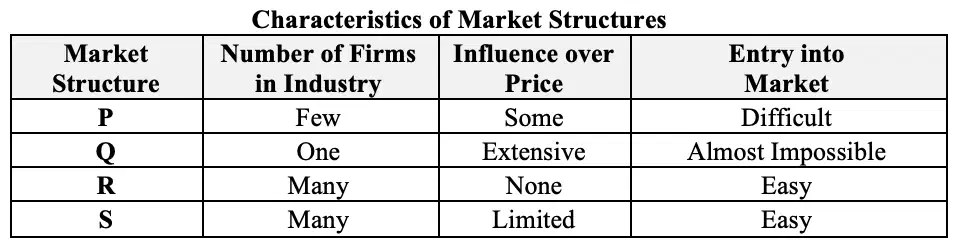
22) DBQ: “Monopolistic competition” should replace what letter in the table?
a)
P
b)
Q
c)
R
d)
S
23.
23) An example of antitrust legislation is the
a)
Americans with Disabilities Act.
b)
Clayton Act.
c)
Wade Act.
d)
Truth in Lending Act.
24.
24) Interlocking directorates occur when the boards of directors of competing companies
a)
buy out similar firms in their industry.
b)
sell their companies to one another.
c)
are composed of many of the same members.
d)
obtain a monopoly in a particular industry.
25.
25) In a perfectly competitive market, there would be
a)
guaranteed profitability.
b)
strict control over price.
c)
many barriers to entry.
d)
numerous buyers and sellers.
26.
26) Natural monopolies are businesses that
a)
deal with natural resources.
b)
compete against other monopolies.
c)
are unregulated.
d)
provide such things as utilities, public transportation, and cable TV.
27.
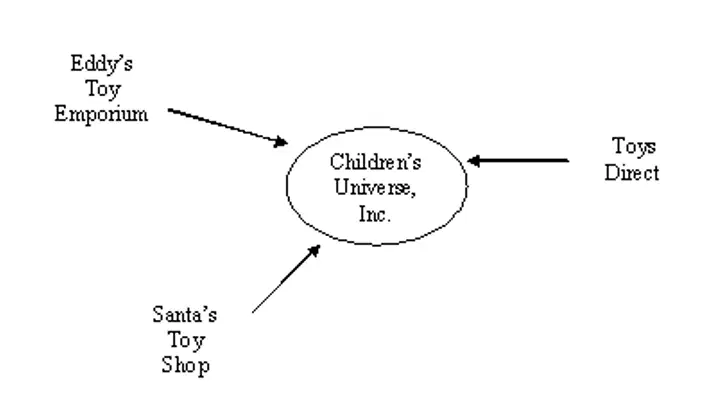
27) DBQ: What type of merger does the illustration show?
a)
horizontal merger
b)
vertical merger
c)
diagonal merger
d)
conglomerate merger
28.
28) Nonprice competition is a characteristic of both
a)
monopolistic competition and an oligopoly.
b)
perfect competition and a pure monopoly.
c)
an oligopoly and perfect competition.
d)
monopolistic competition and a pure monopoly.
29.
29) Government regulations can actually decrease competition in the economy by
a)
allowing foreign companies to compete in the United States.
b)
using antitrust legislation against monopolies.preventing the formation of conglomerates.
c)
preventing the formation of conglomerates.
d)
trying to protect consumers from unfair practices.
30.
30) In a perfectly competitive market, prices are determined by
a)
a single seller.
b)
a group of sellers.
c)
government regulations.
d)
supply and demand.
31.
31) When two or more companies in the same business combine into one corporation, the transaction is known as
a)
joint venture.
b)
vertical merger.
c)
horizontal merger.
d)
conglomerate merger.
32.
32) The industry in the United States that most closely approaches perfect competition is
a)
communications.
b)
mining.
c)
transportation.
d)
agriculture.
33.
33) Which of the following is a characteristic of a pure monopoly?
a)
many sellers of the good or service
b)
many substitutes for the good or service being sold
c)
only one seller of the good or service
d)
no barriers to entry
34.
34) The major difference between monopolistic competition and an oligopoly is
a)
the lack of brand loyalty.
b)
the lack of control over pricing.
c)
the number of sellers of a product.
d)
the number of goods being sold.
35.
35) One goal of government in the United States has been to
a)
protect monopolies.
b)
promote mergers.
c)
encourage competition in the economy.
d)
discourage competition in the economy.
100 %

