wayground logo

Free Printable Worksheets

NEW

Font size

S
M
L
XL
Worksheets

MELTS TEST REVIEW

Total questions: 48

Worksheet time: 1hrs 1mins

Name
Class
Date
1.

energy of movement (motion)

a)

light

b)

sound

c)

electrical

d)

mechanical

2.

energy produced by the flow of electrons (electricity)

a)

sound

b)

energy

c)

electrical

d)

thermal

3.

energy used to see and that solar panels transform and plants use in photosynthesis

a)

light

b)

thermal

c)

sound

d)

electrical

4.

energy of heat

a)

light

b)

sound

c)

thermal

d)

electrical

5.

energy that travels in waves/vibrations

a)

light

b)

energy

c)

sound

d)

thermal

6.

the bouncing back of light waves when it hits a medium through which it cannot pass.

a)

refraction

b)

reflection

c)

absorption

d)

medium

7.

bending or breaking of light as it passes from one medium to another (from air to water)

a)

refraction

b)

absoption

c)

reflection

d)

lens

8.
What object can change electrical energy into light energy?
a)
A candle
b)
A fire
c)
A lamp
d)
A radio
9.
How is light energy different than sound energy?
a)
Light energy moves slower.
b)
Light energy is what you see and sound energy is what you hear.
c)
Light energy uses vibrations and sound energy does not.
d)
Light energy is in a cell phone and sound energy is not.
10.
Which of the following does NOT produce light energy?
a)
car
b)
phone
c)
picture frame
d)
computer
11.
The Sun produces
a)
light and heat energy
b)
sound and light energy
c)
heat and sound energy
d)
electrical and light energy
12.
When water falls through a dam and turns a turbine connected to a generator, electricity is produced. This electricity is often used to light our homes and offices. Which of the following shows the energy transformations that occurs?
a)
electrical → light → mechanical
b)
chemical → mechanical → electrical
c)
mechanical → chemical → light
d)
mechanical → electrical → light
13.
The Electrical Energy of the stove is transferred to _____ Energy.
a)
Solar
b)
Thermal
c)
Potential
d)
Electrical
14.

Electrical Energy is transformed to _____ Energy.

a)

solar

b)

thermal

c)

light

d)

chemical

15.

Solar Energy is transformed to _____ Energy.

a)

mechanical

b)

sound

c)

solar

d)

electrical

16.

Electrical Energy is transformed to _____ Energy.

a)

Mechanical

b)

Electrical

c)

Thermal

d)

Light

17.

This shows energy changing from

_______ to _______.

a)

Sound to wind

b)

Thermal to heat

c)

Mechanical to Electrical

d)

Electrical to Mechanical

18.

This blender shows energy transforming

FROM ELECTRICAL

to

_______ and ______ energy.

a)

Light and Mechanical

b)

Mechanical and Sound

c)

Sound and Light

d)

Mechanical and Electrical

19.
A hairdryer converts -- 
a)
electrical energy into chemical
b)
electrical energy into thermal
c)
chemical energy into mechanical
d)
thermal energy into mechanical
20.
a)
Reflection
b)
Refraction
21.
a)

Smooth

b)

Rough

22.
A student placed a pencil in a cup of water.  The pencil appears broken because light-
a)
always travels in a straight line
b)
bends when it passes through water
c)
makes the water in the glass evaporate
d)
reflects the pencil on the water's surface
23.
lenses
a)
reflect
b)
refract
c)
absorb
24.

What happens to light in a prism

a)

The light is refracted.

b)

The light is reflected

c)

The light is absorbed

d)

The light does not change at all.

25.

The bouncing of light off an object

a)

basketball

b)

refraction

c)

reflection

d)

echo

26.
The pictures shows what a student observed when he looked through a hand lens at a penny.
What happens to light passing through a hand lens that makes the image of the penny appear larger? The light is-
a)
absorbed
b)
reflected
c)
refracted
d)
stopped
27.

Observe the image. After reflecting off of the mirror, which object will the light

coming from the laser most likely strike next?

a)

marble

b)

apple

c)

laser

d)

rock

28.

The arrows in the diagrams below represent light. Which diagram best shows how a

glass mirror would reflect light?

a)

b)

c)

d)

29.
Which of these best completes the circuit?
a)
rubber band
b)
metal nail
c)
leather shoelace
d)
wooden toothpick
30.
A fifth grade class constructed this circuit.  Which of these objects most likely made the light glow when connected to points X and Y?
a)
plastic straw
b)
cotton string
c)
aluminum foil
d)
rubber eraser
31.
Which of these substances conducts electricity the best?
a)
wood
b)
brick
c)
copper
d)
plastic
32.
What material would be safest to use as an insulator to cover electrical wires?
a)
rubber
b)
tin
c)
aluminum
d)
water
33.
This image represents what type of circuit?
a)
open
b)
closed
c)
series
d)
parallel
34.
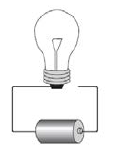
Will the light bulb in this circuit light and why/why not?
a)
yes, because it has two batteries
b)
no, because the switch is open
c)
yes, because it is in a circuit
d)
no, because the bulb is burned out
35.
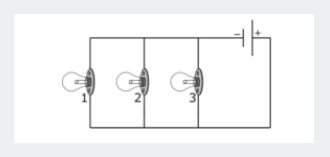
What type of circuit is represented by the diagram?
a)
closed
b)
series
c)
open
d)
parallel
36.
If bulb 1 burns out, what will occur?
a)
bulbs 2 and 3 will go out
b)
bulbs 2 and 3 receive more volts
c)
bulbs 2 and 3 will stay lit
d)
nothing will happen
37.

A student builds a circuit made up of a battery, two light bulbs, and a switch. What will the student most likely observe in this circuit?

a)

Light bulb 1 and light bulb 2 will both be on

b)

Light bulb 1 will be off, but light bulb 2 will be on

c)

Light bulb 1 and light bulb 2 will both be off

d)

Light bulb 1 will be on, but light bulb 2 will be off

38.

The diagram shows a series circuit with three lit bulbs. How many of the bulbs will remain lit if the wire is cut a the point shown by the arrow?

a)

0

b)

1

c)

2

d)

3

39.

A group of students built the circuit shown above. The lightbulb does not glow. Which statement explains this observation?

a)

The battery is not charged

b)

The lightbulb is not part of a complete circuit

c)

The circuit does not have a switch

d)

The bell uses most of the energy from the battery

40.

Students constructed a circuit using different-colored lightbulbs. What will happen if Switch 3 is closed and the other switches are left open?

a)

Only the white bulb will operate

b)

None of the bulbs will operate

c)

Only the white and yellow bulbs will operate

d)

Only the red and blue bulbs will operate

41.

The diagram shows an electric circuit with four bells that a student plans to build. When the student connects the wire as shown, which of the bells will ring?

a)

Bell 1 only

b)

Bells 1 and 4 only

c)

Bells 3 and 4 only

d)

Bells 1, 2, 3, and 4

42.
Is the following photo of an open circuit or closed circuit? 
a)
A closed circuit which allows electricity to flow
b)
An open circuit which does not allow electricity to flow
43.
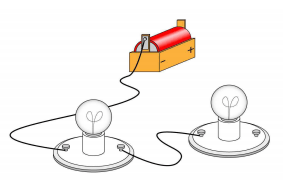
Why won’t the light bulb in the circuit pictured to the right light up?
a)
The wires from the second light bulb are not connected to the battery
b)
The wires are not connected between the light bulbs 
c)
The wires are not connected to both sides of the first light bulb
d)
The wires are too long to complete the circuit 
44.
What kind of circuit is this?
a)
series
b)
parallel
45.

An iron converts electricity into ____ to get wrinkles out of clothes.

a)

sound

b)

movement

c)

heat

d)

light

46.

What is the transfer of energy at a wind farm?

a)

electricity to motion

b)

motion to electricity

c)

sound to electricity

d)

motion to heat

47.

Some students observing a classroom device being used noticed the below energy transformations. Which device were the students most likely observing?

Electrical --> Mechanical --> Sound

a)

A triple beam balance measuring an object’s mass

b)

A pencil sharpener plugged into a wall outlet

c)

A projector displaying a diagram on the screen

d)

A working flashlight used to light up a dark corner

48.

Which object shows an energy transformation from electrical to mechanical?

a)
b)
c)
d)