wayground logo

Free Printable Worksheets

Font size

S
M
L
XL
Worksheets

HW: Lesson 4-1 to 4-3 Review

Total questions: 178

Worksheet time: 6hrs 8mins

Name
Class
Date
1.

Given 

ΔABC ΔDEF \Delta ABC\ \cong\Delta DEF\  
A  ?\angle A\ \cong\ ?  

a)

D\angle D  

b)

E\angle E  

c)

F\angle F  

d)

C\angle C  

2.

Given 

ΔABC ΔDEF \Delta ABC\ \cong\Delta DEF\  
C  ?\angle C\ \cong\ ?  

a)

D\angle D  

b)

E\angle E  

c)

F\angle F  

d)

A\angle A  

3.

Given 

ΔABC ΔDEF \Delta ABC\ \cong\Delta DEF\  
F  ?\angle F\ \cong\ ?  

a)

A\angle A  

b)

B\angle B  

c)

C\angle C  

d)

D\angle D  

4.

Given 

ΔABC ΔDEF \Delta ABC\ \cong\Delta DEF\  
BC  ?\overline{BC}\ \cong\ ?  

a)

DE\overline{DE}  

b)

EF\overline{EF}  

c)

DF\overline{DF}  

d)

FE\overline{FE}  

5.

Given 

ΔABC ΔDEF \Delta ABC\ \cong\Delta DEF\  
CA  ?\overline{CA}\ \cong\ ?  

a)

DE\overline{DE}  

b)

EF\overline{EF}  

c)

DF\overline{DF}  

d)

FD\overline{FD}  

6.

Given Hexagons 

ABCDEF PQRSTUABCDEF\ \cong PQRSTU  
S ?\angle S\cong\ ?  

a)

A\angle A  

b)

B\angle B  

c)

C\angle C  

d)

D\angle D  

e)

E\angle E  

7.

ΔPETΔDOG\Delta PET\cong\Delta DOG  

Which of the following are TRUE 

a)

PD\angle P\cong\angle D  

b)

TEGO\overline{TE}\cong\overline{GO}  

c)

TO\angle T\cong\angle O  

d)

TPGD\overline{TP}\cong\overline{GD}  

e)

TEOG\overline{TE}\cong\overline{OG}  

8.

ΔABC Δ?\Delta ABC\ \cong\Delta?  

a)

ΔEFD\Delta EFD  

b)

ΔDFE\Delta DFE  

c)

ΔDEF\Delta DEF  

d)

ΔFED\Delta FED  

9.
What is congruency?  
a)
Same size and shape 
b)
Same size
c)
segment 
d)
congruent 
10.
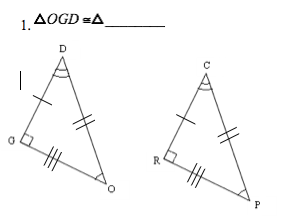
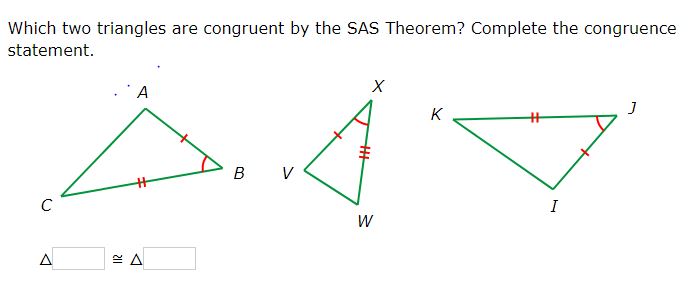
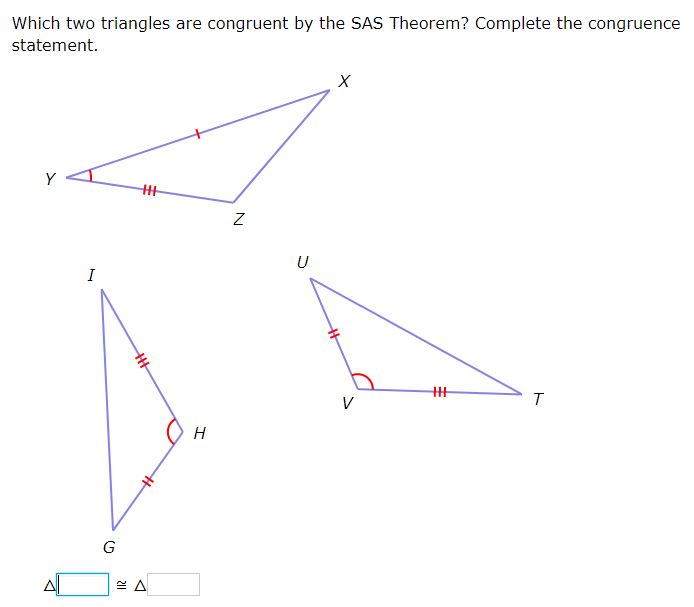
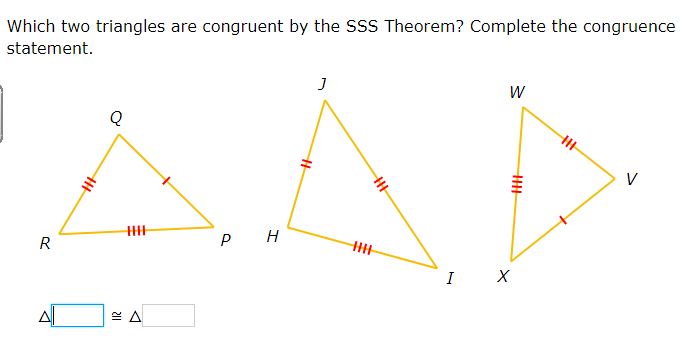
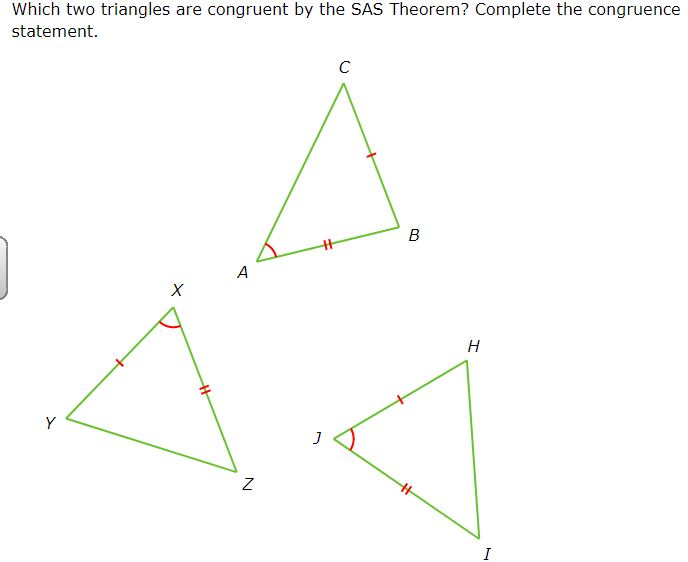
Complete the congruence statement.
a)
CRP
b)
PCR
c)
RPC
d)
PRC
11.

Which of the following are Rigid Transformations?

a)

Reflection

b)

Translation

c)

Contemplation

d)

Rotation

12.

What do we call the original figure after performing a rigid transformation?

a)

Pre Image

b)

Image

13.

What do we call the figure after performing a rigid transformation?

a)

Pre Image

b)

Image

14.

We say that rigid transformations dont change the size or shape of a figure. What does this mean?

a)

What does anything mean really? We're just a blip in the universe; a sound that can't be heard, a face that can't be seen - destined to be forgotten before we're realized. (-//-)

b)

The figures are not congruent.

c)

The figures are congruent

15.

What kind of transformation is this?

a)

Rotation

b)

Reflection

c)

Translation

16.

What kind of transformation is this?

a)

Rotation

b)

Reflection

c)

Translation

17.

What kind of transformation is this?

a)

Rotation

b)

Reflection

c)

Translation

18.

Rigid transformations preserve (a)  

19.

What is another way to describe a translation?

a)

Teleport

b)

Jump

c)

Glide

d)

Slide

20.

When reflecting a figure, you reflect across

a)

the page

b)

The line of reflection

c)

The center point

21.

What is needed when performing a rotation?

a)

A center of rotation

b)

An angle of rotation

c)

A calculator

d)

A compass to measure the angle of rotation and position of the points.

22.

What is needed when performing a reflection?

a)

A center of rotation

b)

All sets of points to be equidistant from the line of reflection

c)

A line of reflection

d)

The direction to be perpendicular to the line of reflection.

23.
Determine where X' would be if you translated X 3 units to the left and 9 units down.
a)
(-4, 4)
b)
(-10, 2)
c)
(-4, -5)
d)
(-1, 5)
24.
Determine where X' would be if you translated X 3 units to the left and 9 units down.
a)
(-4, 4)
b)
(-10, 2)
c)
(-4, -5)
d)
(-1, 5)
25.
What transformation is happening?
(x, y) ----> (x + 2, y - 3) 
a)
slide up 2, left 3
b)
slide right 2, up 3
c)
slide right 2, down 3
d)
slide left 3, right 2
26.
The original figure prior to a transformation.
a)
Pre-image
b)
Image
27.
What rule describes the translation?
a)
(x - 6, y + 2)
b)
(x - 2, y + 6)
c)
(x + 2, y - 6)
d)
(x + 6, y - 2)
28.
Which answer shows a reflection across the x-axis?
a)
d
b)
c
c)
b
d)
a
29.
What is the rule for the following reflection? 
a)
Reflection across       y = 3
b)
Reflection across        x = −3
c)
Reflection across            x = 3
d)
Reflection across          y = −3
30.
Which transformation is NOT a rigid motion (the size changes)?
a)
reflection
b)
rotation
c)
dilation
d)
translation
31.
A rigid motion ...
a)
preserves size and location
b)
preserves shape and location
c)
preserves size and shape
d)
makes the figure larger
32.
Rotate the point (-3,-4) around the origin 180 degrees. State the image of the point.
a)
(-4,-3)
b)
(-4,3)
c)
(4,-3)
d)
(3,4)
33.
Triangle C is rotated 270° counterclockwise with the origin as the center of rotation to create a new figure. Which triangle shows the new location?
a)
A
b)
B
c)
C
d)
D
34.
Triangle A is rotated 270° counterclockwise with the origin as the center of rotation to create a new figure. Which triangle shows the new location?
a)
A
b)
B
c)
C
d)
D
35.

Which of the following is NOT a rigid motion?

a)

Rotation

b)

Reflection

c)

Translation

d)

Dilation

36.

True or False: Rigid motions preserve angle measure.

a)

True

b)

False

37.

True or False: Rigid motions preserve segment length.

a)

True

b)

False

38.
A rigid motion creates figures that are ____________.
a)
congruent
b)
different sizes
c)
similar
d)
larger
39.

Identify the rigid transformation shown in the picture

a)

Translation

b)

Reflection

c)

Rotation

40.

Determine how to translate triangle ABC to triangle A'B'C'.

a)

2 units to the right, 5 units down

b)

2 units to the right, 9 units down

c)

2 units to the left, 9 units up

d)

2 units to the left, 5 units down

41.
Which answer shows a reflection across the y-axis?
a)
a
b)
b
c)
c
d)
d
42.

A transformation that “turns” a figure about a point at a given angle and a given direction.

a)

rotation

b)

translation

c)

reflection

d)

dilation

43.

Figures that are same size, same shape and same angles are...

a)

Congruent

b)

Image

c)

Angles

d)

Vertices

44.
What does a translation do to an image?
a)
Turns it 90* clockwise
b)
Mirrors it
c)
Shrinks it
d)
Slides it
45.
What side corresponds to ED?
a)
TA
b)
NA
c)
TN
d)
RD
46.
How many degrees was the figure rotated?
a)
90 degrees counterclockwise 
b)
180 degrees
c)
270 counterclockwise 
47.
Identify the transformation from A to D.
a)
90o Clockwise Rotation
270o Counter Clockwise Rotation
b)
180o Rotation
c)
270o Clockwise Rotation
90o Counter Clockwise Rotation
d)
360o Rotation
48.
Identify the transformation from C to D.
a)
90o Clockwise Rotation
b)
180o Rotation
c)
270o Clockwise Rotation
d)
360o Rotation
49.
∆ABC≅∆XYZ
which is true?
a)
AB≅XY
b)
AB≅YX
c)
AB≅XZ
d)
BC≅CB
50.
Identify the transformation from ABCD to A'B'C'D'.
a)
Translation
b)
Reflection across the x-axis
c)
Reflection across the y-axis
d)
90o counter clockwise rotation
51.
If the dotted figure is the image, the original figure was reflected over the ...
a)
x-axis
b)
y-axis
52.
Identify the transformation.
a)
Reflection across y-axis
b)
90 Rotation counter clockwise
c)
Translation 5 units left, 1 unit up.
d)
Translation 5 units right, 1 unit down
53.
Does the transformation shown preserve congruence and/or orientation?
a)
Congruence yes, Orientation yes
b)
Congruence No, Orientation No
c)
Congruence No, Orientation yes
d)
Congruence Yes, Orientation No
54.
Does the transformation shown preserve congruence and/or orientation?
a)
Congruence yes, Orientation yes
b)
Congruence No, Orientation No
c)
Congruence No, Orientation yes
d)
Congruence Yes, Orientation No
55.
Does the transformation shown preserve congruence and/or orientation?
a)
Congruence yes, Orientation yes
b)
Congruence No, Orientation No
c)
Congruence No, Orientation yes
d)
Congruence Yes, Orientation No
56.
Find K'.
a)
(4, 1))
b)
(-1, -4)
c)
(1, -4)
d)
(1, 4)
57.
Find E'.
a)
(-1, -5)
b)
(-2, -2)
c)
(0, -4)
d)
(-4, 0)
58.
Reflect the figure across the y-axis. What are the coordinates of A'?
a)
(-2, -4)
b)
(2, 4)
c)
(-2, 4)
d)
(2, -4)
59.

Rigid motions preserve... (select all)

a)

side lengths

b)

orientation

c)

position

d)

angle measures

60.

What is the measure of ∠S?

a)

60⁰

b)

52⁰

c)

45⁰

d)

36⁰

61.
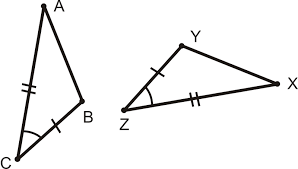
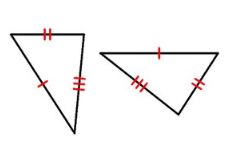
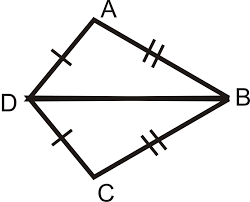
Which triangle congruence theorem can be used to prove the triangles are congruent?
a)
SAS
b)
SSS
c)
ASA
d)
HL
62.
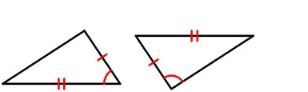
Which triangle congruence theorem can be used to prove the triangles are congruent?
a)
SAS
b)
SSS
c)
ASA
d)
HL
63.
Which triangle congruence theorem can be used to prove the triangles are congruent?
a)
SSS
b)
ASA
c)
AAS
d)
SAS
64.
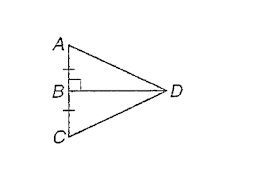
Which triangle congruence theorem can be used to prove the triangles are congruent?
a)
SAS
b)
Not enough information
c)
SSS
d)
AAS
65.

What does SAS stand for?

a)

Side-Angle-Side

b)

Side-Side-Side

c)

Angle-Side-Angle

d)

Angel-Angle-Side

66.

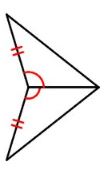
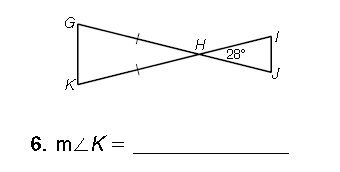
Which triangle congruence theorem can be used to prove the triangles are congruent? Hint: Remember the definition for vertical angles.

a)

AAS

b)

SSS

c)

SAS

d)

SSA

67.

What does SSS stand for?

a)

Angle-Angle-Side

b)

Angle-Side-Angle

c)

Side-Side-Side

d)

Side-Angle-Side

68.

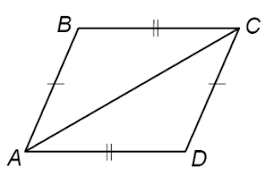
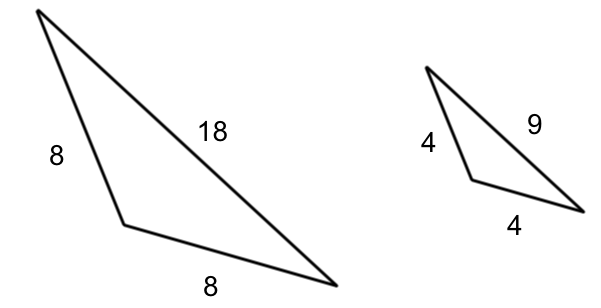
Name the postulate, if possible, that makes the triangles congruent.

a)

SSS

b)

SAS

c)

Not Possible

69.

Name the postulate, if possible, that makes the triangles congruent.

a)

SSS

b)

SAS

c)

Not possible

70.

Name the postulate, if possible, that makes the triangles congruent.

a)

SSS

b)

SAS

c)

Not Possible

71.

Name the postulate, if possible, that makes the triangles congruent.

a)

SSS

b)

SAS

c)

Not Possible

72.

What theorem or can be used to prove that RN RN\overline{RN}\cong\ \overline{RN}   (Segment RN is congruent to itself)?

a)

Transitive

b)

Vertical angles

c)

Alternate interior angles

d)

Reflexive

73.

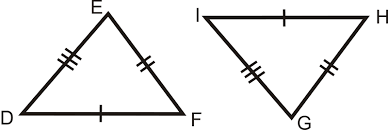
State if the two triangles are congruent. If so, state how you know.

a)

Congruent by SSS

b)

Congruent by SAS

c)

Not Congruent

74.

State if the two triangles are congruent. If so, state how you know.

a)

Congruent by SSS

b)

Congruent by SAS

c)

Not Congruent

75.

State if the two triangles are congruent. If so, state how you know.

a)

Congruent by SSS

b)

Congruent by SAS

c)

Not Congruent

76.

State if the two triangles are congruent. If so, state how you know.

a)

Congruent by SSS

b)

Congruent by SAS

c)

Not Congruent

77.

State if the two triangles are congruent. If so, state how you know.

a)

Congruent by SSS

b)

Congruent by SAS

c)

Not Congruent

78.

State if the two triangles are congruent. If so, state how you know.

a)

Congruent by SSS

b)

Congruent by SAS

c)

Not Congruent

79.

State if the two triangles are congruent. If so, state how you know.

a)

Congruent by SSS

b)

Congruent by SAS

c)

Not Congruent

80.

State if the two triangles are congruent. If so, state how you know.

a)

Congruent by SSS

b)

Congruent by SAS

c)

Not Congruent

81.

State if the two triangles are congruent. If so, state how you know.

a)

Congruent by SSS

b)

Congruent by SAS

c)

Not Congruent

82.

State if the two triangles are congruent. If so, state how you know.

a)

Congruent by SSS

b)

Congruent by SAS

c)

Not Congruent

83.

State if the two triangles are congruent. If so, state how you know.

a)

Congruent by SSS

b)

Congruent by SAS

c)

Not Congruent

84.

State if the two triangles are congruent. If so, state how you know.

a)

Congruent by SSS

b)

Congruent by SAS

c)

Not Congruent

85.

State if the two triangles are congruent. If so, state how you know.

a)

Congruent by SSS

b)

Congruent by SAS

c)

Not Congruent

86.

State if the two triangles are congruent. If so, state how you know.

a)

Congruent by SSS

b)

Congruent by SAS

c)

Not Congruent

87.

State if the two triangles are congruent. If so, state how you know.

a)

Congruent by SSS

b)

Congruent by SAS

c)

Not Congruent

88.

State if the two triangles are congruent. If so, state how you know.

a)

Congruent by SSS

b)

Congruent by SAS

c)

Not Congruent

89.

State if the two triangles are congruent. If so, state how you know.

a)

Congruent by SSS

b)

Congruent by SAS

c)

Not Congruent

90.

State if the two triangles are congruent. If so, state how you know.

a)

Congruent by SSS

b)

Congruent by SAS

c)

Not Congruent

91.

State if the two triangles are congruent. If so, state how you know.

a)

Congruent by SSS

b)

Congruent by SAS

c)

Not Congruent

92.

State if the two triangles are congruent. If so, state how you know.

a)

Congruent by SSS

b)

Congruent by SAS

c)

Not Congruent

93.

State if the two triangles are congruent. If so, state how you know.

a)

Congruent by SSS

b)

Congruent by SAS

c)

Not Congruent

94.
Which triangle congruence theorem can be used to prove the triangles are congruent?
a)
SAS
b)
SSS
c)
ASA
d)
HL
95.
Which triangle congruence theorem can be used to prove the triangles are congruent?
a)
SSS
b)
ASA
c)
AAS
d)
SAS
96.
Which triangle congruence theorem can be used to prove the triangles are congruent?
a)
AAS
b)
SSS
c)
Not enough information given
d)
ASA
97.
Which triangle congruence theorem can be used to prove the triangles are congruent?
a)
AAS
b)
SSS
c)
SAS
d)
SSA
98.
Which triangle congruence theorem can be used to prove the triangles are congruent?
a)
SAS
b)
Not enough information
c)
SSS
d)
AAS
99.
Which triangle congruence theorem can be used to prove the triangles are congruent?
a)
SSS
b)
SAS
c)
AAS
d)
ASA
100.
Name the postulate, if possible, that makes the triangles congruent.
a)
SSS
b)
SAS
c)
ASA
d)
AAS
101.
Name the postulate/theorem that proves these triangles congruent.
a)
SSS
b)
SAS
c)
ASA
d)
HL
102.
The triangles are similar by...
a)
SAS
b)
AA
c)
ASA
d)
SSS
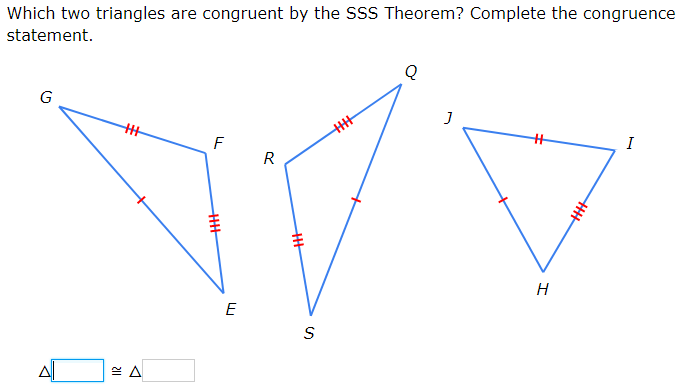
103.
a)
ΔGFE=ΔSRQ
b)
ΔGFE=ΔQRS
c)
ΔGFE=ΔJIH
d)
ΔSRQ=ΔJIH
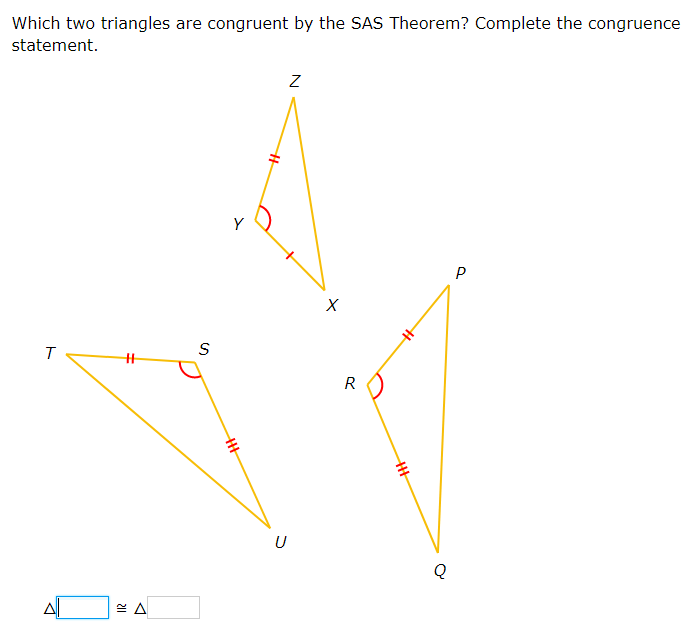
104.
a)
ΔTSU=ΔPRQ
b)
ΔTSU=ΔZYX
c)
ΔQRP=ΔXYZ
d)
ΔPRQ=ΔSUT
105.
a)
ΔABC=ΔJKI
b)
ΔXVW=ΔCBA
c)
ΔKJI=ΔVXW
d)
ΔCBA=ΔKJI
106.
a)
ΔHIG=ΔYXZ
b)
ΔIHG=ΔZYX
c)
ΔUTV=ΔGIH
d)
ΔTVU=ΔGIH
107.
a)
ΔRQP=ΔJHI
b)
ΔWVX=ΔRQP
c)
ΔXWV=ΔJIH
d)
ΔIJH=ΔPQR
108.
a)

ΔYXZ=ΔCBA

b)

ΔJHI=ΔBAC

c)

ΔZYX=ΔIHJ

d)

ΔIJH=ΔACB

109.

What is the measure of ∠S?

a)

60⁰

b)

52⁰

c)

45⁰

d)

36⁰

110.

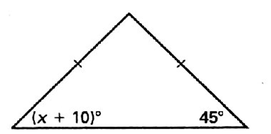
What is the value of x?

a)

16

b)

17

c)

51

d)

78

111.

What is the measure of ∠S?

a)

not enough information

b)

30

c)

60

d)

180

112.

What is the value of x?

a)

16

b)

60

c)

8

d)

not enough information

113.
If two sides of a triangle are congruent, then the _________________ opposite those sides are congruent.
a)
sides
b)
vertices
c)
angles
d)
measures
114.

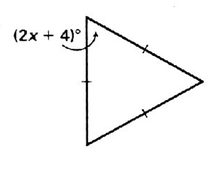
Find x

a)

3

b)

4

c)

2

d)

10

115.
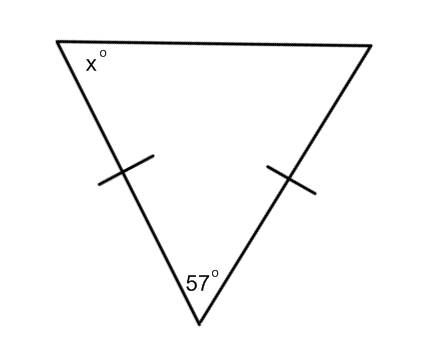
Find x.
a)
180
b)
57
c)
61.5
d)
32.7
116.

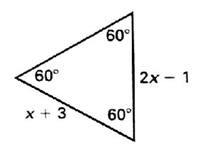
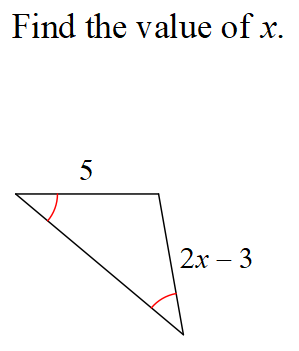
Find the value of x.

a)

1

b)

4

c)

5

d)

8

117.
Find the value of the base angle. 
a)
30
b)
120
c)
60
d)
180
118.
What is the measure of angle 2?
a)
50
b)
65
c)
115
119.
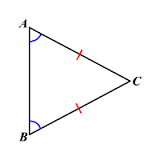
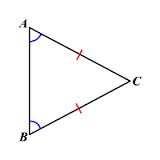
Which segment is the base?
a)
Segment AB
b)
Segment BC
c)
Segment AC
120.
Which angle is the vertex angle?
a)
<C
b)
<A
c)
<B
121.

If an isosceles triangle has a base angle measuring 40°, then what measure is the VERTEX angle?

a)

120°

b)

100°

c)

40°

d)

80°

122.
If two sides of a triangle are congruent, then the _________________ opposite those sides are congruent.
a)
sides
b)
vertices
c)
angles
d)
measures
123.
What is the value of the missing angle?
a)
61
b)
50
c)
60
d)
69
124.

What is the measure of BC?

a)

12

b)

6

c)

9

d)

10

125.
Find x
a)
90
b)
45
c)
22
d)
35
126.
Find x
a)
10
b)
32
c)
116
d)
16
127.

If AEDE, then A  ?If\ AE\cong DE,\ then\ \angle A\ \cong\angle\ ?  

a)

B

b)

C

c)

D

d)

E

128.

Solve for the value of X.

X= (a)  

129.

Solve for x.

a)

72o

b)

144o

c)

46o

d)

36o

130.

What should be the value of x, y and z?

a)

x=43°

y=10

z=10

b)

x=43°

y=10

z=5

c)

x=47°

y=10

z=5

d)

x=47°

y=10

z=10

131.

What type of triangle is shown?

a)

Isosceles Triangle

b)

Equilateral Triangle

132.
Use the picture to answer the question.
a)
76
b)
28
c)
152
d)
56
133.
Which would be the best classification for the triangle shown?
a)
acute isosceles
b)
equiangular scalene
c)
equiangular isosceles
d)
equiangular equilateral
134.
What is the value of the missing angle?
a)
61
b)
50
c)
60
d)
69
135.
What is the value of x?
a)
10
b)
5
c)
-12
d)
9
136.

What is the value of the < A

a)

151

b)

68

c)

80

d)

78

137.
What is the value of x?
a)
75
b)
80
c)
63
d)
60
138.
Which angle is the vertex angle?
a)
<C
b)
<A
c)
<B
139.
Which segment is the base?
a)
Segment AB
b)
Segment BC
c)
Segment AC
140.
a)
60
b)
120
c)
15
d)
30
141.
Find x.
a)
180
b)
57
c)
61.5
d)
32.7
142.
Use the picture to answer the question.
a)
76
b)
28
c)
152
d)
56
143.
Find the measure of the indicated angle. 
a)
145 degrees
b)
24 degrees
c)
20 degrees 
d)
21 degrees
144.
If two sides of a triangle are congruent, then the _________________ opposite those sides are congruent.
a)
sides
b)
vertices
c)
angles
d)
measures
145.
Find x
a)
90
b)
45
c)
22
d)
35
146.

Find the value of x.

a)

1

b)

4

c)

5

d)

8

147.
Find x
a)
60
b)
48
c)
30
d)
28
148.
Find the value of y. 
a)
y=2
b)
y=18
c)
y=8.22
d)
y=9.33
149.
Find the value of the base angle. 
a)
30
b)
120
c)
60
d)
180
150.
Solve for x.
a)
7
b)
9
c)
10
d)
-11
151.
Which would be the best classification for the triangle shown?
a)
acute isosceles
b)
equiangular scalene
c)
equiangular isosceles
d)
equiangular equilateral
152.
What is the value of the missing angle?
a)
61
b)
50
c)
60
d)
69
153.
a)
72
b)
67
c)
65
d)
54
154.
The sides of an equilateral triangle have...
a)
different measures.
b)

Mr M's gallon of water

c)
equal measures.
d)
60°.
155.

Solve for y

a)

70

b)

40

c)

140

d)

Not enough information

156.
a)
A
b)
B
c)
C
d)
D
157.

What is the measure of ∠A?

a)

46

b)

134

c)

90

d)

88

158.

What is the measure of BC?

a)

12

b)

6

c)

not enough information

d)

10

159.

What is the measure of ∠S?

a)

not enough information

b)

30

c)

60

d)

180

160.
Look at the sides of this triangle. What type of triangle is this?
a)
scalene
b)
acute
c)
equilateral
d)
isosceles
161.
Look at the sides of this triangle. What type of triangle is this?
a)
Equilateral
b)
Isosceles
c)
Scalene
d)
Obtuse
162.

In an ______________ triangle, all three angles are less than 90 degrees.

a)

acute

b)

right

c)

obtuse

d)

360 degrees

163.

What kind of triangle is this?

a)

acute

b)

right

c)

obtuse

d)

360 degrees

164.
Look at the sides and angles of this triangle. Which type of triangle is pictured?
a)
Equilateral Triangle
b)
Right Isosceles Triangle
c)
Obtuse Scalene Triangle
d)
Obtuse Equilateral Triangle
165.
What are complementary angles?
a)
Angles that add up to 180°
b)
Angles that add up to 90°
c)
Angles that are equal to each other
d)
Angles that are opposite of each other when lines intersect.
166.

Find the value of x:

(a)  

167.

Find the value of x:

(a)  

168.
a)
72
b)
67
c)
65
d)
54
169.
a)
72
b)
67
c)
65
d)
54
170.
a)
A
b)
B
c)
C
d)
D
171.

What is the measure of ∠A?

a)

46

b)

134

c)

90

d)

88

172.

What is the measure of BC?

a)

12

b)

6

c)

not enough information

d)

10

173.

What is the measure of ∠S?

a)

not enough information

b)

30

c)

60

d)

180

174.

Find the value of x:

(a)  

175.
Find x
a)
90
b)
45
c)
22
d)
35
176.

Solve for the value of X.

X= (a)  

177.

Find x

a)

3

b)

4

c)

2

d)

10

178.

Find the value of x.

a)

1

b)

4

c)

5

d)

8