
Font size
 Worksheets
final chem review
Total questions: 83
Worksheet time: 4hrs 35mins

What is the name of the feature labelled C?
Half equivalence point
Equivalence point
Buffer region
What is the name of the feature labelled B?
Half equivalence point
Equivalence point
Buffer region
What is the name of the feature labelled A?
Half equivalence point
Equivalence point
Buffer region
Define buffer region
when half the moles of acid or base have been neutralised
when the solution is resisting the change in pH
when all moles of acid have reacted with all moles of base / point of neutralisation
when the indicator changes colour

The following titration shows
A strong acid added to a strong base
A strong base added to a strong acid
A weak acid added to a strong base
A weak base added to a strong acid

The following titration shows
A strong acid added to a strong base
A strong acid added to a weak base
A weak acid added to a strong base
A strong base added to a weak acid

Select an appropriate indicator for this titration
Phenolphthalein
Bromoscresol Green
Bromophenol Blue
Methyl Orange
When a strong acid is being added to a weak base, the equivalence point will be
Below 7
Above 7
At, or close to, 7
When a strong base is being added to a weak acid, the equivalence point will be
Below 7
Above 7
At, or close to, 7
30cm3 of NaOH is neutralised by 12.3cm3 of 0.2mol/l HCl. What is the concentration of the NaOH.
82 mol/l
0.82 mol/l
0.49 mol/l
0.082 mol/l
HClO4 + KOH → KClO4 + H2O
Suppose 100 mL of perchloric acid is neutralized by exactly 50,0 mL of 1.0 M of Potassium hydroxide. What is the concentration of the perchloric acid?
SO2 + O2 <−> SO3
If the concentration of SO2 is increased, the equilibrium of the reaction will shift ___________.

N2 (g) + 3 H2 (g) <=> 2 NH3 (g)
If the pressure in the system is increased, which substance(s) will increase in concentration?
2 NO(g) + O2(g) ⇌ 2 NO2(g)
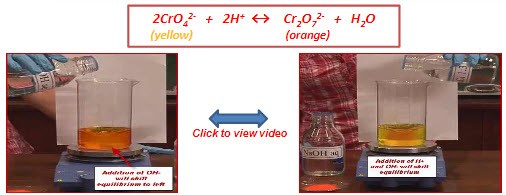
2CrO42- + 2H+ → Cr2O72- + H2O
What will happen when H+ ions are added to the system?
Position of equilibrium will shift to left and become more yellow
Color of system will turn all yellow
Color of system will turn all orange
Equilibrium will shift to right and become more orange
According to the Bronsted-Lowry theory, bases are:
Always oxides and hydroxides of metals
Alkalis which are soluble in water
proton donors
proton acceptors
The pH of a solution of 0.001 mol/L NaOH is:
3
11
1 x 10⁻³
1 x 10-11
A solution of hydrochloric acid is diluted. As a result, its pH changes from 2 to 4. The hydrogen ion concentration of the diluted solution is:
doubled
halved
increased 100 times
decreased 100 times
In which of these equations is water acting as a Bronsted-Lowry acid?
NH3 + H2O ↔ NH4+ + OH-
H2PO4- + H2O ↔ HPO42- + H3O+
HCl + H2O ↔ Cl- + H3O+
NiCl2.6H2O ↔ NiCl2 + 6H2O

Which of these Ka values corresponds to the strongest acid?
4 x 10⁻⁴
5 x 10⁻⁴
6 x 10⁻⁴
7 x 10⁻⁴
Acetic Acid (HC2H3O2) is a weak monoprotic acid. It's concentration is 0.20M and it's Ka value is 1.8x10⁻⁵. Calculate it's pH value.
0.698
2.72
11.28
None of the answers are correct
Which of these Ka values corresponds to the weakest (least strong) acid?
9 x 10⁻¹⁰
5 x 10⁻⁴
6 x 10⁻⁸
7 x 10⁻²
2CaO--> 2Ca + O2
which element, if any, is oxidized?
In a Galvanic Cell, the anode is...
positive
negative
In a Galvanic Cell, the cathode is...
positive
negative
Oxidation occurs at the...
anode
cathode
Reduction occurs at the...
anode
cathode
In a Galvanic cell, the electrons flow from the...
anode to the cathode
cathode to the anode
In the list of standard electrode potentials, the strongest reducing agent is...
K
K+
F2
F-
In the list of standard electrode potentials, the strongest oxidising agent is...
K
K+
F2
F-
In a Galvanic Cell, the salt bridge...
completes the circuit so that electrons can flow through the wire
maintains charge balance
is soaked in an unreactive electrolyte such as KNO3
all of the above
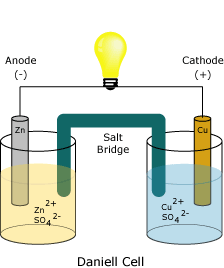
In the above Galvanic Cell, which half cell is undergoing reduction?
Cu | Cu2+
Zn | Zn2+
If an electrochemical reaction is spontaneous, what will Ecell be?
positive
negative
A certain galvanic cell has for its spontaneous cell reaction: Zn + HgO → ZnO + Hg
Which is the half-reaction occurring at the anode?
HgO + 2 e- → Hg + O2-
Zn2+ + 2 e- → Zn
Zn → Zn2+ + 2 e-
ZnO + 2 e- → Zn


When we purify copper using electrolysis...
the pure copper is at the cathode.
the electrolyte contains Cu2+ ions.
impure copper is at the anode.

Which diagram gives the skeletal formula of
2-chloropentan-3-ol ?
A
B
C
D
Give the IUPAC name of this molecular formula C6H14
Hexane
Hexanol
Hexanoic Acid
Hexanal

Molecules with the same molecular structure but have different structural formulas are called...
polymers
biomolecules
constitutional polymers
isomers
the type of reaction that occur in alkenes
elimination
substitution
addition

Identify the functional groups present in this compound.
amine
amide
ether
ester

What is the name of this compound?
ethanol
ethanal
ethanone
methanal

3 of the compounds below can turn acidified potassium dichromate (VI) orange to green which are?
propan-1-ol
propan-2-ol
2-methylpropan-2-ol
3,3 dimethylbutan-2-ol
C5H12 + Br2 --> C5H11Br + HBr
This reaction is called____________________.
Substitution
Addition
Cracking
Combustion


If a methyl group (-CH3), which does not like water, were at the 'R', the amino acid would likely be:
Hydrophobic
Hydrophilic
Ionic
Acidic



Under basic conditions, lipid molecule hydrolysis produces
Glycerol + Water
Glycerol + Fatty acids
Glycerol + Fatty acid salts
Water + Fatty acids
When reacting Na with Cl2, we calculated that the theoretical yield should be 13 grams. Our actual yield was 12.5 grams. What is the percent yield?
90.4%
104%
96.15%
1.04%
Fe2O3(s) + 3H2(g) → 2Fe(s) + 3H2O(l)
How many moles of iron can be made from 6 moles H2?

What is the % atom economy for the formation of ethane in the reaction above?
100
30
28
60
Given the reaction
2KClO3 → 2KCl + 3O2
Masses: O = 16, K = 39, Cl = 35
Calculate the % atom economy for the formation of potassium chloride.
22.4
96
30
60.7
How does Avogadro write to his friends?
Snail mail
With a quill
E-mole
How do astronauts organize a party?
They star it on their calendar
They make it out of this world
They planet
They reach for the stars
Why can't you trust an atom?
Because they make up everything
Because they can be negative
Because they are radioactive
Because they are charged
What did the limestone say to the geologist?
Rock and roll!
This is how I roll!
You rock!
Don't take me for granite!
How do trees get on the internet?
Root ethernet cables
They log in
They branch out
Leaf wifi
What has a bed that you can't sleep in?
A truck
A river
Bedrock
Bedazzled pants
How did Ben Franklin feel after discovering electricity?
Shocked!
Electrified!
Excited!
Lightening!
What did the thermometer say to the graduated cylinder?
It's hot in here!
You're cracking me up!
You graduated but I've got many degrees!
You're cute!
Why did Hydrogen marry Oxygen?
They felt a strong bond between them
He felt positive about her
He was thirsty
She took his breath away

