wayground logo

Free Printable Worksheets

Font size

S
M
L
XL
Worksheets

KC1 Review

Total questions: 101

Worksheet time: 1hrs 19mins

Name
Class
Date
1.
The human skeleton can be subdivided into two parts, what part is made up of the skull, sternum, vertebral column and rib cage?
a)
appendicular
b)
axial
2.
What type of bone is the scapula
a)
long bone
b)
short bone
c)
flat bone
d)
sesamoid bone
3.
what is the function of synovial fluid?
a)
to cover the end of the bones
b)
to lubricate the joint
c)
to attach bone to bone
d)
to attach bone to muscle
4.
fingers and toes
a)
phalanges
b)
metacarpals
c)
metatarsals
d)
fibula
5.
the flares of the hip, largest part
a)
ilium
b)
ischium
c)
pubis
d)
coxa
6.
This is the scientific name for your shoulder blade.
a)
scapula
b)
sternum
c)
vertebral column
d)
tibia
7.
Your upper arm bone is called this.
a)
humerus
b)
tibia
c)
fibula
d)
ulna
8.
The neck is an example of this joint:
a)
Pivot
b)
Ball and Socket
c)
Gliding
d)
Hinge
9.
The wrist bones are also known as:
a)
Carpals
b)
Phalanges
c)
Tarsals
d)
Radius
10.
What is the name of the outermost layer of bone?
a)
Compact
b)
Marrow
c)
Spongy
d)
Periosteum 
11.
What are the 3 types of muscles?
a)
Cardiac, smooth and skeletal
b)
Cardiac, skeletal, prime
c)
Flexion, extension, smooth
d)
Skeletal, smooth, stringy
12.
Tendons connect __________ to bone.
a)
Cartilage
b)
Bone
c)
Muscle
d)
Ligaments
13.
Myofibrils are divided into lengthwise fragments called __________.
a)
Sarcomeres
b)
Epimysium
c)
Endomysium
d)
Perimysium
14.
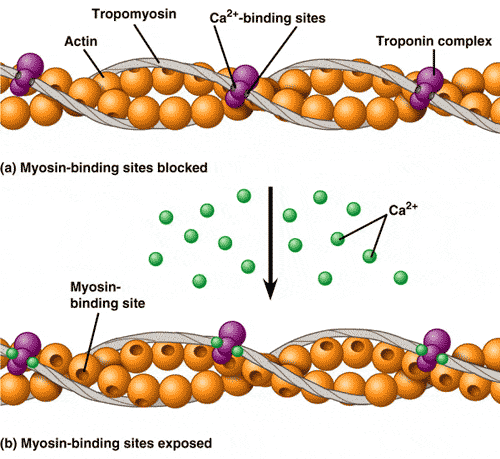
What do troponin and tropomyosin do?
a)
Lengthening and shortening.
b)
Responsible for voluntary body movements.
c)
Carries out mostly involuntary processes like digestion and pumping blood through arteries.
d)
binds calcium ions and uncovers myosin binding sites 
15.
amount of oxygen needed to restore levels of ATP and creatine phosphate in muscles plus the amount of oxygen needed to convert the lactic acid back into glucose
a)
muscle tone
b)
muscle fatigue
c)
oxygen debt
d)
pyramiding
16.
the connection between the motor neuron and the muscle fiber
a)
aponeurosis
b)
endomysium
c)
neuromuscular  junction
d)
epimysium
17.
stores excess energy in muscles, used to turn ADP back into ATP
a)
acetylcholinterase
b)
acetylcholine
c)
creatine phosphate
d)
lactic acid
18.
connective tissue that extends inward from the epimysium separating muscle tissue into fascicles
a)
endomysium
b)
perimysyium
c)
aponeurosis
d)
tendon
19.
Once acetylcholine binds to a muscle cell receptor, what is the first event to occur?
a)
voltage-gated Na+ ion channels open, and Na+ moves out
b)
voltage-gated Na+ ion channels open, and Na+ moves in
c)
voltage-gated K+ ion channels open, and K+ moves out
d)
voltage-gated K+ ion channels open, and K+ moves in
20.
Once an action potential is propagated down the T tubule, why must the SR release CA2+ ions?
a)
the Ca ions must bind to the myosin
b)
the Ca ions must bind to the actin
c)
the Ca ions must bind to the tropomyosin, moving the troponin complex out of the way
d)
the Ca ion must bind to the troponin complex, allowing it to move the tropomyosin out of the way
21.
Would be used for a moderate exercise, like a leisurely swim, slow jog, or yoga.
a)
fast glycolytic fibers
b)
slow oxidative fibers
c)
fast oxidative fibers
22.
Would be used for a moderate exercise, like a leisurely swim, slow jog, or yoga.
a)
fast glycolytic fibers
b)
slow oxidative fibers
c)
fast oxidative fibers
23.
a red pigment that stores oxygen in a muscle
a)
hemoglobin
b)
myoglobin
c)
myosin
d)
actin
24.
What muscle elevates and depresses the scapula?
a)
Serratus Anterior
b)
Latissimus Dorsi
c)
Trapesiuz
d)
Brachioradialis
25.
                                            What                                           muscle
                                          is this?
a)
Gastrocnemius
b)
Tibialis Anterior
c)
Extensor Digitorum Longus
d)
Plantaris
26.
During plantar flexion you __________ your __________.
a)
Flex, foot
b)
Flex, elbow
c)
Depress, foot
d)
Depress, elbow
27.
An __________ muscle is in opposition to a prime mover in that it provides some resistance and/ or reverses a given movement.
a)
Antagonist
b)
Protagonist
c)
Synergist
d)
Prime mover
28.
When the distal portion of a limb makes a circle while the proximal portion remains fixed is called __________.
a)
Circumduction
b)
Flexion
c)
Pronation
d)
Protraction
29.
Flex knee and extend hip
a)
Semimembranosus
b)
Semitendinosus
c)
Biceps femoris
d)
all of these
30.
Extends hip when a forceful extension is required
a)
Rectus femoris
b)
Gatrocnemius
c)
tibialis anterior
d)
gluteus maximus
31.
DOMS
a)
delayed onset muscle soreness
b)
electrocardiogram
c)
echocardiogram
d)
electroencephalogram
32.

This type of joint allows the your first two vertebrae to rotate as in shaking your head no

a)

condyloid

b)

gliding

c)

pivot

d)

saddle

33.
The knee joint is
a)
Hinge
b)
Gliding
c)
Ball and socket
d)
Pivot
34.
Identify the joint action being performed.
a)
Extension
b)
Flexion
c)
Abduction
d)
Adduction
35.
Identify the joint action being performed.
a)
Extension
b)
Flexion
c)
Abduction
d)
Adduction
36.
Identify the joint action being performed.
a)
Extension
b)
Flexion
c)
Abduction
d)
Adduction
37.
Identify the joint action being performed.
a)
Circumduction
b)
Lateral Rotation
c)
Medial Rotation
d)
Eversion
38.
Identify the joint action being performed.
a)
Inversion
b)
Eversion
c)
Plantarflexion
d)
Dorsiflexion
39.
Which of the following is a fixed or fibrous joint?
a)
Hip
b)
Vertebrae
c)
Skull
d)
Ribs
40.
A joint is formed when:
a)
Two or more muscles meet
b)
Two or more ligaments meet
c)
Two or more bones meet
d)
Two or more tendons meet
41.

What does DOMS stand for?

a)

Delayed Onset Muscle Strain

b)

Deliberate Onset Muscle Soreness

c)

Delayed Onset Muscle Soreness

d)

Delayed Offset Muscle Soreness

42.

What causes DOMS

a)

Eccentric muscle contractions performed during exercise, causing tiny muscle tears leading to swelling.

b)

Eccentric muscle contractions performed during exercise.

c)

Fast twitch muscle fibres working harder than slow twitch.

d)

Muscles being overworked.

43.

The muscle that contracts to create movement.

a)

Voluntary

b)

Antagonistic

c)

Antagonist

d)

Agonist

44.
What is the agonist for flexion of the elbow
a)
Triceps Brachii
b)
Biceps Barachii
c)
Wrist Flexor
d)
Wrist Extensor
45.
What is the agonist for flexion of the spine?
a)
Iliopsoas
b)
Rectus femoris
c)
Rectus abdominus
d)
Soleus
46.

The process of muscles on one side of a joint relaxing to accommodate contraction on the other side of that joint

a)

Autogenic Inhibition

b)

Reciprocal Inhibition

47.
When a muscle shortens under tension it is called a...
a)
Concentric contraction
b)
Eccentric contraction
c)
Isometric contraction
48.
Which muscle is the Agonist during the action of 'standing on tiptoes'?
a)
Hamstrings
b)
Quadriceps
c)
Gastrocnemius
d)
Gluteals
49.
Which of these is NOT an antagonistic pair?
a)
Biceps & Triceps
b)
Hamstrings & Quadriceps
c)
Pectorals & Abdominals
d)
Abdominals & Latissimus Dorsi
50.
A bundle of fascicles best describes a
a)
muscle fiber
b)
muscle tissue
c)
myofibril
d)
tendon
51.
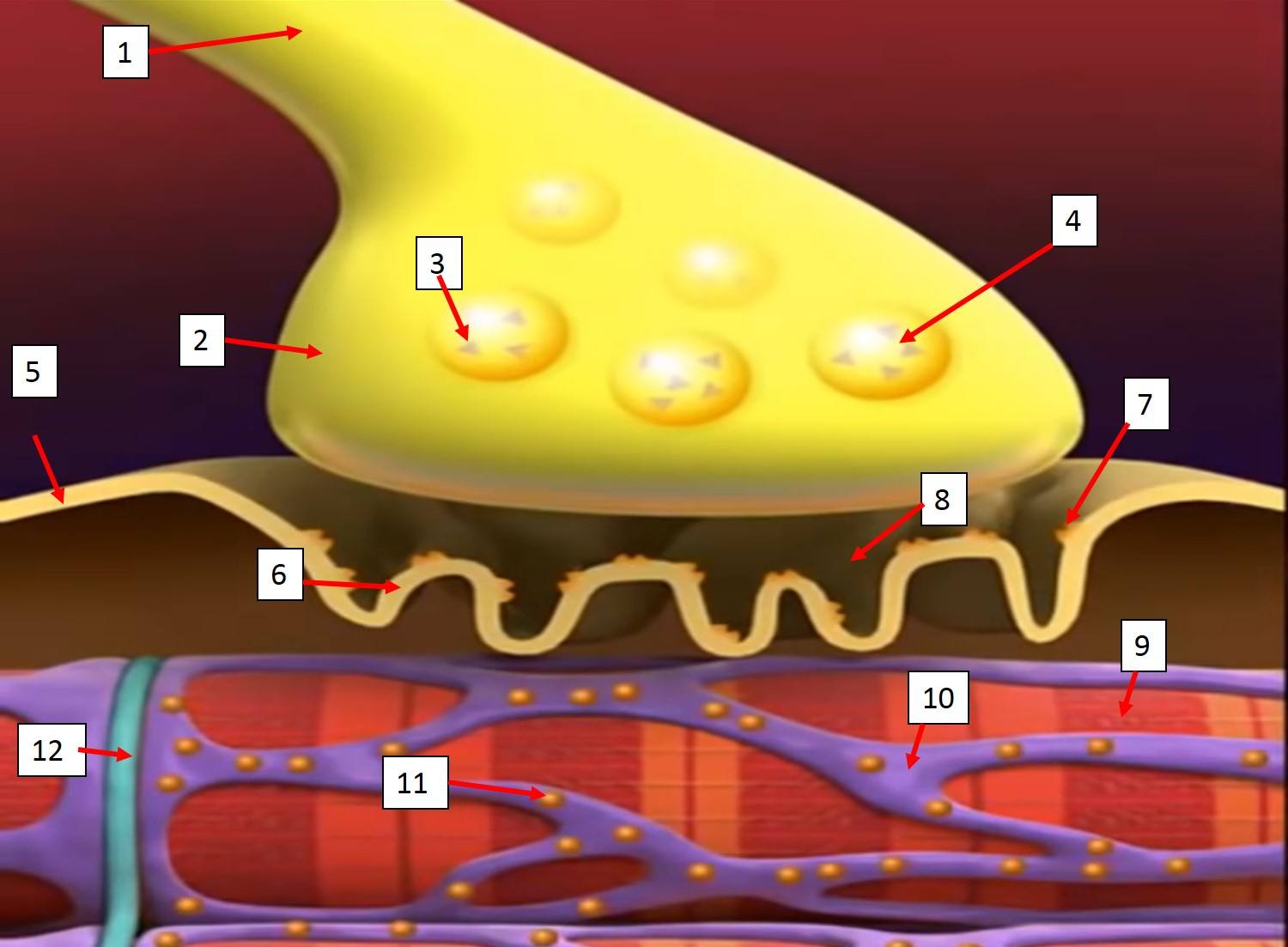
The neurotransmitter stored in the axon terminal identified as #3
a)
Acetylcholine
b)
Protein Channel
c)
Calcium Ion (Ca2+)
d)
Syanptic Cleft
52.
The organelle that stores ACh in the axon is identified as #4
a)
Motor Neuron
b)
Axon Terminal of Motor Neuron
c)
Sarcolemma
d)
 Vesicle
53.

The specialized part of the cell membrane of the muscle fiber identified as #5

a)

Sodium ion (Na+)

b)

Axon Terminal of Motor Neuron

c)

motor end plate

d)

Vesicle

54.
The organelle that contains actin and myosin.
a)
Tendon
b)
myofilament
c)
myofibril
d)
Fiber
55.
Another name for a muscle cell.
a)
Fiber
b)
Sacrolemma
c)
Sacromere
d)
Fascicle
56.
Contractile unit of a muscle.
a)
sarcomere
b)
motor unit
c)
fascicle
d)
myofibril
57.
The plasma membrane of a skeletal muscle cell is called the:
a)
sarcomere
b)
myofilament
c)
sarcolemma
d)
sarcoplasm
58.
What two chemicals are necessary for muscle contraction to occur?
a)
Niacin and Potassium
b)
Calcium and ATP
c)
Sodium and Potassium
d)
Ach and Potassium
59.
Calcium:
a)
causes ATP binding to actin
b)
increases the action potential along the sarcolemma
c)
binds to proteins on myosin
d)
triggers the binding of myosin to actin
60.
What is a crossbridge?
a)
Where myosin binds to actin
b)
Where the calcium crosses into the cytoplasm
c)
Where calcium binds with troponin
d)
None of the answers are correct.
61.
The energy needed to perform a muscle contraction comes directly from
a)
ATP
b)
Oxygen
c)
Glucose
d)
Calcium
62.
Cellular respiration that occurs without oxygen present is called
a)
aerobic
b)
anaerobic
c)
isotonic
d)
isometric
63.
The neurotransmitter that signals muscle contraction is called...
a)
Ach
b)
Myosin
c)
Actin
d)
Calcium
64.
The Ions that are responsible for removing Troponin from Tropomyosin.
a)
Sodium
b)
Calcium
c)
Potassium
d)
Magnesium
65.
enzyme that breaks down the muscle cell neurotransmitter and ends the impulse
a)
lactase
b)
sucrase
c)
lipase
d)
acetylcholinterase
66.
___ and ___ are regulatory proteins bound to actin. 
a)
Troponin and tropomyosin
b)
Myosin and actin
c)
Calcium and Oxygen
d)
Glycogen and hemoglobin
67.
The shaft of the bone is also called the
a)
epiphysis
b)
diaphysis
c)
endosteum
d)
periosteum
68.
The hardest, most dense part of the bone tissue is the
a)
periosteum
b)
spongy bone
c)
osteoblast
d)
compact bone
69.
Which of these is a long bone?
a)
Femur
b)
Patella
c)
Scapula
d)
Carpal
70.
Which of the following is filled with yellow marrrow? 
a)
medulary cavity
b)
spongy bone
c)
periosteum
d)
compact bone
71.
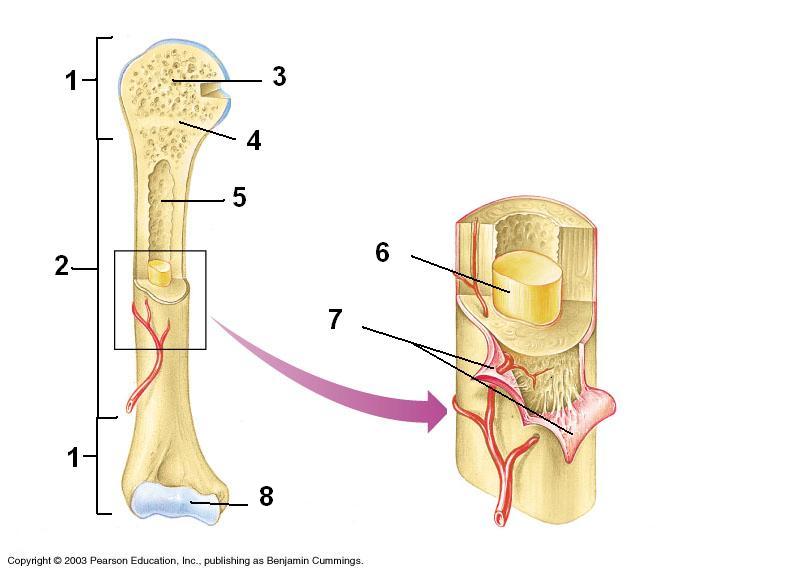
What is structure 8?
a)
trabecular bone
b)
periosteum
c)
yellow marrow
d)
medullary cavity
72.
Where are blood cells made? 
a)
Yellow marrow 
b)
Red marrow
c)
Spongy Bone 
d)
Periosteum
73.
If cartilage remains in this "specific" area, then growth is still occurring; it is located at the end of long bone
a)
Epipyseal plate
b)
 Medulary Cavity 
c)
Diaphysis 
d)
Endosteum 
74.
This lines the medullary cavity
a)
Periosteum 
b)
Endosteum 
c)
Diaphysis 
d)
Osteoblasts 
75.
The ends of the long bone are anatomically referred to as the: 
a)
Epiphyseal plate 
b)
Medulary Cavity 
c)
Periosteum 
d)
Epiphysis 
76.
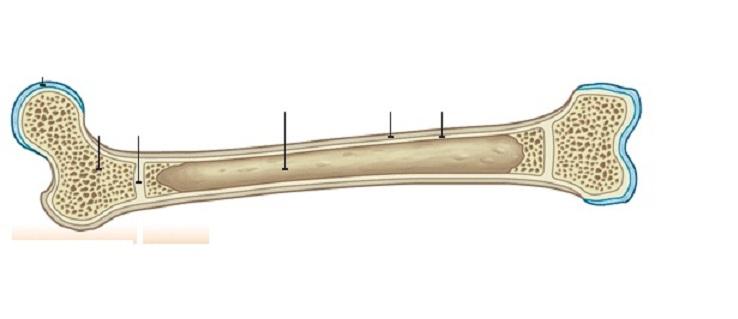
Covering on the end of the bones as represented in structure D. Also on the end of B.  Provides protection
a)
red bone marrow
b)
yellow bone marrow
c)
articular cartilage
d)
medullary cavity
77.
Structure #7 is the 
a)
medullary cavity
b)
periosteum
c)
epiphysis
d)
diaphysis
78.
Spongy bone would primarily be found where in a bone?
a)
diaphysis
b)
epiphysis
c)
periosteum
d)
endosteum
79.
Structure E is
a)
diaphysis
b)
yellow bone marrow
c)
compact bone
d)
spongy bone
80.
The function of yellow bone marrow is 
a)
short term energy storage
b)
long term energy storage
c)
protect the bone
d)
support the bone
81.
yellow bone marrow is which macromolecule?
a)
carbohydrate
b)
protein
c)
lipid 
d)
nucleic acid
82.
Structure #12 is
a)
artery
b)
periosteum
c)
compact bone
d)
yellow bone marrow
83.
Periosteum
a)
the membrane lining the bone cavity
b)
the tough membrane covering the shaft of the bone
c)
the shiny, articulating cartilage on the ends of a bone
d)
the blood vessels inside a bone
84.

Choose a good source of Protein

a)
b)
c)
d)
85.

Name 2 main functions of Protein

a)

growth

b)

repair

c)

sleep

d)

increase injury recovery time

86.

What are the building blocks of protein called?

a)

Lipids

b)

amino acids

c)

incomplete protein

d)

enzymes

87.

Name 2 types of Amino Acids

a)

Complete

b)

Essential

c)

incomplete

d)

Non-essential

88.

Complete Proteins come from what sources?

a)
b)
c)
d)
89.

Protein should make up what % of your diet?

a)

10-35%

b)

5-10%

c)

25-35%

d)

10-15%

90.

How many types of muscle fibre are there

a)

2

b)

3

c)

4

d)

5

91.

Type 1 and 2a are muscle fibres found in the body - select the missing muscle fibre type

a)

Type 1a

b)

Type 2c

c)

Type 2x

d)

Type 2z

92.

A muscle fibre type that has a high aerobic capacity is known as...

a)

...type 1

b)

...type 2a

c)

...type 2b

d)

...type 2x

93.

Which one of the following is a key characteristic of Fast Twitch X muscle fibers?

a)

They are Red in color, meaning they contain a lot of mitochondria

b)

They contract rapidly with great force but fatigue fast

c)

They are recruited for long duration activities

d)

They contain high numbers of Mitochondria

94.
Which one of the following is a key characteristic of slow twitch muscle fibers? 
a)
They contain large amounts of Mitochondria
b)
They are fast to fatigue
c)
They are recruited last
d)
They contain low numbers of Mitochondria
95.
Long distance runners have large proportion of ___________ fibers.
a)
slow oxidative
b)
fast oxidative
c)
fast glycolytic
96.
Type IIa Muscle Fibres are linked to which activity?
a)
400m
b)
100m
c)
1500m
d)
10,000m
97.
Type IIa Fibres are called...
a)
Fast Oxidative
b)
Fast Glycolytic
c)
Slow Oxidative
d)
Slow Glycolytic
98.
Another name for Type II Fibres is....
a)
Fast Twitch
b)
Slow Twitch
c)
Medium Twitch
d)
Super Twitch
99.
What are the characteristics of fast twitch muscle fibres?
a)
explosive activities, fatigue slowly
b)
endurance activities, fatigue slowly
c)
explosive activities, fatigue quickly
d)
endurance activities, fatigue quickly
100.
Which muscle fibre produces the lowest force when in contracts?
a)
Type 1
b)
Type 2a
c)
Type 2b
d)
Type 3
101.
This type of muscle tissue is found only in the heart
a)
Skeletal
b)
Cardiac
c)
Smooth