wayground logo

Free Printable Worksheets

Font size

S
M
L
XL
Worksheets

Overview of Phylum Mollusca

Total questions: 139

Worksheet time: 3hrs 42mins

Name
Class
Date
1.

Animal with name meaning "soft body"

a)

Sponges

b)

Mollusk

c)

Worms

d)

Osteichthyes

2.

Mollusks have what type of symmetry

a)

asymmetry

b)

bilateral

c)

radial

3.

Name the THREE groups of Mollusks.

a)

Gastropods

b)

Arthropods

c)

Cephalpods

d)

Bivalves

4.

Gastropods are _______ .

a)

Two-shelled

b)

Multi-shelled

c)

No-shelled

d)

Single-shelled, AND No-shelled

5.

What are the habitats of Gastropod?

a)

freshwater, saltwater, & terrestrial

b)

saltwater, freshwater

c)

saltwater only

6.

How do Bivalves obtain food?

a)

Tentacles to catch food

b)

Siphons to filter feed

c)

Radula to scrap the sea floor

7.

Gastropods have _______ for feeding.

a)

radula

b)

2 shells

c)

tentacles

d)

siphons

8.

A two-shelled mollusk

a)

Gastropod

b)

Cephalopod

c)

Bivalve

d)

Phylum

9.
Which class of Mollusks include clams, oysters, and mussels?
a)
Gastropods
b)
Bivalves
c)
Cephalopods
10.
Which class of Mollusks includes snails, slugs, or nudibranches?
a)
Cephalapods
b)
Bivalves
c)
Gastropods
11.
What is the radula used for?
a)
Locomotion
b)
Feeding
c)
Swimming
d)
Digging
12.
The protective membrane that surrounds the visceral mass on all mollusks is called...
a)
Radula
b)
Mantle
c)
Nephridia
d)
Visceral Shield 
13.
All mollusks have an external shell.
a)
True
b)
False
14.

What TYPE of mollusk is this?

a)

Bivalve

b)

Gastropod

c)

Cephalopod

15.

What TYPE of mollusk is this?

a)

Bivalve

b)

Gastropod

c)

Cephalopod

16.

What TYPE of mollusk is this?

a)

Bivalve

b)

Gastropod

c)

Cephalopod

17.

What TYPE of mollusk is this?

a)

Bivalve

b)

Gastropod

c)

Cephalopod

18.

What TYPE of mollusk is this?

a)

Bivalve

b)

Gastropod

c)

Cephalopod

19.

Which TYPE of mollusk is most intelligent?

a)

Bivalve

b)

Gastropod

c)

Cephalopod

20.

Which TYPE of mollusk has two shells?

a)

Bivalve

b)

Gastropod

c)

Cephalopod

21.

Which TYPE of mollusk has ONE or NO shell?

a)

Bivalve

b)

Gastropod

c)

Cephalopod

22.
What does Cephalopod mean?
a)
means "2-shells"
b)
means "head-foot"
c)
means "stomach-foot"
23.
Which class of Mollusks include squid, cuttlefish and octopus?
a)
Gastropods
b)
Bivalves
c)
Cephalopods
d)
Polyplacophora
24.
Which part of the Mollusk body is specialized for burrowing, feeding, and movement?
a)
trochophores
b)
visceral mass
c)
mantle
d)
foot
25.
Which class of Mollusks is the only class with some terrestrial species?
a)
Gastropods
b)
Bivalves
c)
Cephalopods
26.
Which class of Mollusks have a closed circulatory system?
a)
Gastropods
b)
Bivalves
c)
Cephalopods
d)
All of the classes
27.
Cephalopods move by
a)
using jet propulsion
b)
waving their tentacles back and forth.
c)
crawling along on a single muscular foot.
d)
clapping their shells together.
28.
Which group of cephalopods has ability to flatten body to fit in small spaces and change skin to blend with surroundings?
a)
Cuttlefish
b)
Nautilus
c)
Squid
d)
Octopuses
29.

Mollusks have

a)

bilateral symmetry

b)

radial symmetry

c)

no symmetry

30.

To which group of mollusks does this squid belong?

a)

cephalopod

b)

bivalve

c)

gastropod

31.

To which group of mollusks does this clam belong?

a)

Gastropods

b)

Cephalopods

c)

Bivalves

d)

Arthropods

32.

Which is the group of mollusks that has a spiral-shaped shell?

a)

Gastropods

b)

Cephalopods

c)

Scaphopoda

d)

Bivalves

33.

To which group of mollusks does this octopus belong?

a)

Cephalopods

b)

Gastropods

c)

Bivalves

34.
Which part of the Mollusk body is specialized for burrowing, feeding, and movement?
a)
trochophores
b)
visceral mass
c)
mantle
d)
foot
35.

Which part of the Mollusk body contains most of the organs?

a)

Foot

b)

Visceral Mass

c)

Trochophore

d)

Mantle

36.

To which group of mollusks does this nautilus belong?

a)

Cephalopods

b)

Bivalves

c)

Gastropods

37.

Which part of the Mollusk body is the tissue covering the body and secretes the shell of bivalves and other shelled mollusks?

a)
Mantle
b)
Trochophore
c)
Foot
d)
Visceral Mass
38.
Which class of Mollusks have the most advanced nervous system?
a)
Gastropods
b)
Bivalves
c)
Cephalopods
d)
arthropods
39.

How do Bivalves eat?

a)

Filter feeders

b)

Radula

c)

Tentacles

d)

Beak

40.

All of the following are Bivalves, EXCEPT:

a)

Clams

b)

Mussels

c)

Snails

d)

Oysters

e)

Scallops

41.
What does Cephalopod mean?
a)
means "2-shells"
b)
means "head-foot"
c)
means "stomach-foot"
d)
means "soft bodied"
42.
The modified arm of male cephalopods that is used for reproduction is called the
a)
spermatophore
b)
hectocotylus
c)
crop
d)
chromatophore
43.

What substance does bivalves secrete to form the shell?

a)

carbon calcinate

b)

Calcium carbonate

c)

carbon calcium

d)

carbonic calcinic

44.

Organs that are in contact with blood supply and specialized for gas exchange.

a)

fin

b)

radula

c)

bivalve

d)

gills

45.

Which TYPE of mollusk has two shells?

a)

Bivalve

b)

Gastropod

c)

Cephalopod

46.

Which of the following is a role of the oyster and/or oyster reef? (Select ALL that apply)

a)

produce medicines for human use

b)

part of the food chain

c)

habitat for other organisms

d)

filter water

47.
Which class of mollusks is shown in the picture?
a)
Gastropoda
b)
Molluska
c)
Bivalia
d)
Polychaeta
48.

What class does this chiton belong to?

a)

Bivalvia

b)

Scaphopoda

c)

Gastropoda

d)

Polyplacophora

49.

What controls the opening and closing of bivalve shells

a)

Mantle

b)

Radula

c)

Adductor Muscles

d)

Siphon

50.
A rasping, tongue-like organ with backwards-facing teeth
a)
radula
b)
buccal cavity
c)
valve
d)
intestine
51.
The cells in skin of cephalopods that allow them to change colors are called
a)
pigmentocytes
b)
chromatophores
c)
dermatophores
d)
branchiocytes
52.

What is a radula?

a)

A Tounge like sturcture used to scrape plant matter into easy to eat pieces.

b)

A part used to make protection.

c)

the fancy way to say "Tentacle"

d)

Movment

53.
Which group of cephalopods has ability to flatten body to fit in small spaces and change skin to blend with surroundings?
a)
Cuttlefish
b)
Nautilus
c)
Squid
d)
Octopuses
54.

Which TYPE of mollusk has two shells?

a)

Bivalve

b)

Gastropod

c)

Cephalopod

55.

Which terms are true of bivalves such as oysters and clams? (Select ALL that apply)

a)

bilateral symmetry

b)

filter feeder

c)

highly intelligent

d)

invertebrate

e)

have tentacles

56.
Which mollusk class would you see organisms moving using
"jet propulsion"?
a)

Gastropoda

b)

Cephalopoda

c)

Bivlavia

d)

Polyplacopoda

57.
Which of the following is the correct description of reproduction in Mollusks?
a)
Mostly asexual
b)
Budding
c)
Regeneration
d)
Mostly sexual
58.

The water jet used by some mollusks to move

a)

siphon

b)

radula

c)

head foot

d)

mantle

59.

The vestigial shell of a squid is called the

a)

siphon

b)

ink sac

c)

pen

d)

mantle

60.

A squid has multiple _______, but only 2 ______.

a)

arms, tentacles

b)

tentacles, arms

61.

When all else fails, some mollusks use this to confuse their prey and escape

a)

siphon

b)

ink sac

c)

pen

d)

chitin

62.

Squids move by

a)

walking/creeping on their tentacles

b)

shortening and lengthening their tentacles

c)

jet populsion

d)

fins

63.

Chromatophores are cells that cannot change color

a)

True

b)

False

64.

A system where blood is not in vessels, but spreads over the organs in some areas is called a(n)______ system.

a)

closed circulatory system

b)

fluid-filled

c)

open circulatory

d)

water vascular

65.

Which of the following bivalves is sessile and creates its own cement to stick to surfaces?

a)

Coquinas

b)

Oysters

c)

Clams

d)

Scallops

66.

What class of mollusks do nudibranchs belong to?

a)

Polyplacophora

b)

Scaphopoda

c)

Bivalvia

d)

Gastropoda

67.

What are chromatophores for?

a)

migration

b)

attacking predators

c)

coloration/ camouflage

d)

eating

68.

What is the internal shell of a squid called?

a)

Pen

b)

Spine

c)

Silica

d)

Cuttlebone

69.

The only solid part of an octopus is its...

a)

Siphon

b)

Spine

c)

Skull

d)

Beak

70.

What controls the opening and closing of bivalve shells

a)

Mantle

b)

Radula

c)

Adductor Muscles

d)

Siphon

71.

What are the tubes used by mollusks for taking in water/food called?

a)

Siphon

b)

Mantle

c)

Operculum

d)

Foot

72.
What do the rings on the clam shell indicate?
a)
species
b)
age
c)
size
d)
genus
73.
Octopuses use their suckers on their tentacles to 
a)
Smell, taste, grab thing,  and crawl. 
b)
see under water
c)
change directions
d)
grow back
74.
What is one thing octopuses do to protect themselves from predators?
a)
Octopuses pretend like they are sleep.
b)
Octopuses use their heads to fight. 
c)
Octopuses do not protect themselves. 
d)
Octopuses  squirt ink into the water to blind other animals.
75.

Which part of the Mollusk body contains most of the organs?

a)

Foot

b)

Visceral Mass

c)

Trochophore

d)

Mantle

76.

What are filter feeders?

a)

A large pile of living organisms and the animals that live among them.

b)

An organism that attaches onto another organism and feeds off of it.

c)

Animals that feed by removing tiny bits of food from the water.

d)

Animals that use sunlight to obtain nutrients.

77.
The part of the mollusk that produces its shells is the ______. 
a)
cavity
b)
mantle
c)
visceral mass
d)
ventral foot
78.
Gastropoda, Bivalva, Cephalapoda are all classes within the Phylum _______. 
a)
Arthropoda
b)
Mollusca
c)
Porifera 
d)
Cnidaria
79.
Mollusk's tongue-like strip covered with teeth that point backward is called the ____
a)
trochopore
b)
radula
c)
gills
d)
visceral mass
80.
Radula is used to _________. 
a)
scrape food from surfaces
b)
regulate water flow
c)
digest food
d)
gas exchange
81.
Which part of the Mollusk body is specialized for burrowing, feeding, and movement?
a)
trochophores
b)
visceral mass
c)
mantle
d)
foot
82.

Which specie of mollusc does not have a shell?

a)

snail

b)

limpet

c)

conch

d)

slug

83.
All gastropods have shells
a)
true
b)
false
84.

What is the meaning of Gastropod?

a)

Soft-bodied

b)

Stomach-footed

c)

Head-footed

d)

Two-shelled

85.
What type of circulatory system do most Molluscs have?
a)
Open
b)
Closed
86.
All mollusks have an external shell.
a)
True
b)
False
87.

Which cephalopod is shown?

a)

Nautilus

b)

Cuttlefish

c)

Squid

d)

Octopus

88.

The shell of a mollusc is made out of what compound?

a)

Calcium Carbonate

b)

Calcium Phosphate

c)

Calcium

d)

Iron Phosphate

e)

Strontium Chloride

89.

The Latin term for stomach-foot is ____.

a)

Mollusca

b)

Gastropod

c)

Cephalopod

d)

Gustoflagella

e)

Limpepodia

90.

How do bivalves eat?

a)

Filter feeders

b)

Radula

c)

Tentacles

91.

These molluscs have a head and a modified foot that are now arms or tentacles.

a)

Cephalopods

b)

Nudibranches

c)

Gastropods

d)

Bivalves

e)

Ctenidia

92.

What class of molluscs does the nautilus belong to?

a)

Bivalvia

b)

Gastropoda

c)

Cephalopoda

d)

Cnidaria

93.

This appendage of the mollusc is used for movement and grasping.

a)

Foot

b)

Mantle

c)

Radula

d)

Ctenidia

e)

Limpet

94.

What type of mollusc has eight overlapping shell plates?

a)

snail

b)

bivalve

c)

chiton

d)

tusk shell

95.
What is the radula used for?
a)
Locomotion
b)
Feeding
c)
Swimming
d)
Digging
96.
The protective membrane that surrounds the visceral mass on all mollusks is called...
a)
Radula
b)
Mantle
c)
Nephridia
d)
Visceral Shield 
97.
All mollusks have an external shell.
a)
True
b)
False
98.

What TYPE of mollusk is this?

a)

Bivalve

b)

Gastropod

c)

Cephalopod

99.

What TYPE of mollusk is this?

a)

Bivalve

b)

Gastropod

c)

Cephalopod

100.

What TYPE of mollusk is this?

a)

Bivalve

b)

Gastropod

c)

Cephalopod

101.

What TYPE of mollusk is this?

a)

Bivalve

b)

Gastropod

c)

Cephalopod

102.

What TYPE of mollusk is this?

a)

Bivalve

b)

Gastropod

c)

Cephalopod

103.

Which TYPE of mollusk is most intelligent?

a)

Bivalve

b)

Gastropod

c)

Cephalopod

104.

Which TYPE of mollusk has two shells?

a)

Bivalve

b)

Gastropod

c)

Cephalopod

105.

Which TYPE of mollusk has ONE or NO shell?

a)

Bivalve

b)

Gastropod

c)

Cephalopod

106.
What does Cephalopod mean?
a)
means "2-shells"
b)
means "head-foot"
c)
means "stomach-foot"
107.
Which class of Mollusks include squid, cuttlefish and octopus?
a)
Gastropods
b)
Bivalves
c)
Cephalopods
d)
Polyplacophora
108.
Which part of the Mollusk body is specialized for burrowing, feeding, and movement?
a)
trochophores
b)
visceral mass
c)
mantle
d)
foot
109.
Which class of Mollusks is the only class with some terrestrial species?
a)
Gastropods
b)
Bivalves
c)
Cephalopods
110.
Which class of Mollusks have a closed circulatory system?
a)
Gastropods
b)
Bivalves
c)
Cephalopods
d)
All of the classes
111.
Cephalopods move by
a)
using jet propulsion
b)
waving their tentacles back and forth.
c)
crawling along on a single muscular foot.
d)
clapping their shells together.
112.
Which group of cephalopods has ability to flatten body to fit in small spaces and change skin to blend with surroundings?
a)
Cuttlefish
b)
Nautilus
c)
Squid
d)
Octopuses
113.

Mollusks have what type of symmetry

a)

asymmetry

b)

bilateral

c)

radial

114.

How do Bivalves obtain food?

a)

Tentacles to catch food

b)

Siphons to filter feed

c)

Radula to scrap the sea floor

115.

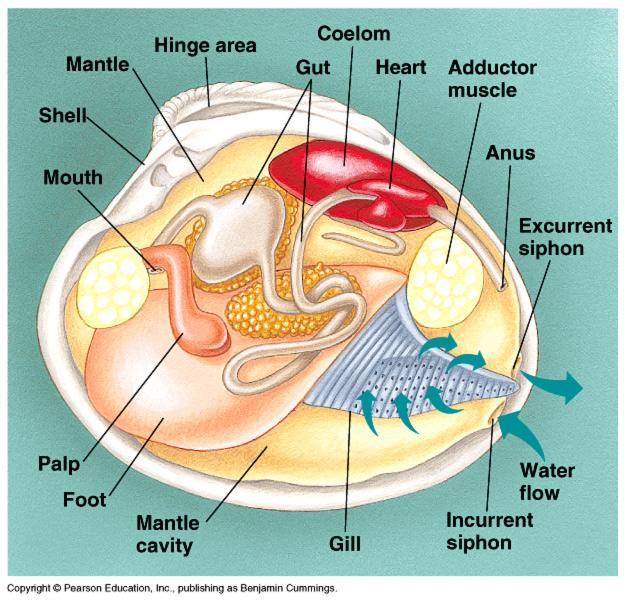
Identify the adductor muscles

116.

Identify the visceral mass

117.

Identify the foot

118.

Identify the gills

119.

Identify the mantle

120.
What is the meaning of Gastropod?
a)
Soft-bodied
b)
Stomach foot
c)
Head-footed
d)
Two-shelled
121.
Which group of Molluscs does the picture belong to?
a)
Gastropod
b)
Bivalve
c)
Cephalopod
122.
What Mollusc group does the snail belong to?
a)
Gastropod
b)
Bivalve
c)
Cephalopod
123.
How do Bivalves eat?
a)
Filter feeders
b)
Radula
c)
Tentacles
124.
Which class of Molluscs include clams, scallops, and mussels?
a)
Gastropods
b)
Bivalves
c)
Cephalopods
125.
What type of gastropod is pictured? 
a)
tulip snail
b)
cowry snail
c)
abalone
d)
nudibranch
126.
Which part of the Mollusk body is the tissue covering the body and secretes the shell?
a)
Mantle
b)
Trochophore
c)
Foot
d)
Visceral Mass
127.
Which part of the Mollusk body is specialized for burrowing, feeding, and movement?
a)
trochophores
b)
visceral mass
c)
mantle
d)
foot
128.
What type of body do all Mollusks have?
a)
Segmented
b)
Soft
c)
Rigid
d)
Clear
129.
What are the major groups of Mollusks?
a)
Cnidarians, Gastropods, Porifera
b)
Gastropods, Bivalves, Cephalopods
c)
Porifera, Cephalopods, Cnidarians
130.
Mollusk's tongue-like strip covered with teeth that point backward is called the ____
a)
trochopore
b)
radula
c)
gills
d)
visceral mass
131.

This is a

a)

blue dragon nudibranch

b)

man o war

c)

blue sponge

132.

Dangerous gastropod with a powerful venom and painful barbed stinger

a)

abalone

b)

giant conch snail

c)

cone snail

d)

nudibranch

133.

Which group of gastropods can "steal" the stinging cells from cnidarians and store them in their own epithelial tissues in order to defend itself from predators?

a)

nudibranches

b)

conch snail

c)

all snails

d)

cone snail

134.
All gastropods have shells
a)
true
b)
false
135.

Which animal does NOT catch its prey with the help of a sharp, barbed harpoon-like structure?

a)

jellyfish

b)

cone snails

c)

ribbon worms

d)

sponges

136.

Geographic cone snails are deadly to humans.

a)

True

b)

False

137.

Nudibranches can eat jellies because they

a)

are immune the to the toxins

b)

have a mucus coating on their esophagus so they don't get stung

c)

trick question, they don't eat jellyfish

d)

have really thick armor that stinging cells can't penetrate

138.

Cone snails can modify the toxins they use when stinging based on the type of animal they are going to attack

a)

True

b)

False

139.

Complete the saying. "If it's a cone, ..."

a)

give it a home

b)

hand it the phone

c)

leave it alone

Similar Resources on Wayground