wayground logo

Free Printable Worksheets

Font size

S
M
L
XL
Worksheets

Unit 4 - Momentum Concepts/Vocab

Total questions: 183

Worksheet time: 3hrs 24mins

Name
Class
Date
1.

Stand and Fighting as usual on a planet is traveling hundreds a miles every minute!

a)

WE SURE ARE

b)

NAH

c)

Earth is Flat

d)

Im Filler :(

e)

You sure are a buddy :)

2.

Trains can't stop quickly or swerve

a)
Trains can stop quickly and swerve easily.
b)
Trains can stop quickly but can't swerve.
c)
Trains can swerve quickly but can't stop.
d)
Trains can't stop quickly or swerve because of their size and weight.
3.

Why are trains so difficult to stop?

a)
Poor track conditions
b)

Large mass and velocity

c)
Inefficient engines
d)
Lack of brakes
4.

What is Momentum?

4 lines
5.

What is Momentum?

a)
Momentum is the quantity of motion an object has.
b)
Momentum is the distance traveled by an object.
c)
Momentum is the force exerted by an object.
d)
Momentum is the speed of an object.
6.

Momentum is how HARD it is to stop something that’s moving

a)
Momentum is a measure of how difficult it is to stop an object that is in motion.
b)
Momentum is the force that causes an object to move.
c)
Momentum is the speed at which an object is moving.
d)
Momentum is the distance an object travels in a given time period.
7.

Momentum refers to the ------ that an object has.

a)
color of an object
b)
size of an object
c)
quantity of motion
d)
speed of an object
8.

quantity of motion - what does it mean

a)
The speed of an object
b)
The weight of an object
c)
Measure of the amount of motion an object has
d)
The color of an object
9.

Momentum is a VECTOR!

a)
False
b)
True
c)
Not sure
d)
Maybe
10.

Vector vs Scale definition in physics

a)
A vector and a scalar have the same definition in physics.
b)
A vector and a scalar have no difference in physics.
c)
A vector has only magnitude, while a scalar has both magnitude and direction.
d)
Vector vs Scale definition in physics: A vector has both magnitude and direction, while a scalar has only magnitude.
11.

Momentum equation is.

a)
F = mv
b)
F = md
c)

P = mv

d)
F = mc
12.

Momentum units

a)
kg m/s
b)
m/s^2
c)
kg/s
d)
kg^2/m
13.

Suppose a passenger train, M = 120,000 kg, is travelling at +25 m/s down the tracks.


  1. How much momentum does the train have?

a)
3,000 kg*m/s
b)
300,000 kg*m/s
c)
3,000,000 kg*m/s
d)
30,000 kg*m/s
14.
  1. How much momentum would a stationary rock, m = 1 kg, have from the perspective of a passenger?

a)
1 kg
b)
0
c)

25 kg m/s

d)
100 kg
15.

What is relative perspective in momentum

a)
Momentum is a scalar quantity that does not have direction.
b)
Relative perspective in momentum refers to the change in momentum over time.
c)
Momentum is an absolute quantity that does not depend on the frame of reference.
d)
Momentum is a relative quantity that depends on the frame of reference.
16.

relative quantity definition

a)
Contrast
b)
Ratio
c)
Comparison
d)
Proportion
17.
  1. Besides having a velocity of zero, is it possible for the truck and the skater to have the SAME momentum?

a)
Yes
b)
Not sure
c)
Maybe
d)
No
18.

A car and skateboarder can have the same momentum if the skateboarder increased its velocity.

a)
No
b)
Yes
19.
  1. A car possesses 20,000 units of momentum. What would be the car's new momentum if …

    1. its velocity was doubled.


a)
30,000
b)
40,000
c)
10,000
d)
60,000
20.
  1. A car possesses 20,000 units of momentum. What would be the car's new momentum if … its velocity was tripled.

a)
80,000
b)
40,000
c)
100,000
d)
60,000
21.
  1. A car possesses 20,000 units of momentum. What would be the car's new momentum if …

    1. its velocity was doubled.

  1. its mass was doubled (by adding more passengers and a greater load)

a)
20000
b)
10000
c)
80000
d)
40000
22.
  1. A car possesses 20,000 units of momentum. What would be the car's new momentum if …

  2. both its velocity was doubled and its mass was doubled.

a)
60,000 units
b)
80,000 units
c)
40,000 units
d)
100,000 units
23.

Velocity and Mass are directly proportional to Momentum

a)
Not sure
b)
True
c)
Sometimes
d)
False
24.
The momentum of an object depends upon the object's ___________&_____________.  
a)
size and shape
b)
mass and speed
c)
mass and veloctiy
d)
mass and energy
25.
Determine the momentum of 1000-kg car moving northward at 20 m/s......... 
a)
20000 N
b)
20000 Joules
c)
20000 Kg * m/s
d)
20000 kg * m/s north
26.
The definition of momentum is
a)
Mass in Motion
b)
The size of an object
c)
The velocity of an object
d)
A comparison between two objects
27.
The equation to calculate momentum is
a)
p=mv
b)
p=1/2mv2
c)
p=mgh
d)
p=mg
28.
In any collision (crash) the ______ is ALWAYS constant
a)
Total Momentum
b)
total speed
c)
total Velocity
d)
Energy
29.
What is Newton's Third Law?
a)
Object in motion stays in motion and an object at rest stays at rest unless acted on by a outside force
b)
Force = mass x acceleration
c)
For every action there is an equal and opposite reaction
30.
A 9 kg blob moving at 5 m/s collides and sticks to a second blob with a mass of 5 kg. If the two bobs stick together, what will the velocity of the two blobs move at?
a)
3.57 m/s
b)
3.2 m/s
c)
10.0  m/s
d)
9.0  m/s
31.
A 9300 kg railroad car traveling at a velocity of 5 m/s strikes a second boxcar that weighs 5000 kg at rest. At what speed will the second boxcar move?
a)
18.6 m/s
b)
9.3 m/s
c)
7.5 m/s
d)
1.86 m/s
32.
A runner has a momentum of 720 kg m/s and is traveling at a velocity of 5 m/s. What is his mass?
a)
14.4 kg
b)
1400 kg
c)
144 kg
d)
360 kg
33.
When the speed of an object is doubled, its momentum
a)
remains unchanged in accord with the conservation of momentum.
b)
doubles
c)
quadruples
d)
decreases
34.
Two football players with mass 75 kg and 100 kg run directly toward each other with speeds of 6 m/s and 8 m/s respectively. If they grab each other as they collide, the combined speed of the two players just after the collision would be:
a)
2 m/s 
b)
3.4 m/s 
c)
4.6 m/s 
d)
7.1 m/s
35.
An open cart on a level surface is rolling without frictional loss through a vertical downpour of rain. As the cart rolls, an appreciable amount of rainwater accumulates in the cart. The speed of the cart will
a)
increase because of conservation of mechanical energy
b)
decrease because of conservation of momentum
c)
decrease because of conservation of mechanical energy
d)
remain the same because the raindrops are falling perpendicular to the direction of the cart's motion
36.

What is impulse in physics?

a)
Impulse is the product of distance and time.
b)
Impulse is the product of mass and acceleration.
c)
Impulse is the product of force and time.
d)
Impulse is the product of velocity and time.
37.

You can explain these phenomena using Newton's 2nd Law. Fnet = m a where Fnet = m * ΔvΔt\frac{\Delta v}{\Delta t}

a)

Yes

b)

No

38.

If time increases, so does the net force decreases according to impulse

a)
false
b)
not enough information
c)
sometimes
d)
true
39.

When throwing and catching an object, you both experience the same impulse as the object has the same mass.

a)
True
b)
Impulse depends on the distance between the thrower and catcher
c)
Impulse depends on the speed of the object
d)
False
40.

If the constant in momentum equation increases, so does the net force!

a)
False
b)
Depends on other factors
c)
True
d)
Not necessarily
41.

If time increases in momentum, so does the net force.

a)
Time and net force are unrelated
b)
True
c)
Not enough information to determine
d)
False
42.

What is the momentum equation?

a)
momentum = mass x velocity
b)
momentum = mass - velocity
c)
momentum = mass + velocity
d)
momentum = mass / velocity
43.

What is the Impulse equation?

a)
Impulse = Force * Time
b)
Impulse = Acceleration * Time
c)
Impulse = Power * Time
d)
Impulse = Mass * Velocity
44.

Why does impulse equal change in momentum?
a)
Impulse is equal to the force applied to an object.
b)
Impulse is equal to the acceleration of an object.
c)
Impulse is defined as the change in momentum of an object.
d)
Impulse is equal to the velocity of an object.
45.

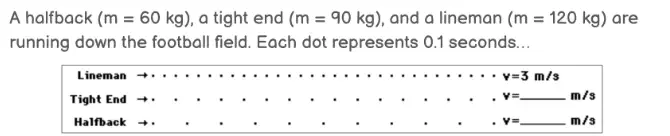
If you represent velocity by points on a line, if they are more spread out, it means its moving faster per second.
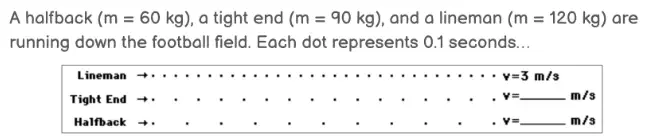
a)
The object is moving faster per second.
b)
The object is moving at a constant speed.
c)
The object is not moving at all.
d)
The object is moving slower per second.
46.

An object with greater velocity but with smaller mass could experience the same momentum if another object has more mass, but less force.

a)
Not sure
b)
True
c)
Maybe
d)
False
47.

Impulse Momentum Theorem

a)
The change in momentum of an object is equal to the impulse applied to it.
b)
The change in momentum of an object is equal to its mass.
c)
The change in momentum of an object is equal to its velocity.
d)
The change in momentum of an object is equal to the force applied to it.
48.

When is Newton 2nd Law of Motion connected with Impulse and Momentum

a)
The connection between Newton's second law of motion and impulse and momentum is through the equation F = ma.
b)
The connection between Newton's second law of motion and impulse and momentum is through the equation F = m/dt.
c)
The connection between Newton's second law of motion and impulse and momentum is through the equation F = mv.
d)
The connection between Newton's second law of motion and impulse and momentum is through the equation F = dp/dt.
49.

The momentum of an object depends upon the object's ___________&_____________.

a)

size and shape

b)

mass and speed

c)

mass and veloctiy

d)

mass and energy

50.

Which one of the following units represents the standard metric units of momentum

a)

Newtons * meter / second

b)

Kilograms * meter / second2

c)

meter / second

d)

Kilograms * meter / second

51.

Which one of the following units represents the standard metric units of impulse

a)

Kilograms * meter / second2

b)

Newton * meter

c)

meter / second2

d)

Newton * second

52.
The law of conservation of momentum states that, 
a)
p before is less than p after
b)
p before is the same as p after
c)
p before is more than p after
53.
When the speed of an object is doubled, its momentum
a)
remains unchanged in accord with the conservation of momentum.
b)
doubles
c)
quadruples
d)
decreases
54.

An object that has momentum can be described as _________

a)

a) changing its velocity

b)

b) moving fast

c)

c) resisting changes in its state of motion

d)

d) having its mass in motion

e)

e) encountering a net force

55.
Softer landings tend to
a)
increase impact force
b)
increase force
c)
increase collision time
d)
increase change in momentum
56.
In any collision (crash) the ______ is ALWAYS constant.
a)
Total Momentum
b)
total speed
c)
total Velocity
d)
Energy
57.
Which takes more force  to catch, a bowling ball or a ping pong ball?
a)
bowling ball because it has more momentum
b)
ping pong ball because it has more momentum
c)
both require the same amount of force when catching
d)
bowling ball because it has less momentum
58.

Which one of these objects has the greater amount of momentum?

a)

A turtle that slowly crosses a road

b)

A parked car

c)

A stop sign

59.

When a cannon fires a cannon ball, it recoils backwards. This occurs because of...

a)

Energy in the system is conserved

b)

Energy in the system is increased

c)

Momentum in the system is conserved

d)

Energy in the system is not conserved

60.
If 2 objects collide and stick together, what will happen to their velocities?
a)
velocities will increase
b)
velocities will decrease
c)
velocities will stay the same
d)
none of the above
61.

An egg landing on a soft surface will remain intact. The surface increases the _____ and decreases the _____ during the impact

a)

impulse, time

b)

impulse, force

c)

force, time

d)

time, force

62.

Padded dashboards in cars are safer in accidents than non padded ones because the passenger hitting the dash has...

a)

a) Increased time of impact

b)

b) decreased impulse

c)

c) decreased impact force

d)

d) a and b

e)

e) a and c

63.
A 0.250 kg cart moving at 0.400 m/s has how much momentum?
a)
0.1 kg-m/s
b)
1 kg-m/s
c)
10 kg-m/s
d)
100 kg-m/s
64.
A 10kg toy truck moves at 5m/s East. It collides head-on with a 5kg toy car moving 10 m/s moving west. What is the total momentum of the system?
a)
0 kgm/s
b)
30 kgm/s
c)
50 kgm/s
d)
10 kgm/s
65.
A biker with a mass of 75 kg moves along the path with a constant velocity of 5 m/s. What is the biker's momentum?
a)
25 m/s
b)
375 m/s
c)
25 kg m/s
d)
375 kg m/s
66.

A freight car of mass 20,000kg moves along a track at 15 m/s. What is the momentum of the car?

a)

30,000 kg*m/s

b)

3,000 kg*m/s

c)

300,000 kg*m/s

d)

3,000,000 kg*m/s

67.
A runner has a momentum of 670 kg m/s and is traveling at a velocity of 9 m/s. What is his mass?
a)
6030 kg
b)
0.0134 kg
c)
74.4 kg
d)
80 kg
68.

A 5 N force is applied to a 3 kg ball to slow it down from 9 m/s to 3 m/s. What is the impulse on the ball?

a)

-2.5 N⋅s

b)

-10 N⋅s

c)

-18 N⋅s

d)

-45 N⋅s

69.

If you threw an egg against a wall, the egg would clearly break. But, if the wall was replaced with a sheet, it would most likely survive. Assuming you threw it at the same speed. Why?

a)

The object experiences the force in less time compared to hitting a wall. The objects velocity also doesn't change rapidly, but slow-lying in a less time, giving it less force to stop it.

b)

The object would not experience either way because you would hit it with the same force.

70.

Why can you explain Impulse and Momentum with the 2nd Law of Newton?

a)
The 2nd Law of Newton has nothing to do with impulse and momentum.
b)
Impulse and momentum are not related to each other.
c)
Impulse and momentum can only be explained by the 1st Law of Newton.
d)
The 2nd Law of Newton explains how impulse and momentum are related.
71.
  • If Δt increases, FNET decreases

  • If Δt decreases, FNET increases

a)

Yes

b)

No

72.

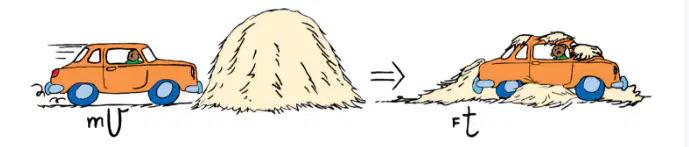
A car runs through hay, why doesn't the car get destroyed? Explain with impulse.

a)
The hay is not dense enough to cause damage
b)
The car is moving too fast for the hay to cause damage
c)
Impulse
d)
The car is made of a strong material
73.

A car drives toward a wall with full force, it breaks. This is because the force takes little time for it to take effect, meaning the force will be greater.

a)

The force takes little time to take effect, making it greater.

b)
The car was not driving at full force.
c)
The force was not applied in the right direction.
d)
The wall was not strong enough to withstand the force.
74.

When a force is introduced over a period of time. Alternatively, the CHANGE in momentum

a)

Impulse.

b)
Mass
c)
Velocity
d)
Acceleration
75.

J = Impulse SI Units = N × s

FNET = Net Force SI Units = Newtons

Δt = Change in time SI Units = Seconds

a)
N × m
b)
N × s^2
c)
N × kg
d)
N × s
76.

If an object is not moving, what is its momentum?

a)
zero
b)
infinite
c)
negative
d)
unknown
77.

A football punter accelerates a 0.55kg football from rest to a speed 28 m/s. The time his foot is in contact with the ball is 0.25 seconds. What force does the punter exert on the ball?

a)
3.5 N
b)
0.14 N
c)
9.8 N
d)
61.6 N
78.

A freight train moves due north at a speed of 8 m/s. The mass of the train is 6 * 10^6 kg. How fast would a 1500 kg automobile have to be moving due north to have the same momentum as the train?

a)
32000 m/s
b)
5000 m/s
c)
80 m/s
d)
0.05 m/s
79.

Two men pushing a stalled car generate a net force of 840 N for 5 seconds. What is the change in momentum of the car?

a)
1680 Ns
b)
6300 Ns
c)
4200 Ns
d)
210 Ns
80.

J represents impulse

a)

Yes

b)

No

81.

A woman driving a golf ball off a tee gives the ball a speed of 38 m/s. The mass of the ball is 0.045 kg, and the duration of the impact with the golf club is 6*10^-3 seconds.


What is the change in momentum of the ball?

a)
0.38 kg*m/s
b)
1.71 kg*m/s
c)
0.0171 kg*m/s
82.

A woman driving a golf ball off a tee gives the ball a speed of 38 m/s. The mass of the ball is 0.045 kg, and the duration of the impact with the golf club is 6*10^-3 seconds.

Determine the force applied by the club

a)
-380 N
b)
-570 N
c)
-190 N
d)

285 N

83.

A car with a mass of 1000 kg moves at 20 m/s. What average braking force is needed to bring the car to a halt in 10 seconds?

a)
100 N
b)
500 N
c)
10000 N
d)
2000 N
84.

An 8 kg bowling ball moving at 2 m/s bounces off a spring at 2 m/s, but it is now traveling in the opposite direction.

What is the change in momentum?

a)
16 kg*m/s
b)
32 kg*m/s
c)
-32 kg*m/s
d)
0 kg*m/s
85.

A woman driving a golf ball off a tee gives the ball a speed of 38 m/s. The mass of the ball is 0.045 kg, and the duration of the impact with the golf club is 6*10^-3 seconds.

If the interaction with the spring lasts 0.5 seconds,calculate the average force the spring exerts on it.

a)
0.045 N
b)
3.8 N
c)
0.038 N
d)
0.855 N
86.

Impulse is equal to momentum

a)
No
b)
Only in certain situations
c)
Yes
d)
Sometimes
87.

The units for impulse are Newton's per second right or wrong?

a)
I don't know
b)
No
c)
Maybe
d)
Yes
88.

Momentum is the product of mass times speed?

a)
Yes
b)
Maybe
c)
Sometimes
d)
No
89.

When an object moves backwards, there is a negative direction?

a)
Yes
b)
Sometimes
c)
It depends
d)
No
90.

An 8 kg bowling ball moving at 2 m/s bounces off a spring at 2 m/s, but it is now traveling in the opposite direction.

If the interaction with the spring lasts 0.5 seconds, calculate the average force the spring exerts on it.

a)
-32 N
b)
16 N
c)
128 N
d)
-64 N
91.

Momentum is the product of mass times speed! Why is this statement wrong?

a)
Momentum is the product of mass times velocity.
b)
Momentum is the product of mass times acceleration.
c)
Momentum is the product of mass times time.
d)
Momentum is the product of mass times distance.
92.
A biker with a mass of 75 kg moves along the path with a constant velocity of 5 m/s. What is the biker's momentum?
a)
25 m/s
b)
375 m/s
c)
25 kg m/s
d)
375 kg m/s
93.
Which takes more force  to catch, a bowling ball or a ping pong ball?
a)
bowling ball because it has more momentum
b)
ping pong ball because it has more momentum
c)
both require the same amount of force when catching
d)
bowling ball because it has less momentum
94.
A runner has a momentum of 670 kg m/s and is traveling at a velocity of 9 m/s. What is his mass?
a)
6030 kg
b)
0.0134 kg
c)
74.4 kg
d)
80 kg
95.

A 5 N force is applied to a 3 kg ball to slow it down from 9 m/s to 3 m/s. What is the impulse on the ball?

a)

-2.5 N⋅s

b)

-10 N⋅s

c)

-18 N⋅s

d)

-45 N⋅s

96.
An object with a mass of 2000 kg at rest has what momentum?
a)
2000 kg m/sec
b)
0 kg m/sec
c)
2000 kg
d)
2000 m/sec
97.
When the speed of an object is doubled, its momentum
a)
remains unchanged in accord with the conservation of momentum.
b)
doubles
c)
quadruples
d)
decreases
98.

A boy kicks a football with a force of 20 N, the time the force acts for is 0.3 s. Calculate the impulse on the ball.

a)

1 N⋅s

b)

6 N⋅s

c)

33.3 N⋅s

99.
How can a tennis ball and a bowling ball have the same momentum?
a)
have the same speed
b)
have different speeds
c)
one is moving backwards
d)
they can't
100.
A 50 kg ball rolls down the street at 5 m/s. Calculate the momentum of the ball. 
a)
55 kg*m/s
b)
100 kg*m/s
c)
250 kg*m/s
d)
500 kg*m/s
101.

The units for Impulse are

a)

kg

b)

NsN\cdot s

c)

N

d)

m/s

e)

kgmskg\cdot\frac{m}{s}

102.
A biker with a mass of 75 kg moves along the path with a constant velocity of 5 m/s. What is the biker's momentum?
a)
25 m/s
b)
375 m/s
c)
25 kg m/s
d)
375 kg m/s
103.
Which takes more force  to catch, a bowling ball or a ping pong ball?
a)
bowling ball because it has more momentum
b)
ping pong ball because it has more momentum
c)
both require the same amount of force when catching
d)
bowling ball because it has less momentum
104.
A runner has a momentum of 670 kg m/s and is traveling at a velocity of 9 m/s. What is his mass?
a)
6030 kg
b)
0.0134 kg
c)
74.4 kg
d)
80 kg
105.

A 5 N force is applied to a 3 kg ball to slow it down from 9 m/s to 3 m/s. What is the impulse on the ball?

a)

-2.5 N⋅s

b)

-10 N⋅s

c)

-18 N⋅s

d)

-45 N⋅s

106.
An object with a mass of 2000 kg at rest has what momentum?
a)
2000 kg m/sec
b)
0 kg m/sec
c)
2000 kg
d)
2000 m/sec
107.
When the speed of an object is doubled, its momentum
a)
remains unchanged in accord with the conservation of momentum.
b)
doubles
c)
quadruples
d)
decreases
108.

A boy kicks a football with a force of 20 N, the time the force acts for is 0.3 s. Calculate the impulse on the ball.

a)

1 N⋅s

b)

6 N⋅s

c)

33.3 N⋅s

109.
How can a tennis ball and a bowling ball have the same momentum?
a)
have the same speed
b)
have different speeds
c)
one is moving backwards
d)
they can't
110.
A 50 kg ball rolls down the street at 5 m/s. Calculate the momentum of the ball. 
a)
55 kg*m/s
b)
100 kg*m/s
c)
250 kg*m/s
d)
500 kg*m/s
111.

The units for Impulse are

a)

kg

b)

NsN\cdot s

c)

N

d)

m/s

e)

kgmskg\cdot\frac{m}{s}

112.

A 0.05 kg egg colides at 5 m/s with the ground and makes a stop. What is the change in momentum?

a)
5 kg*m/s
b)
0.25 kg*m/s
c)
0.05 kg*m/s
d)
-0.25 kg*m/s
113.

Which has more momentum?

a)

A parked semi truck

b)

A moving car

c)

they have the same amount of momentum

114.

Which has more momentum?

a)

A hummingbird zipping down the street (v = 1 m/s)

b)

A bus stopped at a stop sign

c)

A bus barreling down the road (v = 10 m/s)

d)

A hummingbird hovering at a feeder

115.

A bicycle has a momentum of 24 kg•m/s. What momentum would the bicycle have if it had twice the mass and was moving at the same speed?

a)

twice the momentum; 48 kg*m/s

b)

1/2 the momentum; 12 kg*m/s

c)

4x the momentum; 96 kg*m/s

d)

1/4 the momentum; 6 kg*m/s

116.

A bicycle has a momentum of 24 kg•m/s. What momentum would the bicycle have if it had the same mass and was moving with one-half the speed?

a)

twice the momentum; 48 kg*m/s

b)

1/2 the momentum; 12 kg*m/s

c)

4x the momentum; 96 kg*m/s

d)

1/4 the momentum; 6 kg*m/s

117.

A bicycle has a momentum of 24 kg•m/s. What momentum would the bicycle have if it had the twice the mass and was moving with twice the speed?

a)

twice the momentum; 48 kg*m/s

b)

1/2 the momentum; 12 kg*m/s

c)

4x the momentum; 96 kg*m/s

d)

1/4 the momentum; 6 kg*m/s

118.

The momentum of an object depends upon the object's ___________&_____________.

a)

size and shape

b)

mass and speed

c)

mass and veloctiy

d)

mass and energy

119.

A 2 kg cart has a momentum of 16 kg m/s. What is its velocity?

a)

8 m/s

b)

32 m/s

c)

0.125 m/s

d)

18 m/s

120.

What is the momentum if the mass is of an object is 50 kg and it has a velocity of 25 m/s?

a)

2 kg*m/s

b)

125 kg*m/s

c)

10 kg*m/s

d)

1250 kg*m/s

121.

A 3 kg cart has a momentum of 18 kg m/s. What is its velocity?

a)

6 m/s

b)

54 m/s

c)

0.17 m/s

d)

15 m/s

122.

What is the momentum if the mass is of an object is 35 kg and it has a velocity of 10 m/s?

a)

3.5 kg*m/s

b)

35 kg*m/s

c)

0.3 kg*m/s

d)

350 kg*m/s

123.

Cart A is pulled with a 2 Newton force for 2 seconds, and Cart B is pulled with a 1 Newton force for 3 seconds. Which cart experiences the greatest impulse?

a)

Cart B

b)

Cart A

c)

they are the same

124.
The purpose of crumble zones on a car is to
a)
decrease time of impact.
b)
increase force of impact.
c)
increase the time of impact.
d)
decrease the impulse during impact.
125.

A 5 N force is applied to a 3 kg ball to change its velocity from +9 m/s to +3 m/s. The impulse on the ball is ______.

a)

2.5 N s

b)

10 N s

c)

-18 N s

d)

-45 N s

126.
An egg is thrown at a wall and at a bed sheet. The force of impact will be
a)
Greater against the wall
b)
Greater against the sheet
c)
Force is equal
127.

An egg is thrown at a wall and at a bed sheet. The egg's impulse will be

a)

Greater for the wall collision

b)

Greater for the sheet collision

c)

impulse is equal

128.

When considering impulse or change in momentum, an object falling on grass or brick will experience the same impulse, its just that the force will be different!

a)
The impulse experienced by the object falling on grass or brick will be the same, but the force will be different.
b)
The impulse experienced by the object falling on grass or brick will be the same, and the force will also be the same.
c)
The impulse experienced by the object falling on grass or brick will be different, and the force will also be different.
d)
The impulse experienced by the object falling on grass or brick will be different, but the force will be the same.
129.

When calculating the change in velocity, one must remember if your initial and final velocity as well as the direction of the force! Some forces will be negative!

a)
When calculating the change in velocity, only consider the final velocity and ignore the initial velocity and direction of the force.
b)
The direction of the force does not affect the change in velocity.
c)
The change in velocity is always positive, regardless of the initial and final velocity.
d)
Consider the initial and final velocity as well as the direction of the force when calculating the change in velocity.
130.

How does impulse and change in momentum and momentum compare?

a)
Impulse has no effect on momentum.
b)
Impulse and change in momentum are directly related.
c)
Impulse and change in momentum are inversely related.
d)
Impulse and change in momentum are unrelated.
131.

How does impulse and momentum compare?

a)
Impulse and momentum are unrelated concepts in physics.
b)
Impulse is the product of force and time, while momentum is the product of mass and velocity.
c)
Impulse and momentum have opposite directions in physics.
d)
Impulse and momentum are related concepts in physics.
132.

How would one with the knowledge of the Impulse - Momentum Theorem build a device to protect an egg?

a)
By building a device that increases the impulse and momentum of the egg upon impact.
b)
By creating a cushioning system that absorbs the impulse and reduces the momentum of the egg upon impact.
c)
By creating a device that completely eliminates the impulse and momentum of the egg upon impact.
d)
By building a device that redirects the impulse and momentum of the egg upon impact.
133.

A pogo stick, which is capable of launching a child upwards with an initial velocity of +16 m/s is gifted to them on their birthday. The child and pogo stick have a combined mass of 45 kg. The pogo stick spring is decompressed in 0.15 seconds, launching the child vertically.

  1. Identify every instance of an impulse acting on the child/pogo stick (Hint: How many times does the momentum change?)

a)
1
b)
0
c)
3
d)

4

134.

A pogo stick, which is capable of launching a child upwards with an initial velocity of +16 m/s is gifted to them on their birthday. The child and pogo stick have a combined mass of 45 kg. The pogo stick spring is decompressed in 0.15 seconds, launching the child vertically.

  1. What is the initial momentum of the child? The final momentum the moment the spring decompresses?

a)
900 kg*m/s
b)
540 kg*m/s
c)
720 kg*m/s
d)
360 kg*m/s
e)

0 kg m/s

135.

A pogo stick, which is capable of launching a child upwards with an initial velocity of +16 m/s is gifted to them on their birthday. The child and pogo stick have a combined mass of 45 kg. The pogo stick spring is decompressed in 0.15 seconds, launching the child vertically.

  1. How much force was exerted on the pogo stick as the spring decompressed?

a)
+4800 N
b)
+160 N
c)
+2400 N
d)
+9600 N
136.

How is the momentum of the cars transferred in a collision?

a)
Transfer of energy
b)
Exchange of forces
c)
Transfer of mass
d)
Transfer of momentum
137.

If I consider the two objects to be of the same system, is momentum still transferred?

a)
Only in certain conditions
b)
Sometimes
c)
Yes
d)
No
138.

Two objects collide and bounce back with little or no deformation. It’s a perfect rebound. 

a)
inelastic collision
b)
frictionless collision
c)
inelastic rebound
d)
elastic collision
139.
This picture is an example of ____________
a)
Elastic Collision
b)
Inelastic collision
140.
This picture is an example of ____________
a)
Elastic Collision
b)
Inelastic collision
141.
If two objects have the same mass, then the faster moving object has ____________ momentum.
a)
more 
b)
less
c)
the same
142.

The momentum of an object depends upon the object's ___________&_____________.

a)

size and shape

b)

mass and speed

c)

mass and velocity

d)

mass and energy

143.

While playing pool, Emma notices that the pool balls bounce apart. What type of collision is this?

a)

Elastic

b)

Inelastic

c)

Explosion

144.

Peter is playing football and catches the football from his friend. What kind of collision is this when someone catches something and they move with the same velocity afterwards?

a)

Elastic

b)

Inelastic

c)

Explosion

145.

Jose is about to start his motorcycle. He revs the engine, and the motorcycle goes forward while the exhaust goes backwards. What kind of "collision" is this?

a)

Elastic

b)

Inelastic

c)

Explosion

146.

A person is firing a cannon. What kind of "collision" is this?

a)

Elastic

b)

Inelastic

c)

Explosion

147.

T or F: Momentum can be negative.

a)

True

b)

False

148.

T or F: In elastic collisions, two objects hit and they stick together

a)

True

b)

False

149.

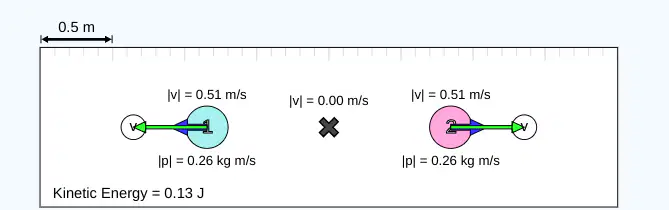
The two objects experience the same force (NIII) and impact time, so they have the same impulse. Impulse equals the change in momentum, so the two objects have the same change in momentum.
a)
The change in momentum depends on the mass of the objects.
b)
The two objects have the same change in momentum.
c)
The two objects have no change in momentum.
d)
The two objects have different change in momentum.
150.

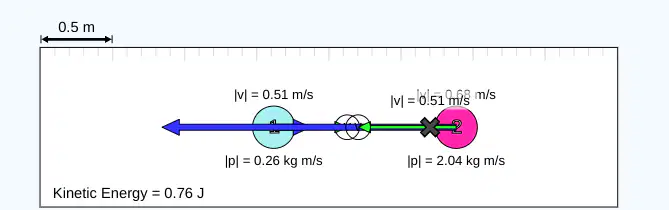
If two objects with the same mass and velocity collide, they will experience the same impulse.
a)
No
b)
Maybe
c)
Sometimes
d)
Yes
151.

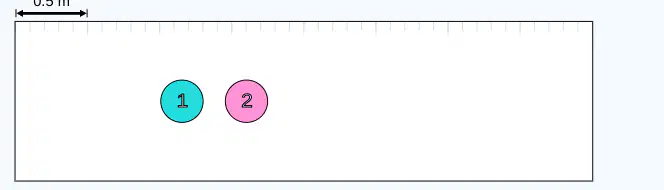
OH NO! Two objects with the same velocity, but different masses are heading straight towards each other. Uh oh! Are their impulses the same?!
a)
No
b)
Yes
c)
Maybe
d)
I don't know
152.

One object is stationary while another object is velocity is high, what will happen when the collide?

a)

Both will experience the same impulse

b)
The stationary object may be pushed or moved by the collision.
c)

Both moved the same rate

d)
The stationary object will remain stationary after the collision.
153.
  1. What velocity must a car with a mass of 1210 kg have in order to have the same momentum as a pickup truck with a mass of 2250 kg and a velocity of 25 m/s?
a)
-46.69421487603306
b)
0
c)
46.69421487603306
d)
1210
154.

Explosion between two objects with different mass. What will happen to the conservation of momentum?

a)
Conservation of momentum will still hold true.
b)

Both will experience the same change in momentum

c)

With drastic differences in mass, one will stop while the other flies by

155.

An explosion occurs between two devices that have the same mass, what will happen to their momentum?

Explain the the conservation of momentum takes its place in this situation.

a)
The momentum of both devices will decrease.
b)

The momentum of both devices will increase, being the same

c)
The momentum of one device will increase while the other device's momentum will decrease.
156.

Same mass and same velocity devices will cancel out the change in momentum

a)
The change in momentum will be doubled.
b)
The change in momentum will be halved.
c)
The change in momentum will be tripled.
d)
The change in momentum will be canceled out.
157.

If a an object with regular mass and regular velocity collies with an object with more mass, what will happen is that regular velocity and mass object will come to to a stop while the other object with more mass will experience have the velocity with the same mass, transferring the momentum to the other object!

a)
Both objects will come to a stop.
b)
The object with regular mass will continue to move with the same velocity while the object with more mass will come to a stop.
c)
The object with regular mass will continue to move with a higher velocity than before collision.
d)

The object with regular mass will come to a stop while the object with more mass will continue to move with the half velocity.

158.
  1. Consider a 6 kg fish that swims toward and swallows a 2 kg fish that is moving at -2 m/s. If the larger fish swims at 1 m/s, what is its velocity immediately after lunch?

a)
2 m/s
b)
0 m/s
c)
-1 m/s
d)
1 m/s
159.

A device goes from a momentum of 0 to a movement of P= (2M)(v/2)

Another device goes from P = - MV to P = 0. What does this tell us?

a)

The first device starts moving while the second device stops moving since it transferred momentum

b)
The first device and the second device both start moving.
c)
The first device stops moving while the second device starts moving.
d)
The first device and the second device both stop moving.
160.

Momentum isn't just created by nothing! You need an external force!

a)
Friction
b)
Inertia
c)
Gravity
d)
An external force
161.

Two objects with the different masses get pushed by an explosion, one with more mass with experience a regular velocity while another in the opposite direction will experience velocity in another direction!

a)
The object with more mass will experience a larger velocity in the opposite direction while the object with less mass will experience a regular velocity.
b)
The object with more mass will experience a regular velocity while the object with less mass will experience a larger velocity in the opposite direction.
c)
The object with more mass will experience a regular velocity while the object with less mass will not experience any velocity.
d)
The object with more mass will experience a larger velocity in the same direction while the object with less mass will experience a smaller velocity in the opposite direction.
162.

In starting Physics classes, the initial velocity is usually 0.

a)
100
b)
10
c)
0
d)
1
163.

Yesterday, we introduced the vocab word conservation. In nature, what other quantities are conserved?

a)
mass, velocity, and temperature
b)
volume, pressure, and density
c)
power, force, and current
d)
energy, momentum, and charge
164.

Noether’s Theorem: “... proclaims that every such symmetry has an associated conservation law, and vice versa — for every conservation law, there’s an associated symmetry.

Two Types of Symmetry:

a)
Bohr's Principle
b)
Newton's Law
c)

Translational

d)

Rotational

165.

Conservation of Momentum

total initial momentum = total final momentum


pTOT, i = pTOT, f

a)
total initial momentum < total final momentum
b)
total initial momentum = total final momentum
c)
total initial momentum > total final momentum
d)
total initial momentum = total final momentum is not conserved
166.

A 2-kg blob of putty moving at 3 m/s slams into a 2-kg blob putty at rest.

Calculate the velocity of the two stuck-together blobs of putty immediately after colliding.

a)
1.5 m/s
b)
4.5 m/s
c)
3 m/s
d)
0.5 m/s
167.

A 2-kg blob of putty moving at 3 m/s slams into a 2-kg blob putty at rest.


  1. Calculate the velocity of the two blobs if the one at rest was 4-kg

a)
v1 = 2 m/s, v2 = 2 m/s
b)
v1 = 3 m/s, v2 = 3 m/s
c)
v1 = 0 m/s, v2 = 0 m/s
d)
v1 = 1 m/s, v2 = 1 m/s
168.

A 70 kg woman and her 35 kg son are standing at rest on an ice rink, as shown. They push against each other for a time of 0.60 s, causing them to glide apart. The velocity of the woman immediately after they separate is +0.55 m/s. Assume that during the push, friction is negligible compared with the forces the people exert on each other.

  1. Calculate the initial velocity of the son after the push.

a)
-0.275
b)
0.825
c)
0.55
d)
0.275
169.

A 70 kg woman and her 35 kg son are standing at rest on an ice rink, as shown. They push against each other for a time of 0.60 s, causing them to glide apart. The velocity of the woman immediately after they separate is +0.55 m/s. Assume that during the push, friction is negligible compared with the forces the people exert on each other.

  1. Calculate the magnitude of the force exerted on the son by the mother during the push.

a)
32.08
b)
16.04
c)
8.02
d)
64.17
170.

Does the elasticity of a collision determine whether the total momentum of the system is conserved?

a)
Not always
b)
No
c)
Yes
d)
Sometimes
171.
In any collision (crash) the ______ is ALWAYS constant
a)
Total Momentum
b)
total speed
c)
total Velocity
d)
Energy
172.
  1. ​ (a)     Distance (D)

  2. ​ (b)   Velocity (v)

  1. ​ (c)   Acceleration (a)  

    ​ (d)   Time (t)

  1. ​ (e)   Force (F)

  2. ​ ​

Choose from the below words
m
m/s
m/s2
s
N
173.
  1. _____  Momentum (p)

  1. _____  Impulse ( J )

  1. _____ Mass (m)

    Coefficient of Friction (𝜇)

  1. _____  Volume (V)

a)
  1. kg (m/s)

b)

N · s

c)

m

d)
Momentum (p)
e)

m3

174.
  1. A truck, with a mass of 4,000 kg moves with a speed of 8 m/s. 

    1. Write the equation for momentum:


a)
p = m * v
b)
p = m - v
c)
p = m / v
d)
p = m + v
175.
  1. A physics student designs an egg drop project for their class. [ Impulse  =  Change in Momentum ]

  2. Will the impulse be less if the project lands on concrete, or grass? Explain. 

a)
concrete
b)
sand
c)
water
d)

none

176.
  1. In which case is there a larger change of momentum grass and concrete ? Explain. 

a)
grass
b)
wood
c)
sand
d)

none

177.
  1. In which case is there a larger impact time? Explain. 

a)

Grass

b)

Concrete

178.
  1. In which case is there a larger force grass or concrete? Explain.

a)
concrete
b)
sand
c)
water
d)
grass
179.
  1. A 0.05 kg egg collides at 5 m/s with a wall and comes to a stop. The collision lasts for 0.1 seconds. 

  1. Calculate the change in momentum for the 0.05 kg egg. 

a)
0.05 kg*m/s
b)
-0.25 kg*m/s
c)
0.25 kg*m/s
d)
0.5 kg*m/s
180.

Why do you get the radian when dividing the arc length over the radius?

a)
Because the arc length is measured in radians
b)
Because the radius is measured in radians
c)
Because dividing the arc length by the radius gives a ratio
d)
Unit of measurement for angles
181.

Why do you get the radian when dividing the arc length over the radius?

a)
Because the arc length is measured in radians
b)
Because the radius is measured in radians
c)
Because dividing the arc length by the radius gives a ratio
d)
Unit of measurement for angles
182.

If a Mack truck and a Volkswagen have a head-on collision, which vehicle will experience the greater...

... impact force the same, acceleration small, damage small ?

a)
None of the vehicles will experience any impact force, acceleration, or damage
b)

ok

c)
Both vehicles will experience the same
d)
Volkswagen
183.

If a Mack truck and a Volkswagen have a head-on collision, which vehicle will experience the greater...

... change in momentum?

a)
Mack truck
b)
Neither vehicle will experience a change in momentum
c)
Both vehicles will experience the same change in momentum
d)
Volkswagen