wayground logo

Free Printable Worksheets

Font size

S
M
L
XL
Worksheets

Chapters 23

Total questions: 25

Worksheet time: 12mins

Name
Class
Date
1.

What is the constant movement of water between Earth's atmosphere and Earth's surface called?

a)

carbon cycle

b)

water cycle

c)

precipitation

d)

climate cycle

2.

Having large quantities of livestock, such as cattle, primarily contributes to which greenhouse gas?

a)

water vapor

b)

carbon monoxide

c)

nitrogen

d)

methane

3.

Starting with the ________________ in the late 1800s, human activities have increased planetary warming.

a)

Revolutionary War

b)

Cultural Revolution

c)

Industrial Revolution

d)

Building of the Sagamore and Bourne

4.

Which natural process removes carbon dioxide from the atmosphere?

a)

forest fires

b)

volcanic eruptions

c)

cellular respiration

d)

photosynthesis

5.

Select the greenhouse gas(es)

a)

CO2

b)

Methane

c)

Oxygen

d)

All of the above

6.

Possible human solutions for limiting global warming and climate change are...

a)

being more energy-efficient

b)

using renewable sources of energy

c)

removing carbon from fossil fuel emissions

d)

all of the above

7.
The warming of the atmosphere by the trapping of heat being radiated to space is called
a)
evaporation
b)
condensation
c)
the greenhouse effect
d)
radiation
8.
Carbon is stored in
a)
Trees and other living things
b)
Oceans
c)
underground in soil and fossil fuels
d)
All are correct
9.
What is the average weather for a particular time and region called?
a)
drought
b)
weather
c)
emissions
d)
climate
10.
What is the definition of weather?
a)
a period of abnormally dry weather that lasts at least 2 years
b)
the specific condition of the atmosphere at a particular place and time
c)
a complex community of organisms and the community's environment
d)
a release of toxic gas
11.
Melting of glaciers and polar ice caps....
a)
will result in cooler temperatures in the Arctic
b)
will result in sea-levels rising
c)
Will have no effect on ecosystems
d)
None of the above
12.
Things you can do to help decrease global warming include:
a)
Eat more ice cream.
b)
Keep your freezer door open.
c)
Keep your air conditioner on high.
d)
Turn off your lights when you’re not using them.
13.
Some greenhouse gases are naturally present in the Earth's atmosphere
a)
True
b)
False
14.
The main human activity that releases greenhouse gases is
a)
using bottled water
b)
burning fossil fuels
c)
texting on cellphones
d)
eating meat
15.
Changes in temperature are expected to be greatest
a)
near the equator
b)
near the poles
c)
between the equator and the North Pole
d)
between the equator and the South Pole
16.
Which of the following is the best conclusion that can be made from this graph?
a)
atmospheric carbon dioxide levels have been decreasing since 1960
b)
Hawaii has a lot of carbon dioxide
c)
humans have been working hard to decrease carbon dioxide levels
d)
atmospheric carbon dioxide levels have increased steadily since 1960
17.
The average temperature of the surface of Earth has increased approximately 1°C in the past century. Which reason best explains this increase in temperature?
a)
lower levels of ozone in the atmosphere
b)
lower levels of nitrogen in the atmosphere
c)
higher levels of carbon dioxide in the atmosphere
d)
higher levels of oxygen in the atmosphere
18.
What are greenhouse gases?
a)
gases that cause climate change
b)
gases that emit green smoke
c)
gases that are used to make green colored glass
19.
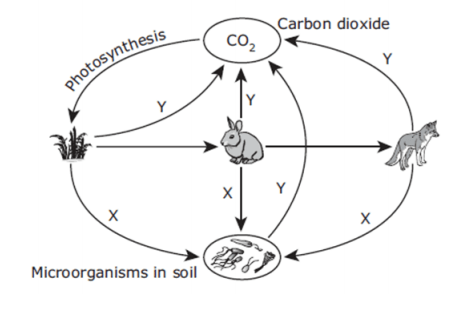
The diagram shows the flow of organic molecules through an ecosystem. What two processes are identified by the labels X and Y?
a)
X : Respiration
Y : Predation
b)
X : Adaptation
Y : Decomposition
c)
X : Fermentation
Y : Nitrogen Fixation
d)
X : Decomposition
Y : Respiration
20.
Organisms that do not decompose can be buried and become what?
a)
water
b)
nutrients
c)
air
d)
fossil fuels
21.
Deforestation contributes to the greenhouse gasses by
a)
loss of trees that would otherwise remove carbon dioxide from the air
b)
as trees are cut, they release carbon dioxide
c)
increasing the amount of oxygen in the air
22.
What is a carbon footprint
a)
the total amount of greenhouse gases that are emitted into the atmosphere
b)
the release of gas
c)
a place or environment where a plant or animal naturally or normally lives or grows
d)
a certain type of greenhouse gas
23.
How do living organisms return carbon to the atmosphere in the carbon cycle
a)
respiration and decomposition
b)
respiration and photosynthesis
c)
death
d)
burning
24.
Which of these does not add CO2 to the atmosphere
a)
cooking with gas
b)
planting trees
c)
burning wood
d)
riding in a bus
25.
When is most of the carbon dioxide that is exhaled from plants formed?
a)
respiration
b)
circulation
c)
photosynthesis
d)
when it starts the carbon cycle