
 Worksheets
Movement and Locomotion in Living Organisms.
Total questions: 10
Worksheet time: 5mins
Muscles work in pairs. They contract and relax simultaneously. How does this help an individual?
It assists in the formation of the bones.
It prevents any injury to the internal organs.
It allows the movement of bones at the joints.
It helps in the absorption of nutrients in the body.
The Pivot joint occur in our skeleton at:
Hip
Knee
Neck
Femur
Recently, in a Science class test, you were asked a question, whether the statements are correct or not?
[A]. The bony framework inside our body is called the skeleton.
[B]. The bones of the skeleton provide a framework that holds our body together.
[C]. Bones are hard and tough but the cartilage is softer than bones.
[D]. There are 306 bones in the human skeleton or human body.
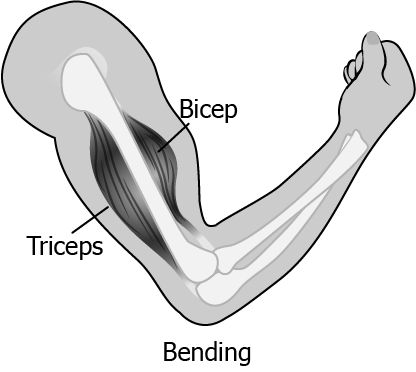
The image shows how the muscles help in the movement of the arm. Based on the image, what will be the length of the muscles during bending?
Both bicep and triceps relax
Both bicep and triceps contracts
The bicep contracts while triceps relax
The bicep relaxes while triceps contracts
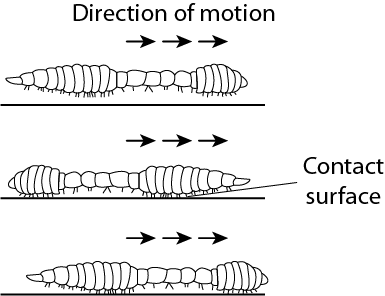
A student observes the movement of an organism that lacks bones. Based on the manner of movement, which organism this can likely be?
(a) Ant
(b)Cockroach
(c)Earthworm
(d)Snake
How can fishes flow around easily in the water?
Due to small-sized body
Due to streamlined body
Due to the presence of thin skin
Due to the presence of scales on their body
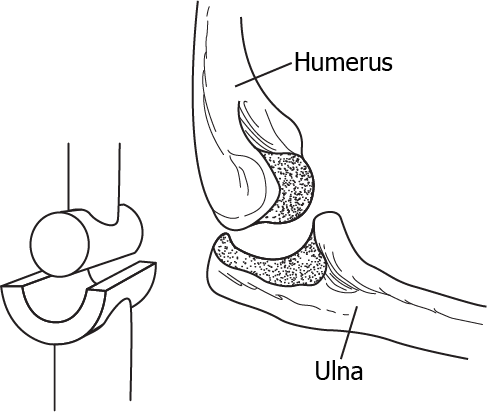
The image shows a joint found at the elbow. What is the type of joint present between the humerus and ulna?
Ball and socket
Fixed
Hinge
Pivot
The skull covers and protects the
Ears
neck
fingers
brain
Which of the following joints is immovable?
Shoulder and arm
Knee and thigh
Upper jaw and skull
The lower jaw and upper jaw
Which of the following parts of our body help us in movement?
(i) Bones
(ii) Skin
(iii) Muscles
(iv) Organs
choose the correct answer from the option below.
(i) and (iii)
(ii) and (iv)
(i) and (iv)
(ii) and (iii)

