wayground logo

Free Printable Worksheets

Font size

S
M
L
XL
Worksheets

HW: Lesson 4-4 to 4-6 Review

Total questions: 152

Worksheet time: 4hrs 20mins
Name
Class
Date
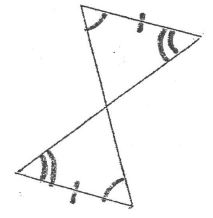
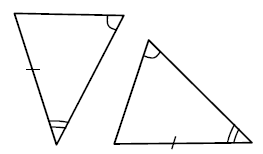
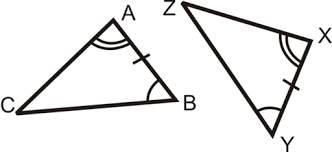
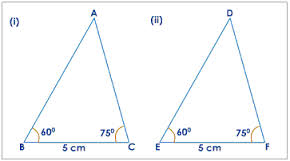
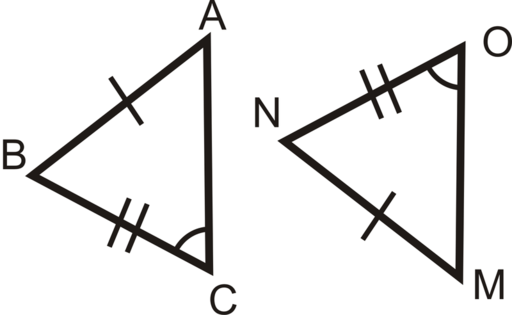
1.

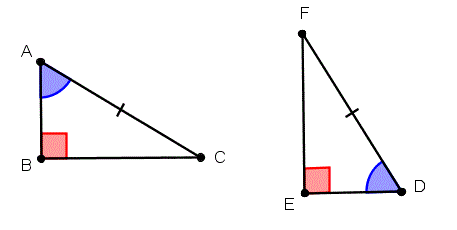
Identify the correct triangle congruence theorem.

a)

ASA

b)

AAS

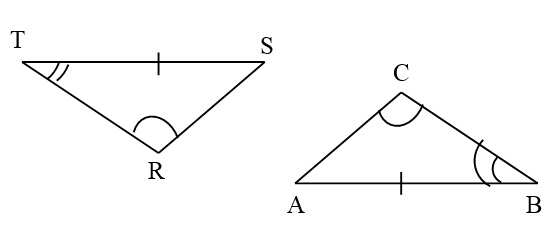
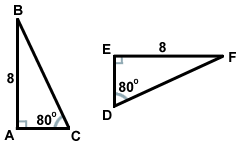
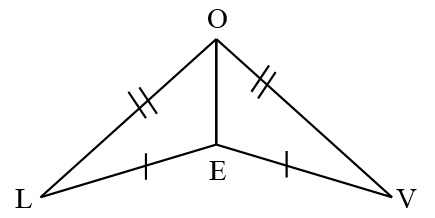
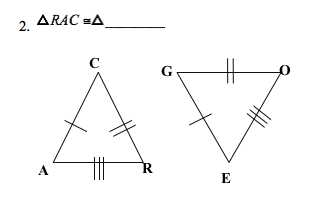
2.

Identify the correct triangle congruence theorem.

a)

ASA

b)

AAS

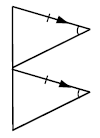
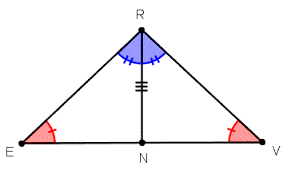
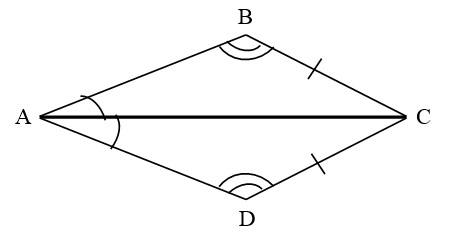
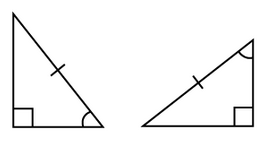
3.

Identify the correct triangle congruence theorem.

a)

ASA

b)

AAS

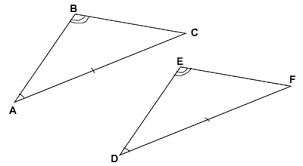
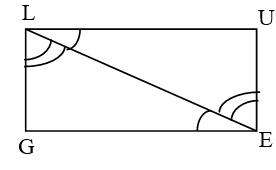
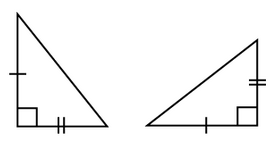
4.

Identify the correct triangle congruence theorem.

a)

ASA

b)

AAS

5.

Identify the correct triangle congruence theorem.

a)

ASA

b)

AAS

6.

Identify the correct triangle congruence theorem.

a)

ASA

b)

AAS

7.

Identify the correct triangle congruence theorem.

a)

ASA

b)

AAS

8.

Identify the correct triangle congruence theorem.

a)

ASA

b)

AAS

9.

What does AAS stand for?

a)

Angle-Angle-Side

b)

Side-Angle-Side

c)

Angle-Side-Angle

d)

Side-Side-Side

10.

What does ASA stand for?

a)

Angle-Angle-Side

b)

Side-Angle-Side

c)

Angle-Side-Angle

d)

Side-Side-Side

11.
What does CPCTC stand for?
a)
Corresponding Parts of Congruent Triangles are Congruent
b)
Congruent Parts of Congruent Triangles are Corresponding
c)
Colorful Pieces of Corresponding Triangles are Congruent
d)
Congruent Pieces of Congruent Triangles are Congruent
12.
a)
ASA and AAS use 2 different pairs of angles
b)
ASA uses the included side, but AAS uses the non-included side
c)
ASA uses the non-included side, but AAS uses the included side
d)
ASA and AAS use different pairs of sides
13.

Identify the correct triangle congruence theorem.

a)

ASA

b)

AAS

14.

Identify the correct triangle congruence theorem.

a)

ASA

b)

AAS

15.

Identify the correct triangle congruence theorem.

a)

ASA

b)

AAS

16.

Identify the correct triangle congruence theorem.

a)

ASA

b)

AAS

17.

Identify the correct triangle congruence theorem.

a)

ASA

b)

AAS

18.
a)
Congruent by HL
b)
Congruent by SAS
c)
Congruent by SSS
d)
Not Necessarily Congruent
19.

Are the triangles congruent?

a)

Yes, by AA≅

b)

Yes, by AAS≅

c)

Yes, by ASA≅

d)

Yes, by SAS≅

e)

Not enough information

20.
Fill in the blank.
a)
Given
b)
Reflexive Property
c)
Transitive Property
d)
They're the same side!!!!!! 
21.

What is the "statement" for step 3 of the proof?

a)

HA=HA

b)

HA=AH

c)

MA=AM

d)

MA=MA

22.

What is the "statement" for step 4 of the proof?

4 lines
23.

What is the "statement" for step 5 of the proof?

4 lines
24.
What is the "reason" for step 5 of the proof?
a)
Angle Bisector Theorem
b)
Reflexive property
c)
CPCTC Theorem
d)
Proof
25.
What is the "statement" for step 3 of the proof? 
a)
∡EDA≅∡DCB
b)
∡AED≅∡BEC
c)
DE=CE
d)
∡AED≅∡CED
26.
In this picture,
a)
<BCA=<DCE because they are vertical angles and vertical angles are always congruent to each other
b)
<C=<C because they are vertical angles and vertical angles are always congruent to each other
c)
<EDC=<ACB because they are vertical angles and vertical angles are always congruent to each other
d)
None of the above; we don't actually have vertical angles
27.
What is statement #1?
a)
BC≅DC
b)
AC≅EC
c)
BC≅DC, AC≅EC
d)
∆BCA≅∆DCE
28.
What is statement #2?
a)
∠ABC≅∠EDC
b)
∠BCA≅∠DCE
c)
BC≅CD
d)
∠E≅∠A
29.
What is reason #3?
a)
SAS
b)
ASA
c)
SSS
d)
AAS
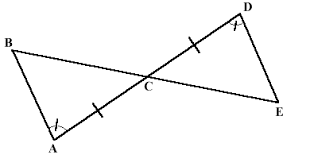
30.

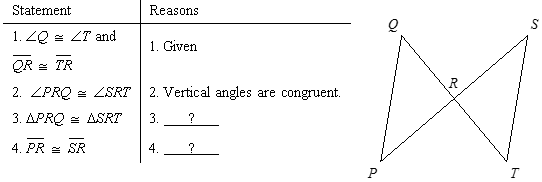
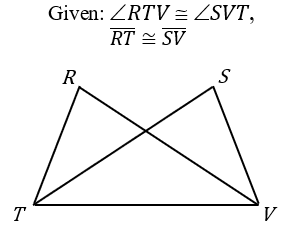
Supply the missing reasons to complete the proof.

Given: ∠Q ≅ ∠T; QR ≅ TR

a)

3. ASA

4.Substitution

b)

3. SAS

4. CPCTC

c)

3. AAS

4. CPCTC

d)

3. ASA

4. CPCTC

31.

Determine if the two triangles are congruent. If they are, state the postulate.

a)

SAS

b)

AAS

c)

Not enough information

d)

SSS

32.

Determine if the two triangles are congruent. If they are, state the postulate.

a)

ASA

b)

SAS

c)

Not enough information

d)

AAS

33.

Determine if the two triangles are congruent. If they are, state the postulate.

a)

ASA

b)

SAS

c)

SSS

d)

Not enough information

34.

Determine if the two triangles are congruent. If they are, state the postulate.

a)

ASA

b)

AAS

c)

Not enough information

d)

SSS

35.
Name the postulate, if possible, that makes the triangles congruent.
a)
SAS
b)
ASA
c)
AAS
d)
Not Possible
36.
Name the postulate, if possible, that makes the triangles congruent.
a)
SSS
b)
ASA
c)
AAS
d)
Not Possible
37.

Are the two triangles congruent? If they are, select the correct congruence postulate. If there is not enough information, select N/A.

a)

SSS

b)

AAS

c)

N/A

d)

ASA

38.

Are the two triangles congruent? If they are, select the correct congruence postulate. If there is not enough information, select N/A.

a)

SSS

b)

AAS

c)

ASA

d)

N/A

39.
What additional information is required to prove the 2 triangles are congruent by ASA
a)
A)
b)
B)
c)
C)
d)
D)
40.

Which congruency statement can be written for the triangles pictured?

a)

ΔABC ≅ ΔEDC

b)

ΔACB ≅ ΔEDC

c)

ΔECD ≅ ΔCAB

d)

ΔBCA ≅ ΔDEC

41.
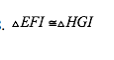
Use the congruency statement to answer the following: 
<F = ___
a)
<H
b)
<I
c)
<G
d)
not congruent to another angle
42.
Which triangle congruence theorem can be used to prove the triangles are congruent?
a)
ASA
b)
SAS
c)
AAS
d)
Not enough information
43.
Which triangle congruence theorem can be used to prove the triangles are congruent?
a)
AAS
b)
SAS
c)
HL
d)
ASA
44.
Which of the following is NOT a triangle congruence theorem?
a)
HL
b)
SAS
c)
AAS
d)
AAA
45.
Which triangle congruence theorem can be used to prove the triangles are congruent?
a)
AAS
b)
ASA
c)
SSA
d)
AAA
46.
Which triangle congruence theorem can be used to prove the triangles are congruent?
a)
ASA
b)
AAS
c)
SAS
d)
AAA
47.
Which triangle congruence theorem can be used to prove the triangles are congruent?
a)
SAS
b)
SSA
c)
ASA
d)
AAS
48.
Which triangle congruence theorem can be used to prove the triangles are congruent?
a)
SSS
b)
ASA
c)
AAS
d)
Not enough information
49.
Which triangle congruence theorem can be used to prove the triangles are congruent?
a)
SAS
b)
ASA
c)
Cannot be proven congruent
d)
HL
50.
How well did you learn this unit on the triangle congruence theorems?
a)
Very well
b)
Not at all
51.
Name the postulate, if possible, that makes the triangles congruent.
a)
SSS
b)
SAS
c)
ASA
d)
Not Possible
52.
Name the postulate, if possible, that makes the triangles congruent.
a)
SAS
b)
ASA
c)
AAS
d)
Not Possible
53.
Name the postulate, if possible, that makes the triangles congruent.
a)
SSS
b)
SAS
c)
ASA
d)
Not Possible
54.
Name the postulate, if possible, that makes the triangles congruent.
a)
SSS
b)
ASA
c)
AAS
d)
Not Possible
55.
Name the postulate, if possible, that makes the triangles congruent.
a)
SSS
b)
SAS
c)
AAS
d)
Not Possible
56.
Name the postulate, if possible, that makes the triangles congruent.
a)
SAS
b)
ASA
c)
AAS
d)
Not Possible
57.
Name the postulate, if possible, that makes the triangles congruent.
a)
SSS
b)
SAS
c)
ASA
d)
AAS
58.
Name the postulate, if possible, that makes the triangles congruent.
a)
SSS
b)
SAS
c)
ASA
d)
HL
59.
Name the postulate, if possible, that makes the triangles congruent.
a)
SSS
b)
SAS
c)
ASA
d)
AAS
60.
a)
SAS
b)
None
c)
SSS
d)
ASA
61.
Complete the congruence statement.
a)
OEG
b)
OGE
c)
EGO
d)
GOE
62.

Given 

ΔABC ΔDEF \Delta ABC\ \cong\Delta DEF\  
A  ?\angle A\ \cong\ ?  

a)

D\angle D  

b)

E\angle E  

c)

F\angle F  

d)

C\angle C  

63.

Given 

ΔABC ΔDEF \Delta ABC\ \cong\Delta DEF\  
C  ?\angle C\ \cong\ ?  

a)

D\angle D  

b)

E\angle E  

c)

F\angle F  

d)

A\angle A  

64.

Given 

ΔABC ΔDEF \Delta ABC\ \cong\Delta DEF\  
F  ?\angle F\ \cong\ ?  

a)

A\angle A  

b)

B\angle B  

c)

C\angle C  

d)

D\angle D  

65.

Given 

ΔABC ΔDEF \Delta ABC\ \cong\Delta DEF\  
BC  ?\overline{BC}\ \cong\ ?  

a)

DE\overline{DE}  

b)

EF\overline{EF}  

c)

DF\overline{DF}  

d)

FE\overline{FE}  

66.

Given 

ΔABC ΔDEF \Delta ABC\ \cong\Delta DEF\  
CA  ?\overline{CA}\ \cong\ ?  

a)

DE\overline{DE}  

b)

EF\overline{EF}  

c)

DF\overline{DF}  

d)

FD\overline{FD}  

67.

ΔPETΔDOG\Delta PET\cong\Delta DOG  

Which of the following are TRUE 

a)

PD\angle P\cong\angle D  

b)

TEGO\overline{TE}\cong\overline{GO}  

c)

TO\angle T\cong\angle O  

d)

TPGD\overline{TP}\cong\overline{GD}  

e)

TEOG\overline{TE}\cong\overline{OG}  

68.
Name the postulate, if possible, that makes the triangles congruent.
a)
SAS
b)
ASA
c)
AAS
d)
Not Possible
69.

Which congruence theorems apply to RIGHT triangles

a)

AAS

b)

SSS

c)

ASA

d)

HL

e)

SAS

70.

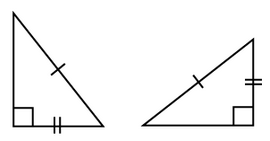
Which pair of triangles can be proven congruent using the Hypotenuse-Leg Theorem?
a)
b)
c)
d)
71.

Which congruence theorems would show that the two right triangles are congruent?

a)

AAS

b)

SSS

c)

ASA

d)

HL

e)

SAS

72.

What theorem can be used to show that ABCDEF?

a)

AAS

b)

SSS

c)

ASA

d)

HL

e)

SAS

73.

For the figures shown, which information can be used to show that ABCDEF?

Select all that apply.

a)

mD + mE = 90°

b)

mD = 37°

c)

E ≅ ∠B

d)

F is a right angle

74.

What additional information is needed to show that ΔABC  ΔDEF\Delta ABC\ \cong\ \Delta DEF by HL ?  (Hint: write your answer in the form A=27 no spaces; use upper case for an angle, lower case for a side)


(a)  

75.
Name the postulate, if possible, that makes the triangles congruent.
a)
SSS
b)
SAS
c)
AAS
d)
Not enough information
76.
Name the postulate, if possible, that makes triangles AED and CEB congruent.
a)
SSA
b)
SAS
c)
HL
d)
Not enough information
77.

Which congruence theorems apply to triangles that are NOT right triangles?

a)

AAS

b)

SSS

c)

ASA

d)

HL

e)

SAS

78.
Which is NOT a criteria for triangles to be congruent by the HL Theorem?
a)
Right triangles
b)
congruent hypotenuses
c)
Two pairs of congruent legs
d)
One pair of congruent legs
79.

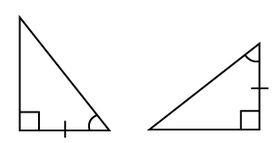
Which pair of triangles can be proven congruent using the Hypotenuse-Leg Theorem?
a)
b)
c)
d)
80.

Which congruence theorems would show that the two right triangles are congruent?

a)

AAS

b)

SSS

c)

ASA

d)

HL

e)

SAS

81.

What theorem can be used to show that ABCDEF?

a)

AAS

b)

SSS

c)

ASA

d)

HL

e)

SAS

82.
Name the postulate, if possible, that makes the triangles congruent.
a)
SSS
b)
SAS
c)
AAS
d)
Not enough information
83.
Name the postulate, if possible, that makes triangles AED and CEB congruent.
a)
SSA
b)
SAS
c)
HL
d)
Not enough information
84.

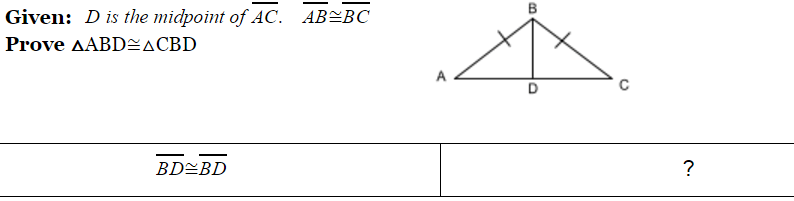
Identify the missing statement or reason

a)

Reflexive Property

b)

Definition of Midpoint

c)

Given

d)

Vertical Angles Theorem

85.
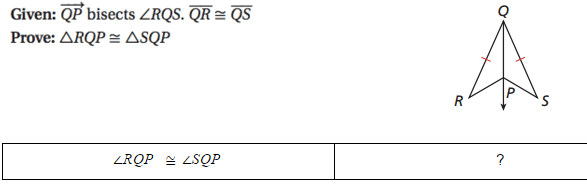
Identify the  missing statement or reason
a)
Given
b)
Vertical Angles Theorem
c)
Definition of Angle Bisector
d)
Alternate Interior Angles Theorem
86.
If DA bisects IE, then
a)
ID=ED
b)
IA=EA
c)
<IDA=<EDA
d)
<IAD and <EAD are right angles
87.
If AD bisects <EDI, then
a)
<ADE=<IDA
b)
IA=AE
c)
ID=ED
d)
All of the above
88.

What is a hypotenuse?

a)

The longest side in any triangle

b)

The side opposite to the right angle in a right-angled triangle

c)

The side adjacent to the right angle in a right-angled triangle

d)

Hypotenuse is a special kind of angle

89.
∠A ≅∠?
a)
∠B
b)
∠E
c)
∠D
d)
∠F
90.

State if the triangles are congruent or not. If they are, state how you know.

a)

Yes - by SSS

b)

Yes - by ASA

c)

Yes - by HL

d)

Yes - by AAS

e)

Not congruent

91.

State if the triangles are congruent or not. If they are, state how you know.

a)

Yes - by SSS

b)

Yes - by ASA

c)

Yes - by HL

d)

Yes - by AAS

e)

Not congruent

92.

State if the triangles are congruent or not. If they are, state how you know.

a)

Yes - by SSS

b)

Yes - by ASA

c)

Yes - by HL

d)

Yes - by AAS

e)

Not congruent

93.

State if the triangles are congruent or not. If they are, state how you know.

a)

Yes - by SSS

b)

Yes - by ASA

c)

Yes - by HL

d)

Yes - by AAS

e)

Not congruent

94.

State if the triangles are congruent or not. If they are, state how you know.

a)

Yes - by SSS

b)

Yes - by ASA

c)

Yes - by HL

d)

Yes - by SAS

e)

Not congruent

95.

State if the triangles are congruent or not. If they are, state how you know.

a)

Yes - by SSS

b)

Yes - by ASA

c)

Yes - by HL

d)

Yes - by SAS

e)

Not congruent

96.

State if the triangles are congruent or not. If they are, state how you know.

a)

Yes - by AAS

b)

Yes - by ASA

c)

Yes - by HL

d)

Yes - by SAS

e)

Not congruent

97.

State if the triangles are congruent or not. If they are, state how you know.

a)

Yes - by AAS

b)

Yes - by ASA

c)

Yes - by HL

d)

Yes - by SAS

e)

Not congruent

98.

State if the triangles are congruent or not. If they are, state how you know.

a)

Yes - by AAS

b)

Yes - by ASA

c)

Yes - by HL

d)

Yes - by SAS

e)

Not congruent

99.

State what additional information is required in order to know that the triangles are congruent for the reason given.

a)

RSQSRS\cong QS

b)

RSQDRS\cong QD

c)

QRSQDS\angle QRS\cong\angle QDS

d)

DSSQDS\cong SQ

100.
Name the postulate, if possible, that makes the triangles congruent.
a)
SAS
b)
ASA
c)
AAS
d)
Not Possible
101.
Name the postulate, if possible, that makes the triangles congruent.
a)
SSS
b)
SAS
c)
ASA
d)
Not Possible
102.
Name the postulate, if possible, that makes the triangles congruent.
a)
SSS
b)
ASA
c)
AAS
d)
Not Possible
103.
Name the postulate, if possible, that makes the triangles congruent.
a)
SAS
b)
ASA
c)
AAS
d)
Not Possible
104.
Name the postulate, if possible, that makes the triangles congruent.
a)
SSS
b)
SAS
c)
ASA
d)
AAS
105.
What are the five ways to prove triangles congruent?
a)
SSS, ASA, AAS, SAS, HL
b)
SSS, SSA, HL, AAS, SAS
c)
SAS, SSA, HL, AAS, SSS
d)
HL, SAS, SSA, SSS, ASA
106.
Which is NOT a test to prove triangles congruent?
a)
SAA
b)
SSS
c)
SSA
d)
SAS
107.
The red and blue triangles are congruent. Identify a common side or angle.
a)
Side DF
b)
Angle E
c)
Angle G
d)
Angle GDE
108.
The red and blue triangles are congruent. Identify a common side or angle.
a)
Side XY
b)
Side XZ
c)
Angle TWZ
d)
Side YT
109.

ΔKNM is congruent to ΔPLM. They have _______ in common.

a)
Angle M
b)
Angle P
c)
Angle K
d)
Angle MLP
110.

Identify any common angles or sides.

a)

JK\overline{JK}  

b)
Angle MJK
c)

KL\overline{KL}  

d)
Angle MKJ
111.

△CDG and △FCE share ______ .

a)

C

b)

∠E

c)

∠F

d)

∠D

112.
Identify common angles or sides
a)
Angle E
b)
Angle D
c)
Angle F
d)
Angle DGF
113.

Which is the common part between triangles LKO and NOK?

a)

KO\overline{KO}  

b)

LK\overline{LK}  

c)

<KPO<KPO  

d)

<POK<POK  

114.

Triangles BDC and CEB share side _____ .

a)

AB\overline{AB}  

b)

EB\overline{EB}  

c)

CB\overline{CB}  

d)

CD\overline{CD}  

115.

Name a side or angle that is overlapping.

a)

∠Y

b)

ZY

c)

YT

d)

NP

116.

According to the diagram, which statement is true?

a)

Triangle DEH is congruent to triangle GFH by AAS

b)

Triangle DEH is congruent to triangle GFH by SAS

c)

Triangle DEF is congruent to triangle GFE by AAS

d)

Triangle DEF is congruent to triangle GFE by SAS

117.
Name a pair of overlapping congruent triangles and state how.  (Hint: they have to be overlapping)
a)
∆AQT ≅ ∆SQT by SAS
b)
∆TAR ≅ ∆TSP by AAS
c)
∆TAR ≅ ∆TSP by ASA
d)
∆AQT ≅ ∆SQT by SSA
118.
Are these triangles congruent?
a)
Yes, by AAS
b)
Yes, by ASA
c)
No they are not congruent
d)
Not enough information to know for sure
119.
Are these triangles congruent?
a)
Yes, by ASA
b)
Yes, by SAS
c)
No they are not congruent
d)
Not enough information to know for sure
120.

Separate and redraw the indicated triangles. Identify any common side(s).


ΔABC and ΔDCB\Delta ABC\ and\ \Delta DCB  

a)

BC\overline{BC}  

b)

CD\overline{CD}  

c)

AB\overline{AB}  

d)

There is not a common side

121.

Separate and redraw the indicated triangles. Identify any common angle(s).


ΔABC and ΔDCB\Delta ABC\ and\ \Delta DCB  

a)

A\angle A  

b)

B\angle B  

c)

C\angle C  

d)

There is not a common angle

122.

Separate and redraw the indicated triangles. Identify any common side(s).


ΔEFG and ΔHGF\Delta EFG\ and\ \Delta HGF  

a)

EF\overline{EF}  

b)

FG\overline{FG}  

c)

GH\overline{GH}  

d)

There is not a common side

123.

Separate and redraw the indicated triangles. Identify any common angle(s).


ΔEFG and ΔHGF\Delta EFG\ and\ \Delta HGF  

a)

F\angle F  

b)

G\angle G  

c)

H\angle H  

d)

There is not a common angle

124.

Separate and redraw the indicated triangles. Identify any common side(s).


ΔJML and ΔNKL\Delta JML\ and\ \Delta NKL  

a)

JL\overline{JL}  

b)

LN\overline{LN}  

c)

KN\overline{KN}  

d)

There is not a common side

125.

Separate and redraw the indicated triangles. Identify any common angle(s).


ΔJML and ΔNKL\Delta JML\ and\ \Delta NKL  

a)

M\angle M  

b)

K\angle K  

c)

L\angle L  

d)

There is not a common angle

126.

Separate and redraw the indicated triangles. Identify any common side(s).


ΔBYA and ΔCXA\Delta BYA\ and\ \Delta CXA  

a)

AB\overline{AB}  

b)

YB\overline{YB}  

c)

AC\overline{AC}  

d)

There is not a common side

127.

Separate and redraw the indicated triangles. Identify any common angle(s).


ΔBYA and ΔCXA\Delta BYA\ and\ \Delta CXA  

a)

A\angle A  

b)

B\angle B  

c)

X\angle X  

d)

There is not a common angle

128.

Separate and redraw the indicated triangles. Identify any common side(s).


ΔGEH and ΔFEH\Delta GEH\ and\ \Delta FEH  

a)

HF\overline{HF}  

b)

EH\overline{EH}  

c)

EG\overline{EG}  

d)

There is not a common side

129.

Separate and redraw the indicated triangles. Identify any common angle(s).


ΔGEH and ΔFEH\Delta GEH\ and\ \Delta FEH  

a)

E\angle E  

b)

H\angle H  

c)

F\angle F  

d)

There is not a common angle

130.

Separate and redraw the indicated triangles. Identify any common side(s).


ΔMPN and ΔMOQ\Delta MPN\ and\ \Delta MOQ  

a)

NM\overline{NM}  

b)

PM\overline{PM}  

c)

OM\overline{OM}  

d)

There is not a common side

131.

Separate and redraw the indicated triangles. Identify any common angle(s).


ΔMPN and ΔMOQ\Delta MPN\ and\ \Delta MOQ  

a)

M\angle M  

b)

Q\angle Q  

c)

P\angle P  

d)

There is not a common angle

132.

The given triangles are congruent. Identify their common side.


 ΔADC and ΔBCD\ \Delta ADC\ and\ \Delta BCD  

a)

DC\overline{DC}  

b)

AC\overline{AC}  

c)

BD\overline{BD}  

d)

There is not a common side

133.

The given triangles are congruent. Identify their common angle.


 ΔADC and ΔBCD\ \Delta ADC\ and\ \Delta BCD  

a)

D\angle D

b)

C\angle C  

c)

B\angle B  

d)

There is not a common angle

134.

The given triangles are congruent. Identify their common side.


 ΔKNJ and ΔKML\ \Delta KNJ\ and\ \Delta KML  

a)

JK\overline{JK}  

b)

NK\overline{NK}  

c)

LM\overline{LM}  

d)

There is not a common side

135.

The given triangles are congruent. Identify their common angle.


 ΔKNJ and ΔKML\ \Delta KNJ\ and\ \Delta KML  

a)

J\angle J  

b)

K\angle K  

c)

L\angle L  

d)

There is not a common angle

136.

The given triangles are congruent. Identify their common side.


 ΔUXV and ΔVWU\ \Delta UXV\ and\ \Delta VWU  

a)

UV\overline{UV}  

b)

XV\overline{XV}  

c)

UW\overline{UW}  

d)

There is not a common side

137.

The given triangles are congruent. Identify their common angle.


 ΔUXV and ΔVWU\ \Delta UXV\ and\ \Delta VWU  

a)

W\angle W  

b)

V\angle V  

c)

X\angle X  

d)

There is not a common angle

138.

The given triangles are congruent. Identify their common side.


 ΔQTR and ΔSRT\ \Delta QTR\ and\ \Delta SRT  

a)

RS\overline{RS}  

b)

TR\overline{TR}  

c)

TQ\overline{TQ}  

d)

There is not a common side

139.

The given triangles are congruent. Identify their common angle.


 ΔQTR and ΔSRT\ \Delta QTR\ and\ \Delta SRT  

a)

T\angle T  

b)

R\angle R  

c)

S\angle S  

d)

There is not a common angle

140.

The given triangles are congruent. Identify their common side.


 ΔEGH and ΔEGF\ \Delta EGH\ and\ \Delta EGF  

a)

EG\overline{EG}  

b)

HF\overline{HF}  

c)

HG\overline{HG}  

d)

There is not a common side

141.

The given triangles are congruent. Identify their common angle.


 ΔEGH and ΔEGF\ \Delta EGH\ and\ \Delta EGF  

a)

E\angle E  

b)

F\angle F  

c)

G\angle G  

d)

There is not a common angle

142.

The given triangles are congruent. Identify their common side.


 ΔYNI and ΔYPZ\ \Delta YNI\ and\ \Delta YPZ  

a)

PZ\overline{PZ}  

b)

YP\overline{YP}  

c)

IN\overline{IN}  

d)

There is not a common side

143.

The given triangles are congruent. Identify their common angle.


 ΔYNI and ΔYPZ\ \Delta YNI\ and\ \Delta YPZ  

a)

Z\angle Z  

b)

N\angle N  

c)

Y\angle Y  

d)

There is not a common angle

144.
The red and blue triangles are congruent. Identify a common side or angle.
a)
Side XY
b)
Side XZ
c)
Angle TWZ
d)
Side YT
145.
The red and blue triangles are congruent. Identify a common side or angle.
a)
Side DF
b)
Angle E
c)
Angle G
d)
Angle GDE
146.
The red (ΔKNM) and blue (ΔPLM) triangles are congruent. Identify a common side or angle.
a)
Angle M
b)
Angle P
c)
Angle K
d)
Angle MLP
147.
Identify common angles or sides
a)
Angle E
b)
Angle D
c)
Angle F
d)
Angle DGF
148.
Identify any common angles or sides
a)
JK
b)
Angle MJK
c)
LK
d)
Angle MKJ
149.
IF THESE TRIANGLES ARE CONGRUENT, 
WHAT THEOREM PROVES THIS? 
a)
SSS
b)
SAS
c)
ASA
150.
Which of the following cannot be used to prove triangles congruent?
a)
HL
b)
AAA
c)
SSS
d)
SAS
151.
Name the postulate, if possible, that makes the triangles congruent.
a)
SSS
b)
SAS
c)
ASA
d)
AAS
152.
Name the postulate, if possible, that makes triangles AED and CEB congruent.
a)
SSA
b)
SAS
c)
HL
d)
Not enough information