
Font size
 Worksheets
cells quiz
Total questions: 25
Worksheet time: 34mins
One difference between a plant and animal cell is that and animal cell does NOT have
a nucleus
a cell membrane
chloroplast
centrioles
Most of the reactions by which energy from carbohydrates is released for use by the cell take place within the
mitochondria
ribosomes
nuclei
vacuoles
When preparing a wet mount of onion cells, a student put a drop of a Lugol's iodine solution on the slide. Lugol's iodine solution was applied in order to
prevent air bubbles
make cell structure more visible
increase magnification
increase respiration of the cells
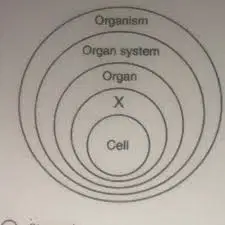
What term would best represent X?
human
stomach
tissue
organelle
What is common to all cells?
All cells have a cell wall
All cells are photosynthetic
All cells divide to form new cells
all cells have a nucleus

Which structure is responsible for the synthesis of ATP?
F
B
M
H
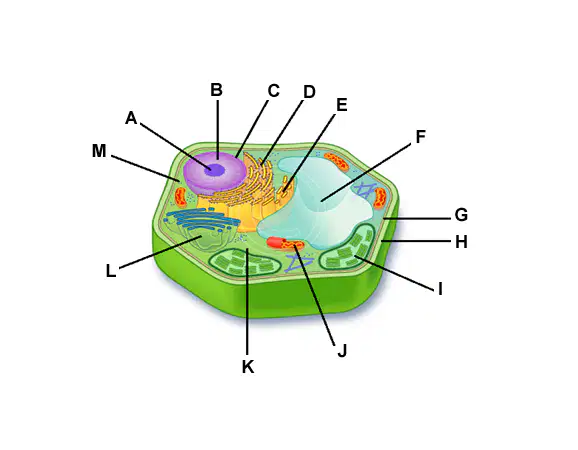
Which structure is responsible for the passage of materials into and out of the cell?
A
F
J
G
If the ribosomes of a cell were destroyed, what effect would this most likely have on a cell?
it would stimulate mitotic cell division
the cell would not be able to make protein
increased protein absorption
development of abnormal features would occur
Reorder the following from smallest to largest
cell
organelles
organ
organ system
organism
What has to be properly functioning in unicellular organisms for homeostasis to be maintained?
organelles
guard cells
insulin
antibodies
Food -----> Amino Acid -----> (a) ------>Protein
Mitochondria provide ribosomes with
ATP for protein synthesis
Amino acids for protein synthesis
oxygen for respiration
carbon dioxide for respiration
The cell membrane is to the cell as
the ocean is to the Earth
the atmosphere is to the Earth
a house is to the Earth
a forest is to the Earth
In a cell, all organelles work together to carry out
diffusion
active transport
information storage
metabolic processes
Which statement supports the fact that humans contain many kinds of tissues?
Cells break down food through the process of respiration.
All organisms are made up of only one cell.
Cells reproduce by a process known as mitosis.
All organisms are made of one or more cells.
Which statement is a part of the cell theory?
all cells come from preexisting cells
humans are multicellular
all life comes from spontaneous generation
all cells are unicellular
Which of the following correctly matches an organelle with its function?
mitochondrion…photosynthesis
nucleus…cellular respiration
vacuole…storage
chloroplast…movement
What is the basic unit of life found in all living organisms?
cell
atom
organelle
nucleus
Which organelle is correctly paired with its function?
nucleus - provides carbohydrates for fermentation
Chloroplast - serves as a site for photosynthesis
centriole - makes digestive enzymes
lysosome - packages cellular information
In single-celled organisms, materials are stored primarily in
ribosomes
nuceli
mitochondria
vacuoles
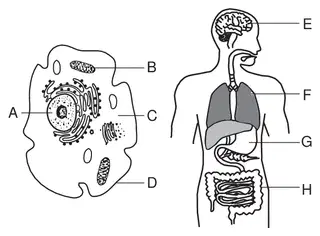
Which statement correctly identifies the levels of organization for the structures indicated?
A and B are tissues, E and G are organs
A and B are organs, E and G are systems
A and B are tissues, E and G are organelles
A and B are organelles, E and G are organs
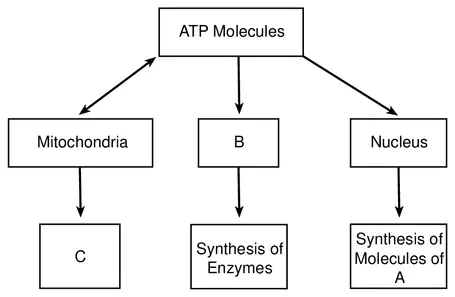
Which structure is represented by B
vacuole
ribosome
cytoplasm
chloroplast
This organelle produces proteins
cell membrane
lysosome
mitochondria
ribosome

