
Font size
 Worksheets
Honors Big Bang Quiz
Total questions: 25
Worksheet time: 16mins
Our Big Bang Balloon activity showed galaxies are moving away with farther galaxies are moving faster. Who discovered this phenomenon?
Hubble
Penzias
Wilson
Our Big Bang Balloon activity showed galaxies are moving away with farther galaxies are moving faster. If we rewind the data we can see extrapolate that
The universe was smaller and hotter in the past
The universe was larger and hotter in the past
The universe was larger and colder in the past
The universe was smaller and colder in the past
According to the Big Bang the Universe started with as super atom (a singular point) that contained all the ______ in the Universe today.
matter
both because E=mc^2
As the Universe expanded it started to cool and form atoms. Which equation explains how we can make atoms from energy and energy from atoms?
v=Hd
E=mc^2
v=frequency x wavelength
Which of the following is evidence for the Big Bang Theory (choose all correct answers... there's more than 1)
Galaxies are moving away from us with the farthest galaxies moving fastest
Cosmic Background Microwave Radiation
The composition of the Universe is approximately 75% H, 24% He, and trace amounts of Li.
The Universe is hotter today than it was in the past
The early Universe was too hot for atoms to form. What were the first three elements to form as it cooled?
H, He, Li
H, Be, B
Li, C, O
He, N, Fe
Today, the Cosmic Background Radiation is very cold, only 2.725 K above absolute zero, thus this radiation shines primarily in the _____________________ portion of the electromagnetic spectrum, and is invisible to the naked eye.
Microwave
Gamma Ray
Visible Light
Radio Waves
Since light travels at a constant (the same) speed across great distances, it takes a long time to reach us on Earth. Therefore, astronomers observing distant objects are looking into the past. We observe Andromeda, the nearest big galaxy, as it was about ________ because Andromeda is 2.5 million light-years away.
2.5 million years ago
2.5 years ago
2.5 thousand years ago
none of these
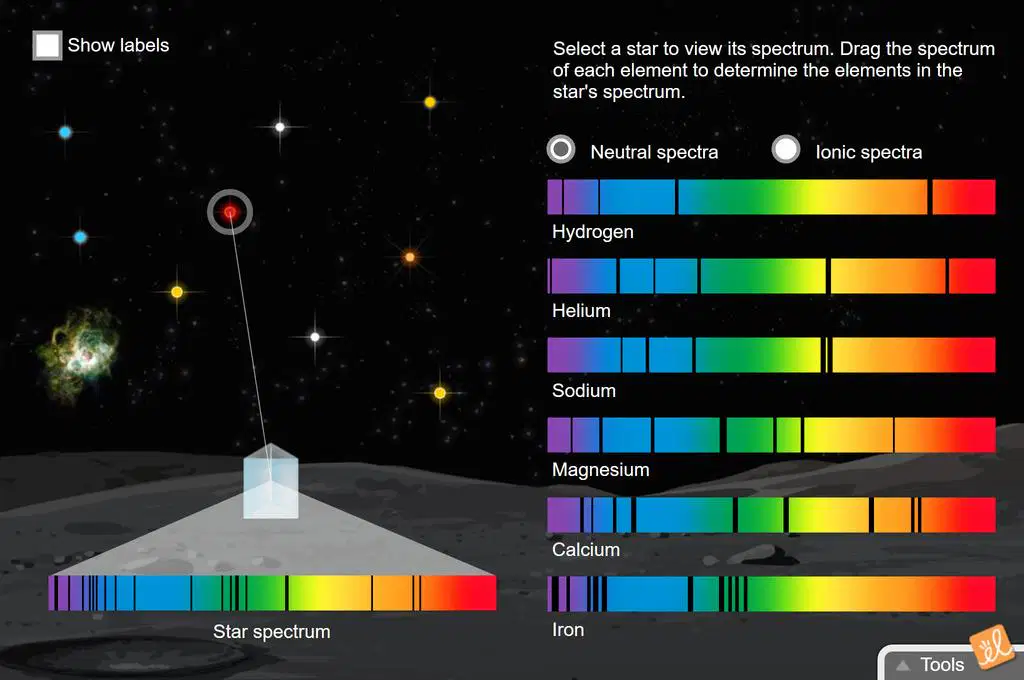
True or False: We can use spectrometers to determine which elements are in which stars
True
False
If the elemental fingerprints of the star are shifted to the red section it shows that the galaxy is:
moving away from us
moving towards us
staying at the same distance from us
Wavelengths that are longer are seen in the ____ spectrum
red
blue
Galaxies that are red shifted are
moving away
moving closer
not moving
Doppler shows movement because objects (like a duck in a pond) make ripples close together as they ____ and ripples farther apart as they ____.
approach, leave
leave, approach
leave, leave
approach, approach
Longer wavelengths appear to be ___ while shorter wavelengths appear ___.
red, blue
blue, red
blue, blue
red, red
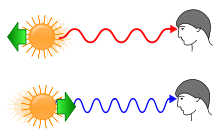
Our universe is
expanding.
shrinking.
staying the same size.
We don't know what it's doing.

Upon closer examination, sunlight (and all stars) actually emit ___ spectra.
bright-line (or emission)
absorption (or dark-line)
continuous
multiple

Each element on the periodic table can be identified by its
classification as a solid, liquid or gas.
location on the table.
ability to react to form compounds.
unique spectral "fingerprint."

After hydrogen is ___ - which is made up of two protons, two neutrons & two electrons.
helium
beryllium
lithium
oxygen

If an object like a star is moving away from Earth, the spectral lines are observed to be
smaller or thinner & red-shifted.
smaller or thinner & blue-shifted.
wider or broader & blue-shifted.
wider or broader & red-shifted.

Spectral lines that are observed to be narrower & blue-shifted indicates that an object is
moving away from Earth.
showing transverse motion.
moving towards Earth.
showing radial motion.
Which wavelength can humans see?
Microwaves
Radio waves
Visible light
Gamma rays

Which elements are in the mixture?
A only
D only
Z only
A and D
D and Z

Based on these spectra, we can conclude that Galaxy C is moving ___ us.
away from
toward

