
NEW
Font size
 Worksheets
Electromagnetic Spectrum Review Sheet
Total questions: 26
Worksheet time: 13mins
The most likely reason sound travels faster in salt water than in fresh water is that salt water
is more elastic.
absorbs heat faster.
has a higher density.
reflects sound better.
An echo is a sound wave that has been
absorbed.
refracted.
scattered.
reflected.
What takes place as a light wave enters a denser medium?
it is reflected
it is absorbed
it is refracted
it is compressed
What process forms an image in a mirror?
absorbing light
reflecting light
refracting light
transmitting light
Which object best reflects light?
gray door
white floor
black sweater
brown carpet

A student performs an experiment to study how sound waves are transmitted by placing a ringing buzzer inside a bell jar and sealing the jar. The student then connects the bell jar to a vacuum pump to remove the air from inside of the jar. The table shows the student’s observations before and after removing the air from the bell jar.
What can be concluded from the experiment?
Sound waves are transverse waves.
Sound waves do not carry energy when they are transmitted.
Sound waves do not transmit through material mediums.
Sound waves transfer energy through the vibration of particles in mediums.
Sound waves travel fastest in
air.
iron.
water.
a vacuum.
Which of these materials on the walls of a room would work best to keep sound from making an echo?
marble
carpet
wood
glass
The speed of sound is generally greatest in
air
glass
metal
water
The speed at which sound waves travel depends on the
distance between the vibration source and the receiver.
type of material through which the sound travels.
size of the object making the sound.
type of device making the sound.
Sound waves travel the fastest through dense materials. Through which of these would sound waves travel the SLOWEST?
air
glass
metal
water
A science class is divided into two groups. The first group plays loud music in a room that has thick carpet on the ceiling, walls, and floor. The second group is outside of the room but does not hear the music because the sound was
absorbed by the carpet.
refracted by the carpet.
reflected by the carpet.
amplified by the carpet.
Which of the following surfaces will gain thermal energy most quickly when exposed to sunlight?
a convex mirror
a clean windowpane
a sheet of white plastic
a wooden board painted red
A student in an empty classroom shouts, "Hello!" Which best explains what the student hears after the shout?
an increased loudness of sound
a reflection of sound
an increased frequency of sound
a refraction of sound
Which diagram best represents the reflection of a wave?
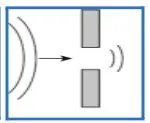
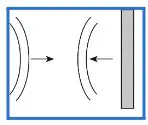
I
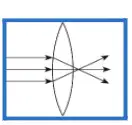
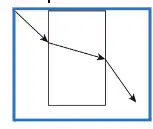
Sonar equipment sends waves into deep water and measures the
time delay of the reflected waves.
refraction of the transmitted waves.
direction of the transmitted waves.
interference of the transmitted and reflected waves.
A laser beam is aimed at four different objects. Through which of these objects will the laser beam pass and be refracted?
a black cloth
a piece of aluminum
a sheet of paper
a glass prism
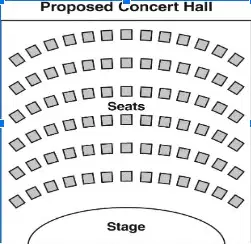
Which design of the walls would be most desirable to help avoid echoes?
They should use bumpy walls for all four sides.
They should use bumpy walls for only one side.
They should use smooth walls for all four sides.
They should use smooth walls for only one side.
How does the color of an object affect the amount of energy it receives from sunlight?
Light colored objects reflect more light and become warmer than darker objects.
Light colored objects absorb more light and become warmer than darker objects.
Dark colored objects reflect more light and become warmer than lighter objects.
Dark colored objects absorb more light and become warmer than lighter objects.
What happens to a ray of white light when it passes through a prism?
The ray of light is combined into a single color.
The ray of light is completely absorbed by the prism.
The ray of light is bent backward toward the source of light.
The ray of light is bent in several pathways showing a rainbow.
Which statement correctly describes how a sound wave travels through air?
The wave carries molecules of air away from the source of the sound.
The wave carries energy that causes molecules to move back and forth.
The wave carries a molecule in one direction until it collides with another molecule.
The wave moves through the air and gains energy from the moving molecules that it touches.
Rainbows are formed when light is refracted or bent by water droplets. Why is light refracted by water droplets?
Light speeds up when it enters the water.
Light slows down when it enters the water.
Light gets trapped by water inside the droplet.
Light gets different colors from water inside the droplet.
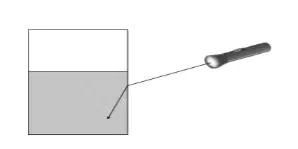
A single beam of light is shone into a glass containing milky water. Which statement best describes why the beam of light bends downward?
The milk blocks the passage of light through the water.
The light is moving from air into another medium.
The force of gravity affects light more when it is in a liquid.
The farther light is from its source, the slower it moves.
Some students were on a tour exploring the inside of a cave. While the students were in the cave, they realized they heard an echo every time that they spoke. Which most likely caused the echo to occur?
the accumulation of the sound waves
the diffraction of the sound waves
the refraction of the sound waves
the reflection of the sound waves
Which statement about sound waves is correct?
Sound waves transfer energy through a vacuum.
Sound waves transfer energy through vibration of a medium.
Sound waves transfer energy in the electromagnetic spectrum.
Sound waves transfer energy by permanent displacement of particles.
Which of these is a way that sunglasses help protect the eyes?
reflecting light rays away from the eyes
refracting more light rays into the eyes
reflecting more light rays into the eyes
refracting light rays away from the eyes

