wayground logo

Free Printable Worksheets

Font size

S
M
L
XL
Worksheets

CHE142 Chapter 1

Total questions: 28

Worksheet time: 1hrs 18mins

Name
Class
Date
1.

Which of the following statement is referring to Aufbau principle?

a)

Only maximum of two electrons are allowed in one orbital and two electrons in the same orbital must have opposite spins.

b)

Electrons is arranged from lowest energy level to highest energy level.

c)

When more than one orbital has the same energy, Electrons occupy all the orbitals of a given subshell singly before pairing begins. These unpaired electrons have parallel spins

d)

As n increases, the spacing between energy levels becomes smaller

2.

This statement: When more than one orbital has the same energy, Electrons occupy all the orbitals of a given subshell singly before pairing begins. These unpaired electrons have parallel spins

is referring to which principle?

a)

Aufbau

b)

Hund

c)

Pauli

3.

3s has higher energy level than 3p. True or False?

a)

True

b)

False

4.

Write the electron configuration for Fe

(a)  

5.

  1. Write the electron configuration for Ca2+


(a)  

6.

  1. Write the electron configuration for S


(a)  

7.

What atom would be expected to have a half-filled 4s subshell?

(a)  

8.
What elements generally make an ionic bond?
a)
metal and nonmetal
b)
2 nonmetals
c)
metal
d)
none of the above
9.
What elements generally make a covalent bond?
a)
metal and nonmetal
b)
2 nonmetals
c)
metal
d)
none of the above
10.
In chemical compounds, covalent bonds form when
a)
the electronegativity difference between two atoms is very large.
b)
electrons are completely transferred between two metals.
c)
pairs of electrons are shared between two nonmetal atoms.
d)
two nonmetal atoms are attracted to each other by opposite charges.
11.
Predict the bond that will form between Be and F.
a)
Ionic
b)
Covalent
12.
Predict the bond that will form between Se and Cl
a)
Ionic
b)
Covalent
13.
How many electrons can the first energy level hold?
a)
1
b)
2
c)
8
d)
0
14.
The number of _____ is most important in determining how an atoms will bond. 
a)
Neutrons
b)
Protons
c)
Valence Electrons
d)
Electron sin the innermost shell
15.
High Melting & Boiling Points
a)
Ionic
b)
Covalent
16.

Ionic bonds happen when valence electrons are

a)

shared

b)

too heavy

c)

transferred

17.

Valence electrons are

a)

neutral (no charge)

b)

found in the outer most energy level of the atom

c)

equal to the number of protons

18.

Is this molecule polar or non-polar?

a)

Polar

b)

Non-polar

19.

Is this molecule polar or non-polar?

a)

Non-polar

b)

Polar

20.
How many sigma and pi bonds does this have?
a)
1 sigma and 1 pi
b)
2 sigma and 1 pi
c)
1 sigma and 2 pi
d)
2 sigma and 2 pi
21.

Which of the following molecules are polar molecule? Can tick more than 1

a)

HCl

b)

H2O

c)

CH4

d)

NH3

22.

Which of the following is a non-polar molecule?

a)

HClHCl

b)

NH3NH_3

c)

CCl4CCl_4

d)

H2OH_2O

23.

Which one has the highest boiling point?

a)

CH4

b)

H2O

c)

SO2

24.

Between HF and H2O... which one has a higher boiling point?

a)

HF

b)

H20

25.

Intermolecular forces for: NH3

a)

Dispersion Force

b)

Dipole dipole

c)

Hydrogen bonding

26.

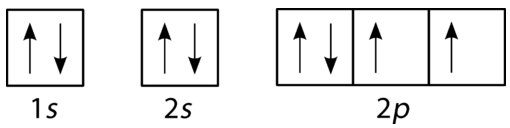
Which guideline is violated in the following orbital diagrams?

a)
Hund's
b)
Aufbau's
c)
Pauli's Exclusive
27.
What is incorrect about this orbital diagram?
a)
Both arrows in the 2p box should be pointing up
b)
There is nothing incorrect with this diagram
c)
In the 2p box there should only be 1 electron in the first 2p box and one in the 2nd 2p box
d)
All the arrows should be pointing up.
28.
This orbital diagram represents:  
a)
C
b)
B
c)
N
d)
O